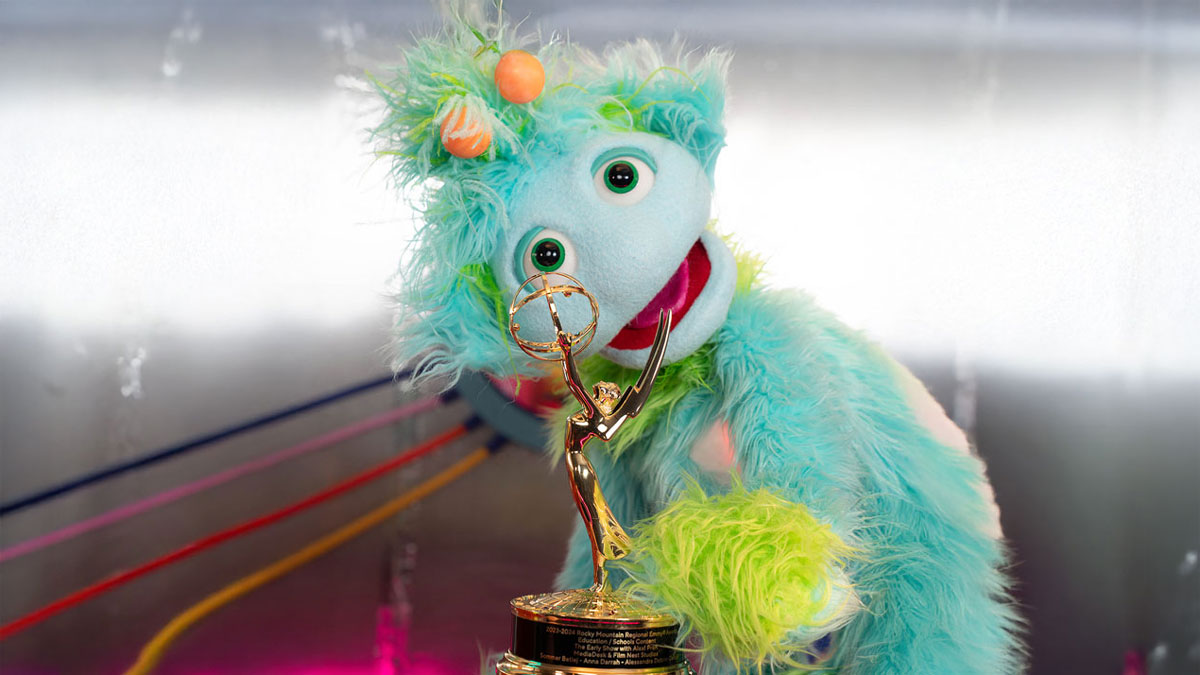
There is a familiar species of government mascot: the solemn eagle, the smiling droplet, the hard hat with eyes. Alax is not that species. Alax is turquoise, furry, cheerfully asymmetrical, and equipped with three eyes. The character came to Earth, according to the premise of The Early Show with Alax, to ask experts the questions parents ask about young children. Then something stranger happened. People watched.
The first three seasons passed 12 million YouTube views and gathered more than 27,000 subscribers. In 2024, the show won a Rocky Mountain Southwest Chapter Emmy. A state department had become the publisher of a family show, and the cheerful extraterrestrial had become the most legible explanation of an Albuquerque company called MediaDesk.
The client choice that became the company
MediaDesk was founded in Albuquerque in 2013 by José Viramontes and Sommer Betlej. Viramontes, now the owner and CEO, had spent nearly two decades at the U.S. Department of the Interior. Betlej, the creative director, has led the visual work from the beginning. Their consequential decision was less about what the agency would make than whom it would make things for: nonprofits, foundations, and public agencies.
That sounds like positioning language until you consider the operating problem. A shoe company sells a shoe. A water-planning bureau asks a resident to understand an aquifer, care about a distant deadline, and perhaps change a habit. An early-childhood department must reach grandparents, parents, educators, rural families, and households speaking different languages. The transaction is not a purchase. It is comprehension, trust, and action.
MediaDesk built a full-service agency around that awkward transaction. The menu includes branding, graphic design, strategic messaging, websites, media relations, advertising, media buying, photography, video, motion graphics, and analytics. Clients can hire the team for a defined project or ongoing communications support. Partnerships with funders, the agency says, also let it offer a sliding scale to smaller nonprofits.
“Families are the most important audience, and we need to be innovative in how we reach them. Alax is exactly that.”Elizabeth Groginsky · New Mexico ECECD Cabinet Secretary
A campaign is a system, not a deliverable
The conventional agency handoff is a file. MediaDesk’s better work behaves more like infrastructure. Moments Together, created for the New Mexico Early Childhood Education and Care Department, began alongside the new department in 2020. It combined message testing, a bilingual website, advertising, photography, animation, printed materials, a texting campaign, and ambassador training. Tutorial videos appeared in English, Spanish, Diné, and Vietnamese. The same friendly identity could meet a family on a billboard, at a health site, on a phone, or inside a storybook.
How one public message becomes a campaign
Alax pushed the method into entertainment. MediaDesk conceived the show, Film Nest Studios helped produce it, and university programs supplied research and family-engagement expertise. New Mexico PBS and United Way were part of the wider partnership. The character appeared in episodes, on billboards, in cinemas, and at New Mexico United soccer games. There were stickers, mugs, bookmarks, temporary tattoos, movie posters, and onesies. This was not merchandise searching for a reason to exist. Each surface was another invitation into the same body of useful information.
Published campaign signals. They describe different projects, periods, and audience actions, so they should not be read as a like-for-like scorecard.
The first thing to fail is the universal message
The tempting mistake in public communication is to approve one sentence and call it inclusive. MediaDesk’s briefs show why that fails first. The state’s early-childhood campaigns had to reach urban and rural households, Hispanic and Tribal communities, families of children with special needs, and people missed by traditional media. Translation alone could not do the work. Language, cultural context, channel, and trusted messenger all mattered.
A small example reveals the habit. For New Mexico’s 2025 Family Engagement Survey, MediaDesk and ECECD wanted responses broad enough to represent the state demographically and geographically. Outreach included a distinct visual identity, a media kit, a standalone website, social ads, text messages, mailed flyers, event materials, and an incentive. The incentive had been $5. They raised it to $10 because other surveys were competing for the same people. What changed their mind was not taste. It was the market price of attention.
A visible public price tag
A New Mexico legislative evaluation reported that roughly $810,000 from the Homeowner Assistance Fund went to MediaDesk for advertising. The public record does not separate agency fees from production and paid-media spend, so the figure is best understood as campaign expenditure, not profit.
The number is useful because public-interest creative work is often discussed as if good intentions eliminate media costs. They do not. Reaching people statewide means buying distribution, producing formats for different screens, testing messages, and doing enough repetitions to be remembered. The work is accountable twice: first to the audience and then to the public ledger.
What the desk actually sells
MediaDesk competes with local advertising and PR firms, national cause-marketing specialists, freelancers, and the in-house team that is already overwhelmed. Its advantage is not one proprietary tool. It is pattern recognition at the seam between institutions and residents. The team knows how a public agency approves work, how a nonprofit’s capacity runs thin, and how an audience behaves when nobody is required to pay attention.
That knowledge travels. For Main Stream New Mexico, the Office of the State Engineer and Interstate Stream Commission needed to explain water planning without flattening the science. MediaDesk built the identity, website, articles, photography, videos, advertising, and earned-media program. Animated explainers about groundwater, snowpack, and a hotter climate drew more than 1.5 million views in their first three months. The articles could improve search visibility and then become social material. One piece of research did several jobs.
Its customer list makes the market position clear: the University of New Mexico Art Museum, Explora, Future Focused Education, Albuquerque Community Foundation, McCune Charitable Foundation, Tamaya Wellness Center, Albuquerque Sign Language Academy, and multiple state agencies. These organizations do not lack stories. They lack the time and connected capabilities to turn those stories into a brand, site, campaign, press pitch, video, and measurement plan without losing the plot between vendors.
The parts worth stealing
There is a practical playbook here for any small agency or communications team. It is less glamorous than the alien and more reusable.
- Choose the audience before the medium. A show was useful because families were the audience, not because video happened to be fashionable.
- Build a world, not a one-off. A character, voice, visual system, website, and physical materials reinforce one another.
- Partner for specialist depth. MediaDesk directs the campaign while studios, researchers, broadcasters, and community organizations add credibility or craft.
- Measure the boring parts. Survey completion, subscriber growth, awareness, search traffic, and distribution determine whether the clever idea did its job.
The approach has conditions. It needs an institution willing to sound unlike an institution, subject experts who can protect accuracy without draining the life from the work, and enough distribution budget to make repeated contact. A mascot without research is decoration. A multilingual video without community review can be an expensive misunderstanding. A charming campaign without a useful next step is merely charming.
MediaDesk’s own culture mirrors the pitch. Job materials describe a high-trust team where people are expected to ask questions and say when they need help, with flexible work, health coverage, retirement, generous leave, and an extra stipend for bilingual teammates. In 2025, the company said it contributed $230,200 in donated services, volunteer time, cash, and sponsorships to causes, alongside $115,000 in matching grant funds. In 2026, it received New Mexico’s Rust Award for ethical practice by a small for-profit business.
The awards are tidy punctuation. The more interesting achievement is conceptual. MediaDesk has made a business from treating communication as part of the service itself. The family who finds child-care help, the homeowner who learns about assistance, or the resident who finally understands where river water comes from is not downstream of the creative work. That person is the point of it. Sometimes the shortest route between a government program and a human being turns out to have turquoise fur and three eyes.