A wine bottle can lose 110 grams without losing a drop of wine. That sounds like a small achievement until you remember how many bottles travel from a glass plant to a winery, then to a warehouse, then to someone’s table. At O-I, the company whose name rarely gets invited to dinner, those missing grams are a useful place to begin.
- O-I sells glass containers and the engineering that makes them usable.
- Estampe and Drinktainer show how packaging changes the customer’s experience.
- The MAGMA shutdown shows why a manufacturing invention must also earn its keep.
A machine in the family
Michael Owens’s contribution was to make the bottle less dependent on the glassblower. In 1903, his automatic bottle-making machine entered use, and the Owens Bottle Machine Company took shape with financial backing from Edward Libbey. Mechanization helped make glass containers more widely available. Owens-Illinois emerged from the combination with Illinois Glass in 1929. The present name, O-I Glass, followed a corporate restructuring in 2020.
That ancestry matters because O-I has always occupied an awkwardly interesting position: selling an object people recognize while doing work they mostly overlook. Its customers include AB InBev, Coca-Cola, Heineken and Diageo. They buy a container that must protect a product, suit a brand and behave itself on a filling line. An attractive shape that jams the equipment is an expensive sculpture.
O-I makes bottles and jars for beer, wine, spirits, food and non-alcoholic drinks. Most container sales go directly to customers through annual or multi-year supply agreements. Longer contracts typically allow adjustments for changing costs. The business depends on making repeatable objects, in considerable quantities, close enough to customers to make delivery practical.
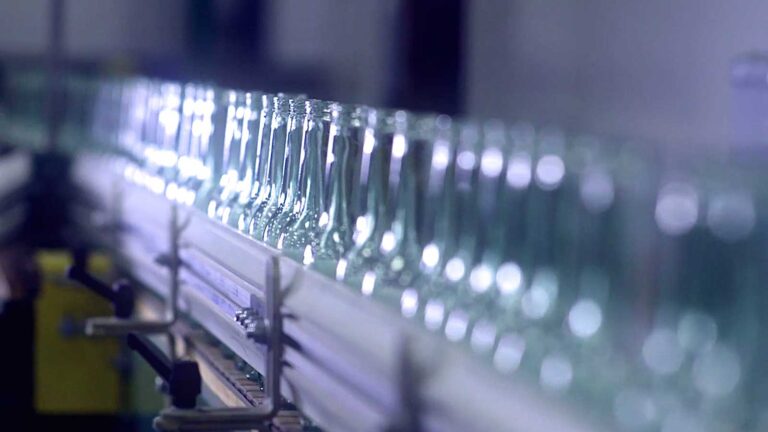
The missing 110 grams
Consider Estampe, launched in France in February 2024. The wine bottle weighs about 390 grams. O-I compared it with a conventional 500-gram bottle and reported roughly 25 percent lower carbon emissions. The Carbon Trust validated its footprint and reduction plan. The comparison belongs to this bottle and its stated baseline; it is no universal verdict on packaging materials.
Weight is unusually honest. Subtract 390 from 500 and you have removed 22 percent of the glass mass in that comparison. The carbon figure differs because a footprint includes more than the amount of material. A lighter design, recycled inputs and production choices interact. The interesting achievement is keeping the bottle useful while reducing what goes into it.
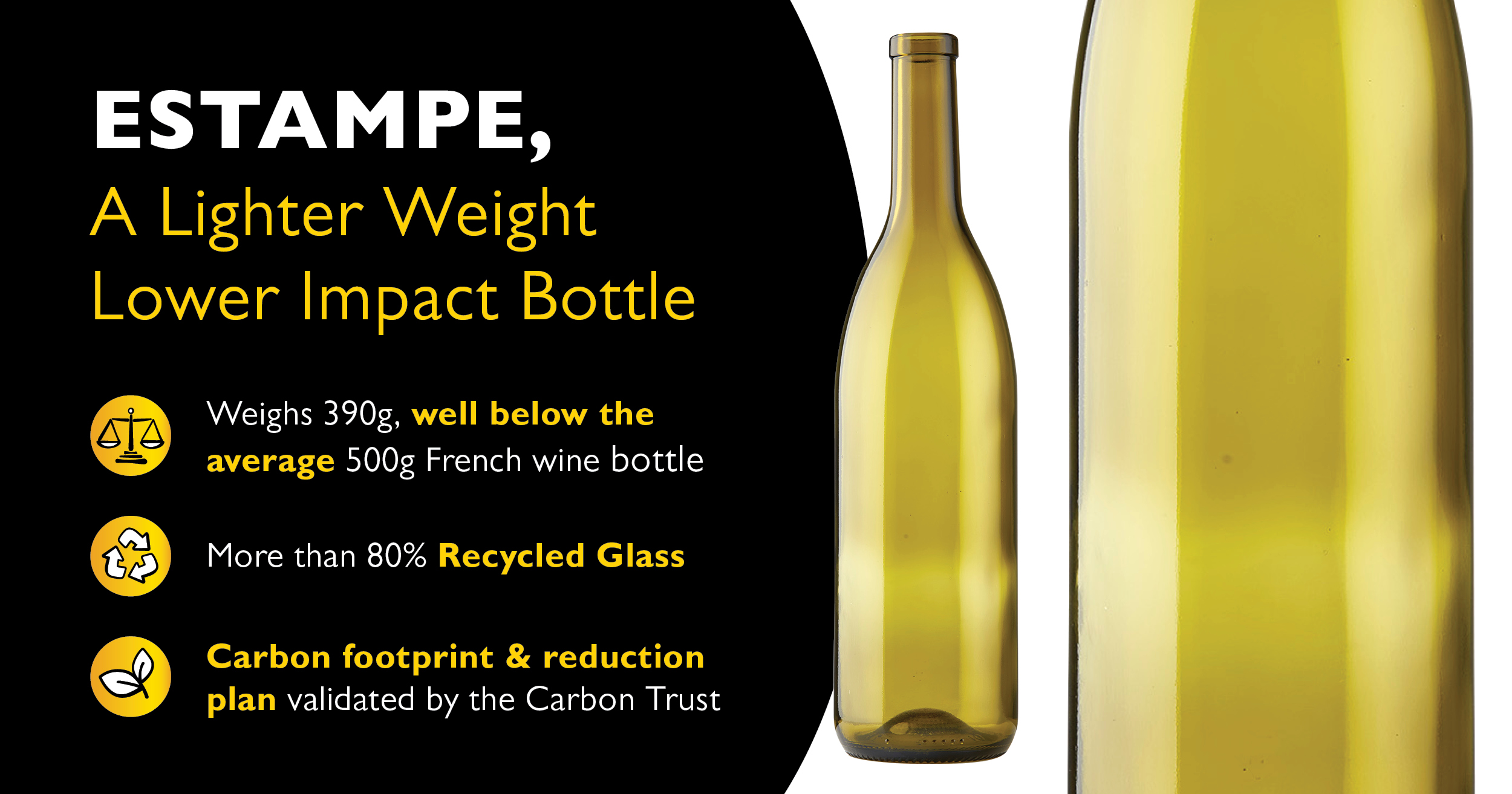
22% less glass mass · calculated from O-I’s published comparison
The Union des Vignerons des Côtes du Rhône, a cooperative of 200 winegrowers, chose B0 Estampe for its La Resistance wine. O-I’s account places the supplying Labégude glass plant about 20 kilometres away. Here sustainability becomes a set of purchasing decisions: which bottle, which plant, which journey. The cooperative’s example makes those decisions easier to picture than a distant corporate target.
The opening is only the beginning
Drinktainer tackles a different problem. A narrow bottle opening gives the drinker a different experience from a drinking glass. O-I widened the mouth and paired it with a 42 mm RipCap closure. Sarah Brennan, discussing the design in 2023, put the intention plainly: “It’s all about the wide mouth.” Aroma and mouthfeel were part of the brief.
Then came the less photogenic question: who would fill it? O-I partnered with F.X. Matt Brewing. By April 2024, the collaboration had a dedicated Drinktainer filling line, with Right Coast Spirits Italian Ice announced as its first commercial brand. The package came with a route into production. A beverage entrepreneur could consider a market test without first solving every filling problem alone.
The conveyor is an unforgiving design critic.An observation from the factory floor
That is also where O-I’s wider services fit. Container engineers translate a designer’s idea into something manufacturable. O-I : EXPRESSIONS adds decoration and tactile customization. O-I Packaging Solutions serves smaller companies with turnkey and custom options. O-I competes with other glassmakers, including Ardagh and Verallia, and with cans, plastic and cartons. Its pitch combines the container with help getting it made.
For a buyer, that suggests a useful order of operations. Start with the drink or food, expected volumes and the existing filling setup. Then ask which container shapes and closures fit. Decoration can follow. This is a purchasing lesson drawn from O-I’s examples: involve the people who will run the package through equipment before approving the shape everyone wants to photograph.
The invention that lost its argument
For a company descended from an inventor, MAGMA was a particularly consequential bet. O-I broke ground in Bowling Green, Kentucky, in April 2023 on a facility built around the glassmaking technology. The announced multi-phase investment was up to $240 million. A modular batch system, melter and forming machines were intended to demonstrate a different manufacturing approach.
In July 2025, O-I halted further MAGMA development and operations. Chief executive Gordon Hardie acknowledged “meaningful technical advancements” but said the platform lacked a path to its required operational and financial returns. Management expected its alternative operating strategy to produce more premium output at lower cost and capital intensity. It planned to reconfigure Bowling Green.
Upper end of the announced multi-phase plant investment plan, 2023.
2025 charges related to halting MAGMA. This is not its lifetime spending.
The distinction matters. O-I’s 2025 reporting recorded $117 million in charges related to the halt, within broader restructuring charges. That figure does not measure everything MAGMA ever cost. Nor does the announcement identify the first engineering component to disappoint. The disclosed failure was the program’s economic argument. Management changed course when the anticipated returns no longer justified continuing.
The factory gets the final vote
O-I reported $300 million in Fit to Win benefits in 2025. The reset still had friction. In July 2026, operational disruption and European commercial and energy pressures accompanied a lower outlook. Expected three-year benefits fell to at least $650 million from $750 million. Cost reduction had not made the business immune to the conditions inside and outside its plants.
There is a people question here, too. O-I’s published values include learning, innovation and responsibility for its impact. In practice, decisions about equipment and capacity put those aspirations under pressure. A credible account of the business has to hold the design work and the disruption in view at the same time.
The practical lesson for another business is to test the whole adoption chain. Ask who fills, ships and collects the product. Give experimental manufacturing an explicit return test. For buyers, the answer still depends on volume, equipment, transport, energy and local recycling. A bottle’s recyclability needs a collection system to become recycling. O-I’s story becomes useful precisely where the elegant object meets these awkward particulars.