Nick Greenfield could have gone to Brazil. There was a job at a daily-deals company, a plausible beginning for a Stanford graduate with a degree in international relations. He stayed in the Bay Area instead. He wanted to play Ultimate Frisbee. A job would pay for the privilege of living there. The career could arrange itself around the disc.
It is an agreeably untidy opening for someone who would become an early Lyft employee and later co-found Candid. Retrospective biographies tend to give every youthful decision a necktie and a purpose. Greenfield’s account leaves room for pleasure, accident and a sport that rarely appears in a recruitment brochure. His first professional calculation included a field.
That choice put him at Zimride in 2011, before Lyft existed. A decade later, he would make a decision considerably harder to explain: closing a consumer business that had expanded across the country. Between those moments lies a career spent finding ways to grow, then learning when growth was giving the wrong answer.
The coach before the company
Before the startups came Home Run Baseball Camp in the Washington, DC area. Greenfield attended as a player and eventually worked as a coach through high school. John McCarthy, known as Coach Mac, taught a curriculum that extended well beyond the distance a child could hit a ball.
McCarthy asked about books. He cared about eye contact. The camp’s wheel of success put fun, safety, hustle and doing things properly on the same hat. Greenfield remembers these details decades later. A coach could reward conduct and curiosity alongside performance; a child could learn to compete without making the scoreboard his entire personality.
Greenfield also recalls trips connected with McCarthy’s education work in the Dominican Republic: reading and teaching in the morning, baseball in the afternoon. The coach later wrote his college recommendation. There is a pleasing continuity here. Before anyone asked Greenfield how he would build an organization, somebody had asked what he was reading.
His own interests were broad. He played several sports, took part in quiz bowl, did theater and sang in a high school a cappella group. Summer work included youth reporting at WAMU, the Washington public radio station. He covered the Anacostia River and experienced the discipline of producing work inside a newsroom.
Politics or diplomacy once seemed plausible. At Stanford, where he studied from 2007 to 2011, he captained men’s Ultimate and served as president of club sports. There was enough organizing in his extracurricular life to keep a small committee entertained. Specialization would have had to make an appointment.
“The biggest risk you can take is not taking risk.”
Nick Greenfield, on early careers
A pink mustache with a job to do
Zimride sold a rather different proposition from the rides people summon today. It helped organize longer-distance carpooling through closed networks, including universities. Greenfield arrived out of college and watched the company change direction. The shift to short, local rides opened a market with a much more immediate use.
Early Lyft had a conspicuous accessory: a large pink mustache attached to the front of the car. In photographs it can look like a marketing department had escaped supervision. Greenfield’s explanation is more practical. Getting into a stranger’s vehicle was an unfamiliar act. An absurdly cheerful identifier helped make the encounter feel approachable.
That is a useful glimpse of his operating mind. A piece of theater can have an economic purpose. The mustache helped people understand the invitation before the app had become a habit. The product was asking customers to alter their behavior, and a little silliness made that request easier to accept.
He is equally direct about what made the service valuable: lower prices and shorter waits. Decorative flourishes could help introduce it, but the underlying exchange had to work. A clever campaign has a limited career if the customer is still stranded on the pavement.
A simple proposition. A complicated operation.
Los Angeles, now casting drivers
Once the service worked in San Francisco, the next question was how to repeat it elsewhere. Greenfield helped launch eight markets. The task required turning local success into something another city could support, while resisting the comforting assumption that every city was merely San Francisco with different weather.
Drivers came first. Riders needed enough cars to make opening the app worthwhile; drivers needed enough demand to make staying available worthwhile. Early guarantees provided a floor for driver earnings while the marketplace developed. Recruiting one side without supporting the other could leave everyone waiting, which is a rather expensive way to stand still.
Los Angeles supplied its own answer. Many aspiring actors and musicians had cars, irregular schedules and a need for income. Greenfield recalls a colleague running what amounted to casting calls for drivers. The local labor market shaped the recruitment method. A city launch involved learning the city’s habits, then putting those habits to work.
The harder problem became keeping drivers. Greenfield remembers sending Lyft co-founder Logan Green a long email about retention. Green preferred short messages with a few specific points. Greenfield supplied the extended edition. The concern was concrete: acquiring drivers cost money, and departures could undo the work before the marketplace had settled.
Would they stay? Would they work when demand was strongest? Those questions still inform his hiring. He looks for people who have identified an overlooked constraint and solved it. The résumé matters most when its owner can explain which part of the machine was stuck, and what happened after they fixed it.
The laundry, the refunds, the friends
After Lyft came Washio, an on-demand laundry startup where Greenfield worked in marketing and growth. His Los Angeles years also included living with early Snapchat employees. He remembers the parties. It is an unusually literal version of being surrounded by an emerging industry: some of the network shared the house.
In 2015 he moved east and joined Paribus as chief operating officer. The company helped consumers recover money when prices dropped after a purchase. It was another business concerned with an ordinary inconvenience, and another chance to work on acquisition and operations together. Capital One acquired Paribus in 2016.
Paribus co-founder Eric Glyman publicly thanked Greenfield for helping understand and multiply the company’s growth. That acknowledgment is useful because operating work so often disappears behind a founder’s name. Companies need people who can turn an attractive idea into a repeatable process, including the unglamorous middle where most of the work lives.
The relationships carried on. Glyman and Karim Atiyeh later founded Ramp. Greenfield says Candid became its first customer, a distinction he recounts with evident amusement. Connections in his story tend to reappear as colleagues, customers and useful conversations. The network has practical errands to run.
Forty-five doors, one difficult decision
Greenfield co-founded Candid in 2017. Its early consumer model combined online sales with physical studios. The first studio opened in 2018; eventually there were 45. The business offered plenty of familiar signs of progress: locations, customers, a growing team, a brand people could encounter in the street.
Then came the question that a growth specialist might prefer to postpone. What did another customer actually cost? In advertising markets, yesterday’s economical acquisition can become tomorrow’s auction against several competitors. A business can get better at selling while the platforms collecting its advertising money get better at charging.
Candid had developed a professional partner channel alongside its consumer operation. Greenfield’s response was decisive. In January 2022 the company announced it would close its direct-to-consumer business and all 45 studios, concentrating on CandidPro. The retail footprint that once advertised expansion became something he was prepared to relinquish.
One company. A different route to its customers.
At the beginning of 2021, he said, direct-to-consumer sales had represented 99.5 percent of revenue. Even at year’s end, the share remained well above 90 percent. This was a substantial operating change, with an immediate cost to revenue. He chose to put the organization behind one distribution model.
“I’m a big believer in being highly decisive,” he said that February. The sentence is plain enough to fit on an office wall; closing the doors gives it more weight. His reasoning was that a clear view of the next three to five years should change the company’s priorities now.
There is no need to turn this into a fable in which doubt vanishes on cue. The decision itself is interesting enough. Someone whose career had involved opening cities and attracting customers was willing to stop a channel that still supplied most of the revenue. Experience had taught him to examine the shape of growth.
Still willing to be a beginner
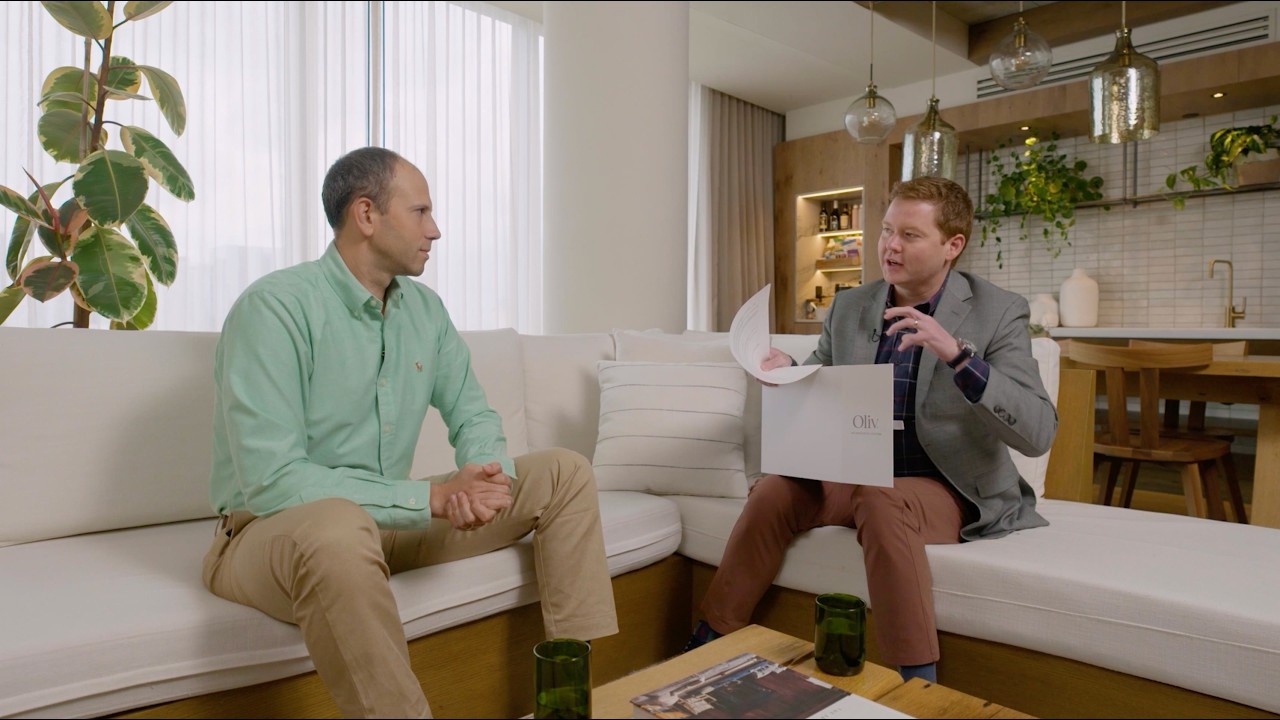
By 2026, Greenfield was also publicly appearing as Oliv’s CEO, while Candid continued to list him as co-founder and CEO. In September, a three-part conversation with his Stanford friend Alex Oppenheimer returned to the questions beneath the job titles: how to learn, how to choose a market, how to keep building.
He favors breadth of experience and encourages young people to take recoverable risks. For founders already committed to a company, his advice combines urgency about the business with patience about the years required. He credits that longer view in part to Danaher co-founder Mitch Rales. An organization can take a decade merely to get going.
Greenfield’s story gives that advice texture. A baseball coach, a radio newsroom, an Ultimate field, a car wearing a mustache, a company closing its own shops: each belongs in the account. He has learned from expanding things and from ending them. The next move still requires judgment. Fortunately, he has never insisted that a sensible career must travel in a straight line.
Keep the conversation going
Follow Greenfield’s work and hear the stories in his own words.