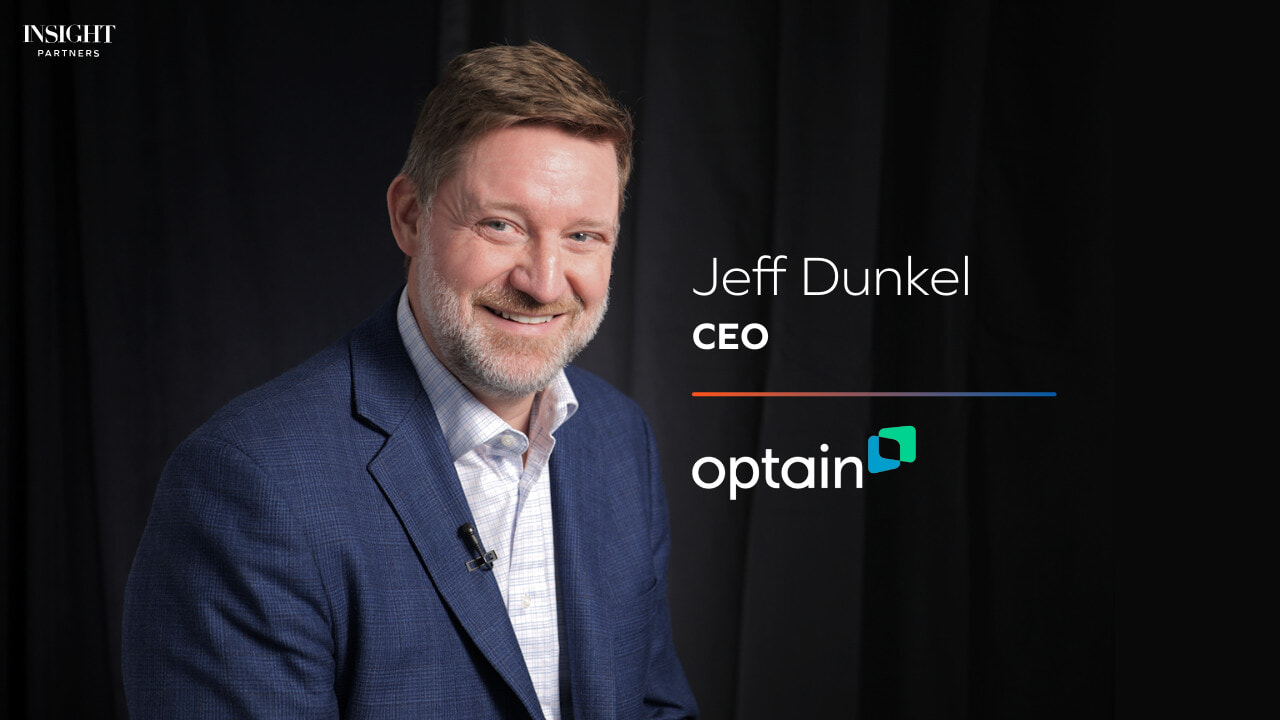
Jeff Dunkel arrived at a public hearing in 2019 with a modest offer. He offered “a break from death by PowerPoint.” He proposed simply talking. For an audience facing a procession of presentations, this was a reasonably attractive opening bid.
He was there from Titan Spine, where he worked on strategy. But he wanted to speak beyond the boundaries of one employer. He also worked, pro bono, with more than ten small innovative companies. He had spent time inside large organizations and startups, and he wanted the room to understand something of both.
The opening catches a particular version of Dunkel: comfortable enough with institutional proceedings to participate in them, and willing to puncture a little of their ceremony. Years before becoming CEO of Optain, he was already doing work that required explaining one organization’s difficulties to another.
That is a useful place to begin his story. Company announcements tend to compress a career into titles. Dunkel’s route makes more sense when you follow the work between those titles: selling, negotiating, arranging partnerships, and persuading institutions to make room for something new.
The apprenticeship in the middle
Originally from Memphis, Dunkel earned a Bachelor of Science at Indiana University. His professional path would take him through Johnson & Johnson, Titan Spine, NuHope, and Mindset Medical before Optain. The employers varied considerably in size. So did the jobs. Strategy remained a recurring responsibility.
At Johnson & Johnson, he worked in commercial roles. His public career record includes account management and regional responsibilities. The vocabulary sounds ordinary because it describes work that must happen repeatedly: understanding the buyer, maintaining a relationship, and making an offer that someone can actually approve.
In 2014, he joined Titan Spine. By the time of a 2016 appointment announcement, his title was Vice President, Strategic Partnering. His remit included market access, policy, training, product launches, contracts, negotiation, and management. He worked with marketing, sales, and operations. It was a job description with very little spare room.
Those duties put an executive in the middle of a company’s promises. A launch requires salespeople who can explain it, customers who can buy it, and operations that can deliver it. Contract language eventually has to meet a calendar. Someone must keep track of the meeting between the two.
Dunkel later became Titan Spine’s executive vice president of strategy. In January 2020, he moved to NuHope as CEO. His career also includes the chief strategy officer role at Mindset Medical. The progression took him from helping shape a company’s direction to carrying responsibility for the organization as a whole.
Strategy & partnering
Chief executive
Chief executive
A company with more than one beginning
Optain’s public launch came on May 9, 2023, with an initial seed investment of $12 million. Dunkel was its CEO. The announcement introduced a new company to an American audience, although much of the work behind it had begun elsewhere, years earlier.
The business traced its roots to Eyetelligence, an Australian company launched in 2019, and to research led by Professor Mingguang He. Optain emerged through Ascertain, the company creation collaboration between Aegis Ventures and Northwell Holdings. Northwell was identified as its flagship commercial customer.
Several beginnings therefore belonged to the same story: a research program, an Australian business, an American company creation partnership, and a new commercial launch. Dunkel stepped into a company whose relationships already crossed national and institutional boundaries. The CEO’s task included bringing those different histories into a workable business.
That structure matters when reading a founder’s biography. A new company can carry a long inheritance. Naming a launch date tells you when it entered public view; it tells you much less about the effort, knowledge, and relationships that were already there.
Later in 2023, Dunkel discussed growth at O=MEGA23 in Melbourne. The appearance placed him in the country where the company’s earlier roots lay. Optain’s international character was present from the start, in the people and organizations around it, rather than something added after an American launch proved successful.
The people on both sides of the table
On September 10, 2025, Optain announced a $26 million Series A led by Insight Partners. The round also included seven major institutional investors from the company’s customer sector, alongside other investment firms. Its backers were helping finance a business they intended to put to work.
The funding announcement described enterprise deployments, entry into new markets, and further international expansion. It also named Informed Ventures, Lumio Capital, Meridian Ventures, and the UniQuest Extension Fund among the participating investors. Dunkel’s organization was gathering several kinds of backing at once.
An investor who can also be a customer brings a particular relationship to a young company. The conversation involves capital and an operating environment. Product decisions have consequences for an organization that may be sitting across the table in more than one capacity.
For an executive with a background in strategic partnering and contracts, this is familiar territory. The relationship must survive beyond an introduction. Teams need a workable agreement, clear responsibilities, and enough confidence in each other to proceed. Enthusiasm is helpful; someone still has to arrange the next steps.
The round gives Dunkel’s career a visible milestone. It also makes the surrounding network easier to see. Aegis, Northwell, the Australian team, and the later investors each occupy a different place in Optain’s development. The company was growing through a collection of relationships, with the CEO responsible for keeping them moving toward shared work.
Series A · September 2025
Led by Insight Partners
Two years before the announcement
The next public milestone followed on November 6, 2025: Optain announced its acquisition of EyePACS. The companies had already collaborated for two years. The deal put a formal corporate structure around a relationship that had been developing since roughly the period of Optain’s launch.
That interval gives the announcement some texture. By then, the two organizations had experience working together. EyePACS brought an established network and operating history. Optain brought its own technology and expansion plans. The acquisition joined teams with a shared working relationship already behind them.
The announcement also made a practical commitment: existing EyePACS platforms and workflows would continue operating, with investment and integration to follow over time. For people already using a service, continuity can matter as much as the buyer’s plans. A new owner’s enthusiasm is easier to appreciate when Monday still works.
At the time of the announcement, Optain reported 200 live sites globally and more than 1,000 deployments in planning. These were different categories of progress. One described an existing footprint. The other described a queue of work. A growing company needs to understand both, particularly when it is bringing another organization into the fold.
Dunkel’s earlier strategy roles provide context for this moment. An acquisition creates obligations across operations, commercial agreements, and people. The announcement is brief. Carrying out what it says takes longer, and reaches far beyond the executive whose name appears in it.
A microphone, and a little less ceremony
There is another route into Dunkel’s public personality: he likes listening to other people talk about building companies. Sharing an appearance with Jake Villarreal, he called himself a podcast junkie. The interest makes his own place in the founder interview circuit feel pleasantly circular.
He has appeared with Villarreal and with Optain president Zachary Tan in other interview settings. The December 19, 2025 edition of Tech It to the Limit included both Dunkel and Tan in a program recorded around HLTH2025. Public company leadership involves a good deal of repetition; finding a conversation you enjoy probably helps.
His acknowledgments often distribute the credit. When sharing coverage, he thanks partners and the people helping tell the company’s story. When discussing an acquisition, he points to employees. These are small public gestures, but they are consistent with a career spent working through organizations rather than speaking solely for himself.
In a March 2026 interview, his emphasis landed on the people doing the building. He credited the team behind the company. The thought has a useful consequence: the product takes its place among the things a team produces, and attention returns to the people responsible for it.
“the real success behind Optain is the team”
Jeff Dunkel · March 2026 interview
What the next chapter asks of him
Optain’s stated plans include enterprise deployments and expansion into additional markets. For Dunkel, those ambitions extend the work that has followed him across jobs: helping different organizations agree on what to do, then making the agreement useful in practice.
His earlier career gives the current title depth. There is the commercial employee learning accounts and buyers, the partnering executive coordinating departments, and the CEO dealing with capital and acquisitions. Each role places a different demand on someone trying to turn an intention into a functioning company.
The appeal of his story lies in that accumulated experience. A company can announce its arrival in a morning. It then needs people prepared to negotiate, explain, coordinate, and return to the unresolved details. Dunkel’s career has given him repeated exposure to that less ceremonial part of business.
The slide deck eventually ends. The people in the room still have to work together. That is where this particular CEO’s story keeps taking him.
Follow the conversation
Company milestones, interviews, and Jeff’s professional profile.