The most revealing thing about Optain's retinal camera may be the room it is meant to occupy. The machine belongs in a primary care office, where someone has come for diabetes management, a prescription renewal, or an ordinary checkup. A retinal photograph could expose damage long before a patient notices a change in vision. Yet the patient may never reach the separate eye appointment. Optain has built a business around that small, familiar gap between an advised test and a completed one.
- Optain brings retinal image capture and interpretation into frontline care.
- In the U.S., its FDA-cleared Resolve camera is paired with professional teleophthalmology grading.
- A $26 million Series A and the acquisition of EyePACS expanded its route into health systems and community clinics.
- Its broader AI work aims to read eye and systemic health clues from the same image, subject to local approvals.
This is a company with an alluring scientific premise: the retina is one of the few places a clinician can directly observe blood vessels and nerves without surgery. But the commercial problem is more earthbound. A useful screening system must take a sharp picture, get that picture interpreted, return a report to the right chart, and help the clinician act. If any link fails, the impressive biology does little for the person in the chair.
A photograph in the wrong room
Diabetic retinopathy offers Optain its first plain test of that proposition. People with diabetes need regular retinal screening, yet traditional eye exams often mean another visit, another queue, and sometimes a dilated pupil. Optain's pitch is that a primary care team can capture the image during an existing visit. The camera automates eye detection, focus, and adjustment; voice prompts guide the patient. CEO Jeff Dunkel says it can guide patients in seven languages. That sounds like a modest feature until you remember the variety of patients a community clinic sees before lunch.
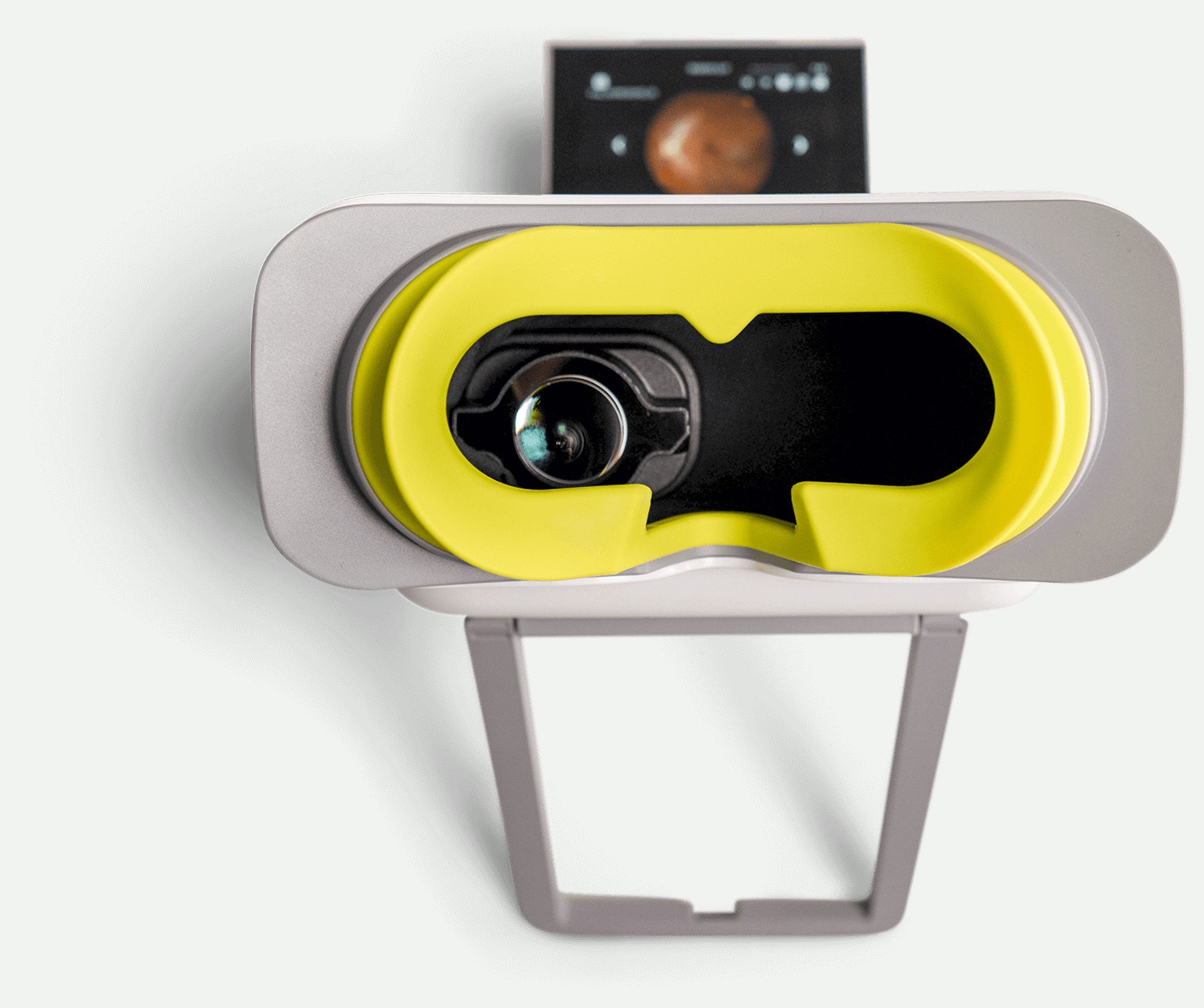
The Resolve camera received FDA 510(k) clearance in April 2025 as an aid to evaluating ocular health. The clearance is for the imaging device. It does not make the U.S. product an autonomous diagnostic system. Optain's American service sends images for professional interpretation and returns a coded report, typically the same day according to the company. A clinician can then decide whether a referral or further examination is needed. The distinction matters: an attractive risk signal is not a diagnosis, and a camera cannot substitute for the clinical decision that follows.
Automated, undilated retinal photography in a primary care setting.
A licensed grader reviews the image through the teleophthalmology workflow.
A coded report goes into the clinical record so the care team can follow up.
The scientists came first. Then came the scheduling problem.
Optain was launched in 2023, but the research is older. Its roots run through Eyetelligence, the Australian company founded by ophthalmologist Mingguang He and commercial healthcare leader Jason Sun. He had spent more than a decade on AI analysis of retinal images at the University of Melbourne and the Centre for Eye Research Australia. Ascertain, a venture-building partnership of Aegis Ventures and Northwell Health, announced a $12 million investment in Eyetelligence in 2023 and a U.S. launch under the Optain name. Dunkel was brought in to lead the new company.


Their complementary expertise is the point. He brings ophthalmology research and clinical validation. Dunkel brings years in medical devices and healthcare operations. The company employs clinicians, engineers, regulatory specialists and commercial operators; its problem requires all four sorts of patience. An algorithm might identify a lesion, but a health system still needs evidence that staff can run the device, the report arrives where it belongs, and the economics justify repeated use.
“First, you have to provide clinical value. Second is you need to have a fiscal ROI.”Jeff Dunkel, speaking to Insight Partners
The visible cost of the strategy is investment. The company announced $12 million for its initial U.S. push and a further $26 million Series A in September 2025, led by Insight Partners. Seven U.S. health systems participated, including Northwell, Memorial Hermann, Novant, Ohio State University Wexner Medical Center and UPMC. Their involvement says something about the buyer: Optain is courting organizations that measure care gaps, referral completion and clinic capacity, not consumers shopping for a gadget.
Why buy the people who read the pictures?
Two months after the Series A, Optain acquired EyePACS. This was less a sudden pivot than the formal end of a two-year collaboration. EyePACS had spent more than twenty years building a U.S. teleophthalmology network across community clinics, county systems and home-health programs. At the time of the deal, it reported more than 740 clinical sites, 1.5 million people screened over its history, and more than 140,000 people identified with severe sight-threatening disease. Those are EyePACS's historical figures, not a tally of Optain camera users.
The acquisition answers a question that hardware startups often discover late: who performs the service around the machine? EyePACS supplies a grading network and established relationships with the very clinics Optain hopes to serve. Optain supplies easier image capture and a larger research program. The combined offer is a business-to-business screening service: device, interpretation, report, and integration. For a clinic comparing it with a specialist referral or a conventional fundus camera, the decisive difference may be how many separate arrangements it no longer has to manage.
Optain reported 200 provider sites live globally in November 2025, with more than 1,000 deployments in planning. The distinction between those numbers is a useful discipline. A planned camera is not a completed screen. The company's real measure of progress will be whether sites use the equipment routinely, produce interpretable images, return reports promptly, and close the loop on patients who need specialist care.
The eye can tell more; the rules still matter
Optain's ambition reaches beyond diabetic eye disease. Its Eyetelligence Assure software analyzes retinal images for signs of diabetic retinopathy, glaucoma and age-related macular degeneration; Assure+ also assesses cardiovascular risk. The company says its development used more than one million retinal images. These products have market-specific regulatory status. Optain explicitly says automated disease-detection software is not for sale in the United States, where its present service uses teleophthalmology interpretation. It is a vital difference for anyone tempted to collapse the company into a headline about instant AI diagnosis.
Australia remains the engineering center of gravity. In October 2025, Victoria announced that Optain would establish an Asia-Pacific headquarters and expand its Melbourne research and engineering hub, with up to 49 jobs and a planned $10 million in R&D spending. The company is headquartered in New York, but its research lineage and much of its next product work remain in Melbourne.
In Australia, Optain is working with Monash University and the Digital Health Cooperative Research Centre on a research project linking retinal images with longitudinal health data to study cardiovascular and kidney disease risk. That is an appealing direction, and still research. A risk assessment might eventually help decide who needs further testing. It cannot replace the tests, clinicians or validation needed to know what a patient's result means.
For another medical technology company, the lesson is unusually transferable. Find the step at which patients disappear. Build the device and the service around that step. Check the regulatory claim in every market. Count completed workflows, not boxes shipped. Optain has not solved all of those problems by announcing them; its acquisition and early site count show how seriously it is trying. The most interesting future for the retinal photograph is not that it becomes magical. It is that, one day, a patient gets it taken without thinking to ask.