Before Malinka Walaliyadde had venture investments to evaluate or a company to run, he had a career fair to organize. There were reservations to make, employers to recruit, registrations to process and students to get through the door. It was the sort of assignment that can turn an appealing idea into a long conversation about parking. He helped build a student organization around it anyway.
At Cornell, he founded the Engineering Career Fair Team in 2009. His supervisor, Ami Stuart, later remembered a freshman delegating to seniors and graduate students, following up on details and planning months ahead. The resulting February fair brought together 1,600 students and 79 companies. Long before anyone asked him about artificial intelligence, there was evidence that he could make a complicated undertaking happen.
Today, Walaliyadde is co-founder and CEO of AKASA, based in South San Francisco. His route there runs through a materials engineering degree, a student engineering competition and a partnership at Andreessen Horowitz. The connecting thread is surprisingly practical: bringing people with different specialties into the same project, then doing the work required to make their contributions fit.
A cricket follower in Ithaca
Walaliyadde was born in Sri Lanka and grew up in Sharjah, in the United Arab Emirates. By his senior year at Cornell, he had become sufficiently recognizable around campus to appear among the student newspaper's 25 “Mysterious Seniors.” The brief portrait supplied two details unlikely to appear in a financing announcement: he followed cricket avidly and played guitar casually.
Those were the interests recorded in 2011, alongside his materials science studies and his work as a senior adviser to Cornell's engineering competition team. The combination gives the young Walaliyadde some welcome texture. There is the technical student, certainly, but also someone whose life included a sport capable of making an afternoon seem like a preliminary commitment.
His university years involved organizing as well as studying. The career fair required employers and students to find each other. The competition team required people from different disciplines to make something together. Both put him in the middle of coordination problems, where being technically right is useful and getting everyone ready at the same time is useful too.
A February career fair organized through the student team he founded in 2009.
The pleasure of a thing that works
In 2011, Cornell's iGEM team was building a Biofactory: an arrangement of microfluidic chips designed to produce useful chemicals. Walaliyadde served as a senior undergraduate adviser. The project brought together students in biological and chemical engineering, materials science and engineering physics. It depended on modeling, fabrication and experiments, with each discipline supplying something the others needed.
The team earned a gold medal at the Americas competition in October and went on to win Best Manufacturing Project at the world championship in November. It had arrived with a tested, working system. That detail gives the award its weight. A proposal can arrange all its difficulties in the future tense; a working device has already had to negotiate with them.
“The judges said they were especially impressed with how we tied everything together.”
Malinka Walaliyadde, 2011
His comment after the competition emphasized integration. The individual parts mattered, but so did their relationship to one another. For a student moving toward a business career, it was a concrete encounter with a recurring organizational task: specialists can each do their work well and still need someone to help the whole system function.
Four years on the other side of the table
After Cornell, his early career included time at Corning, Counsyl and Deloitte. In February 2014, he joined Andreessen Horowitz. At the venture firm, he worked with Vijay Pande on the bio fund launched in 2015. The job placed him among founders trying to turn specialized ideas into companies, with all the commercial questions that accompany that translation.
By the time of his 2018 Forbes profile, he had worked on 16 deals, from seed investments to growth rounds. Benchling was among them; he had sourced the investment. He also held board observer roles at companies including Apeel Sciences. Forbes included him in its 2018 30 Under 30 list for venture capital, published the previous November.
There is a useful distinction between the two jobs in his biography. Investing asks someone to assess an enterprise, its people and its prospects. Founding requires living with the consequences of thousands of decisions inside it. Walaliyadde eventually crossed that boundary. The earlier role gave him a view across companies; the later one concentrated his attention on building his own.
- 2009Founds Cornell's Engineering Career Fair Team
- 2011Advises the prize-winning Biofactory team
- 2014Joins Andreessen Horowitz
- 2019Begins his tenure as AKASA's CEO and co-founder
- 2021Announces the AKASA name and Series B
A conversation about collective knowledge
One of his public appearances from the investor years offers another angle on his interests. In August 2017, he joined Luis von Ahn, Jay Komarneni and Vijay Pande for a discussion called The Taxonomy of Collective Knowledge. The subject was how people organize information so that humans and machines can coordinate around it.
Von Ahn, the founder of Duolingo and reCAPTCHA, brought a particular connection to the question of collective intelligence. The conversation ranged from philosophy to practical ways of structuring knowledge. It puts Walaliyadde's later work with AI in a longer frame: he was discussing how to organize complicated information years before the recent rush to put language models into products.
The career fair and the Biofactory were arrangements of people and physical work. This was an arrangement of knowledge. The resemblance is an editorial observation, but a useful one: throughout his public career, Walaliyadde keeps appearing where individual contributions need to become something that other people can use.
Four founders, one shared undertaking
Walaliyadde's CEO tenure at AKASA began in 2019. His co-founders were Varun Ganapathi, Ben Beadle-Ryby and Andy Atwal. Recalling the beginning, he described a group assembled through friends and friends of friends, people whose abilities came recommended by others. The company started with a few people working in a shared office setting.
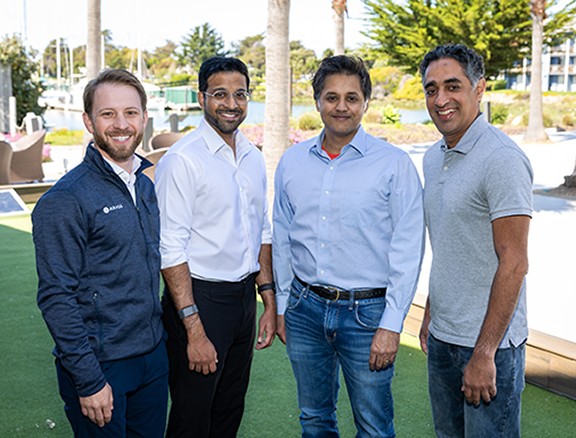
In March 2021, the company announced a $60 million Series B led by BOND, with Andreessen Horowitz, Costanoa Ventures and existing investors participating. It also introduced the AKASA name, replacing Alpha Health. His former firm had become an investor in the company he was running, extending an existing professional relationship into a different kind of responsibility.
The name has an unusually expansive origin for an enterprise software business. Akasa is a Sanskrit word for sky, space or aether. The company also gives its logo an explanatory role: separate dots become connected, then resolve into a solid foundation. Even its visual identity is concerned with getting scattered things to work together.
The founding group also makes the leadership story less solitary. Ganapathi brought the technology role, Atwal engineering, and Beadle-Ryby commercial work. Walaliyadde took the CEO role within that division of responsibilities. Those distinctions matter in a profile of a founder whose earlier projects depended on different kinds of expertise. The photograph has four people in it for a reason.
A little room for being wrong
Walaliyadde's published writing offers a counterweight to the usual certainty of technology promotion. In a 2021 essay on automation, he examined problems a system knows how to solve, problems it recognizes without having an answer, and problems it cannot anticipate. The difficult design question is what happens when software meets that last category.
His argument favors an expert-in-the-loop approach, allowing human expertise to help address unfamiliar situations. That is a practical position for someone selling automation to take. It puts the awkward case inside the design brief. A system's usefulness depends partly on how it behaves when the tidy example has run out.
In a separate 2020 essay, he explored the relationship between AI, confidence and human judgment. Together, these pieces show a founder willing to discuss limitations as engineering problems. The ambition survives; it acquires a few conditions. Anyone who has organized an event will recognize the value of allowing for the thing nobody put on the spreadsheet.
The bookshelf and the unfinished work
His recommended reading is similarly concerned with the mechanics of running organizations. The books he named for a 2022 podcast included High Output Management, The Hard Thing About Hard Things and High Growth Handbook. His podcast choices included a16z and Invest Like the Best. It is a reading list with an evident appetite for operating detail.
There are company milestones beyond funding announcements. In January 2023, AKASA reported that 91 percent of employees surveyed described it as a great place to work. In March 2026, the company announced its sixth consecutive Great Place To Work certification. Such results concern the organization Walaliyadde and his colleagues have built, alongside the products they sell.
When discussing his priorities in 2025, he put continued research and development near the center of his attention. He also interrupted the technical discussion to mention recruiting. It was a recognizable founder's move: a conversation about difficult work becomes an invitation to help do it. The student who once brought employers to campus now had roles of his own to fill.
His story can be told through prestigious names and investment rounds. It becomes more interesting at the smaller scale: the early registrations, the working chips, the recommended colleagues, the willingness to plan for exceptions. The career fair offers a fitting place to leave him. People arrived because someone had done the unglamorous work of making arrival possible.