An engine can tell you that it is going wrong before it stops. In 2005, while still a university student, Nevzat Ataklı worked on software that listened to that warning through vibration data. It was an early encounter with a question that would follow him into business: what could a machine tell you in time to do something useful?
Two decades later, Ataklı is co-founder and CEO of Trio Mobil, where connected devices and artificial intelligence help industrial operators detect risks and respond. The surroundings have changed from an engine to entire working environments. The interval that interests him remains the same: the space between a warning and a consequence.
That is an unusual place to build a public story. A company can photograph a new factory or announce a contract. A successfully avoided problem is less obliging. It leaves no wreckage for the annual report. Ataklı has built his career around making that quiet interval visible, measurable and worth a customer's attention.
The education after the degree
Ataklı graduated from Sabancı University in 2008 with a bachelor's degree in mechatronics engineering. His next classroom was Ford's research and development operation, where he worked as a software engineer. The discipline combined in his degree - mechanical systems, electronics and software - would also become the practical combination behind his company.
He spent about two years at Ford Otosan. Later, he described the experience as being “like a master's degree” - a translation of his Turkish phrase. He valued what the corporate environment taught him while deciding that he wanted to build a business of his own. An orderly career had given him useful training for a rather less orderly occupation.
His future co-founder, Celal Barış Özdemir, was a friend from university. Together they founded Trio Mobil in 2011. Investor 212 describes Ataklı's responsibilities as product, sales and growth strategy. That combination matters: he had to understand what could be engineered, persuade someone to buy it and work out how to repeat the transaction.
The founder's role consequently stretched well beyond writing software. A working product is an achievement; a working business must survive the customer's questions too. Ataklı's path placed those questions close together. His technical background belonged in the sales conversation because the product had to perform in the physical world.
When software needed a body
The early company worked on vehicle and fleet tracking software. Ataklı has recalled selling an early remote diagnostics system to construction-equipment maker JCB. After difficulties on a project following 2013, the founders began developing hardware as well. The software business was acquiring something considerably harder to update: objects.
That turn is a revealing part of the story. Software can describe a moving vehicle, but it depends on equipment to collect the information. Taking responsibility for both sides gave Trio Mobil a different engineering task. The founders were bringing more of the chain under their own roof, from the device in the field to the information a customer could use.
Today, the company says it develops its intellectual property internally and employs more than 250 people, including over 60 R&D engineers. Its connected systems span industrial sites and fleet operations. The continuity with Ataklı's earlier work is practical: software still has to make sense of something that moves, wears out or occupies space.
“Which safety decisions change because of it?”
Nevzat Ataklı, on judging AI adoption
A factory is an exacting setting for that ambition. People, vehicles and machinery share a changing environment. A system must interpret events while operations continue around it. A useful warning needs an audience, a response and enough time for that response to matter. Otherwise, the business has merely produced a more expensive way to notice something.
A forklift is a demanding audience
Ataklı's present focus gives the broad phrase “Internet of Things” a specific job. Trio Mobil combines AI vision, ultra-wideband proximity sensing and controls around industrial traffic. Depending on the installation and equipment, its systems can issue alerts, manage zones and support automatic speed reduction. The point is to connect detection with action.
These are complementary ways of observing a workplace. Camera-based recognition and proximity sensing provide different inputs. Combining them is intended to improve coverage in environments where sightlines and traffic patterns change. Ataklı's company has chosen the complicated business of coordinating those inputs rather than treating a camera as the entire answer.
For a reader accustomed to AI that produces paragraphs, this is a useful change of scenery. Here the output may be a warning in a cab or a control signal to equipment. The customer is buying an operational response. Eloquence has limited influence over a forklift; the machine is famously indifferent to a well-turned sentence.
The distinction also helps explain Ataklı's emphasis on prevention. Recording an event and changing its course are different engineering assignments. His business sits where perception, communications and equipment behavior have to meet. The claim deserves to be judged at that junction, in the working installation, where an alert either informs a useful action or adds to the noise.
The money arrived after the machinery
Outside investors joined a business already built around products and customers. Ak Portföy invested in 2017. In June 2021, 212 made its first investment in Trio Mobil. Ataklı publicly welcomed the backing as a way to accelerate international growth. The ambition was already larger than the company's original market.
On July 29, 2024, a new financing announcement put a number beside that ambition: $26.5 million. NewSpring Growth led the round, with participation from existing investors 212 and TIBAS Ventures. The announced purpose included supporting global customers and strengthening operations in the United States and other markets.
Ataklı put a human destination on the investment: “Our mission is to ensure that every worker returns home safely.” It is a plain sentence alongside the elaborate vocabulary of financing. It also supplies a test for the expansion. More installations and more revenue must remain connected to the reason customers install the technology.
The company reported operations across 65 countries at the time of that round. Its customers included Coca-Cola, Unilever, Mercedes-Benz, Ford and Beko. These names describe the reach of the business, but the work underneath is local and particular. An international sale eventually becomes equipment in a particular facility, used during a particular shift.
That creates a second job for the engineer-founder: making the organization travel as well as the product. Distribution, implementation and ongoing support become part of what the customer buys. In Ataklı's account of the company's growth, investment helped make the organization itself capable of scaling. The circuit board was only one of the things that needed a reliable design.
Growth financing led by NewSpring Growth, with participation from 212 and TIBAS Ventures.
New York, and the argument beyond the demo
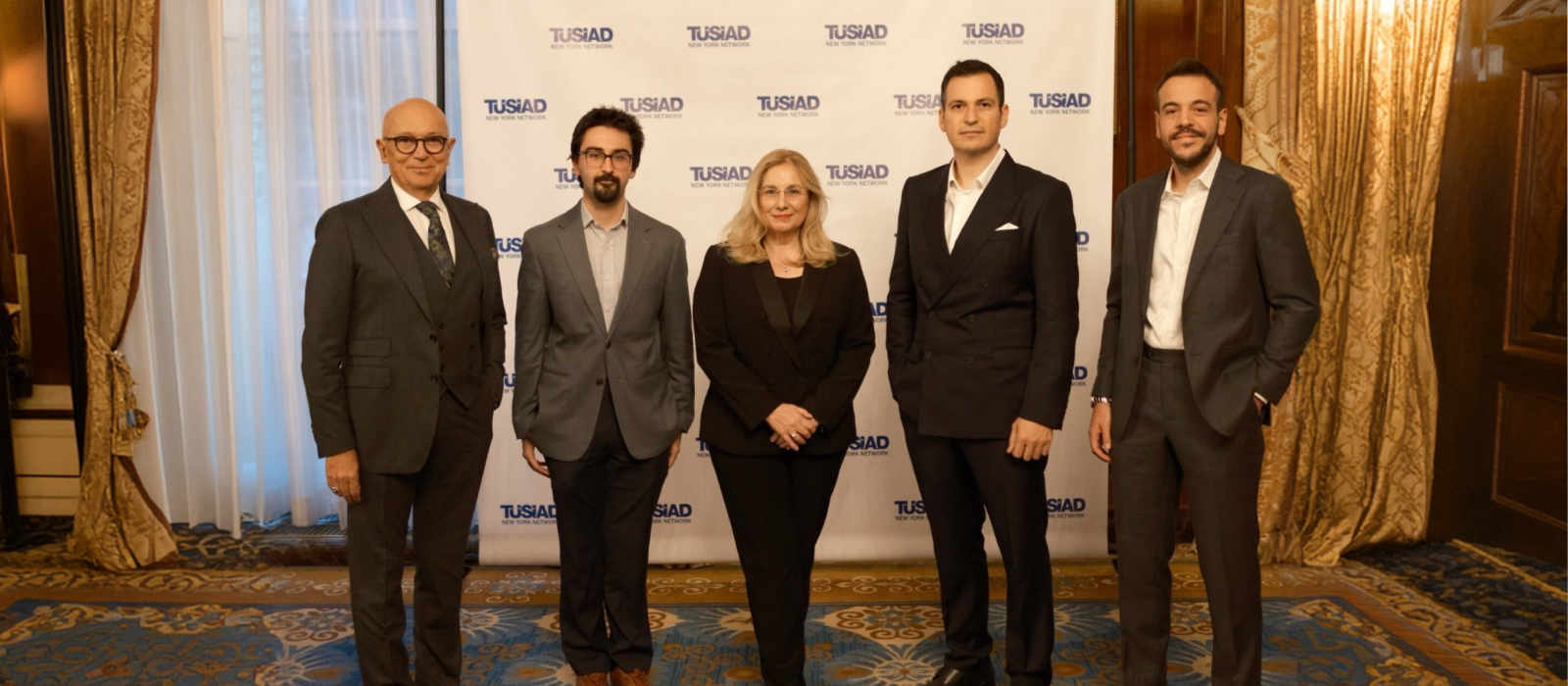
In October 2025, Ataklı joined a TÜSİAD panel on AI and entrepreneurship in New York. The session formed part of a delegation visit to New York and Boston. He presented Trio Mobil's prevention-first approach, bringing a business rooted in industrial engineering into a wider discussion about international technology companies.
The setting captures a change in his work. The early founder had to explain a product to a buyer. The CEO now also explains an approach to investors, executives and other entrepreneurs. The example remains concrete: connected intelligence has to help people make decisions inside operations, rather than remain an attractive idea outside them.
His writing makes that argument more demanding. In an article about AI adoption, he asks whether the technology changes decisions. He identifies unclear ownership and slow organizational responses as obstacles to moving beyond pilots. A demonstration can establish that something works technically while leaving unsettled who is supposed to act on its findings.
This is a useful complication from someone selling technology. The purchase does not finish the task. Managers still have to decide who owns the response, how information reaches them and how it changes routine work. Ataklı's test brings the discussion back to the operating day. A dashboard gets its meaning from what somebody does after looking at it.
Why zero still leaves a question
In March 2026, Ataklı published “The Zero Accident Trap.” His argument challenges the comfort of a clean historical record. A period without accidents may leave dangerous conditions undiscovered. He wants managers to examine current exposure and the safeguards around it, as well as the figures describing what has already occurred.
There is a coherent line from that position back to the engine-vibration project. Both concern information that arrives before an obvious failure. Read this way, his career has developed around an expanding unit of attention: a machine, a fleet, a facility, then an organization deciding how to respond. The scale grows; the timing question persists.
He has also written about manufacturing's appeal to young professionals. In his view, a workplace's visible systems and operational discipline influence whether people see it as somewhere they want to build a career. That extends his argument beyond equipment buyers. The working environment communicates with prospective employees too, even before a recruiter begins the tour.
In a 2025 interview, Ataklı set out a five-year ambition for global leadership in industrial safety technology, pursued through product development, international expansion and partnerships. The ambition is his stated target. The more revealing detail is the sequence of work behind it: learn the machinery, build with a friend, take responsibility for hardware, then build an organization around the result.
Ataklı's career gives an unfashionably practical answer to what AI might be for. Listen to the equipment. Notice the conditions. Give someone time to act. The work is successful when a shift proceeds without the event everyone hoped to avoid. For a founder, that is a curious product to sell: the evidence keeps moving, while the desired ending is an ordinary day.