The pineapple had questions to answer. In January 2015, Yasser Khan and his colleagues brought an unusual demonstration to an AT&T hackathon in Las Vegas: a piece of fruit, wired up so that a mobile phone could ask its name and whether it needed water. The replies were configured by the team’s software. The pineapple was an interface with a crown.
Khan was there as the technical leader of Plasma’s C2M team. Its application, called One, reached the top 20 among 600 entries. A talking pineapple makes a fine exhibition anecdote. It also introduces a question that runs through his career: how do you make the physical world intelligible to the people responsible for it?
Today, Khan leads MicroAI, the business that grew out of a partnership between Plasma and Japan’s Systena. His work has moved toward factories, equipment and software that can interpret what machines are doing. The object at the other end of the conversation has become more expensive. The wish to ask it a useful question has survived.
A useful conversation begins with a connection
Plasma’s early pitch for C2M brought several jobs together: connecting devices, collecting their data, analyzing it, displaying it and triggering business workflows. Those jobs sound orderly when listed in a brochure. In an operating business, they involve a less orderly collection of systems, people and equipment that already have things to do.
Khan’s place in that business was technical as well as entrepreneurial. Systena identified him as Plasma Computing Group’s founder and chief technology officer when the companies announced their Japanese partnership in May 2016. C2M would become part of Systena’s SmartAttach offering. The agreement carried a Texas-developed platform into a Japanese distribution relationship.
That is a revealing early chapter. Khan was working on the connective tissue of an enterprise: the software that lets an event in one place become useful information somewhere else. An executive dashboard is only the visible end of that arrangement. Underneath it sits the harder business of getting different systems to cooperate.
The human part required explanation, too. At the 2015 IoT6 xChange summit in Dallas, Khan was scheduled to host individual meetings and present a case study on making IoT development more efficient. These were conversations about deployment, with people who had to decide how a technology would fit their organizations. A demonstration can win attention. A working integration has to keep it.
The refrigerator acquires a security detail
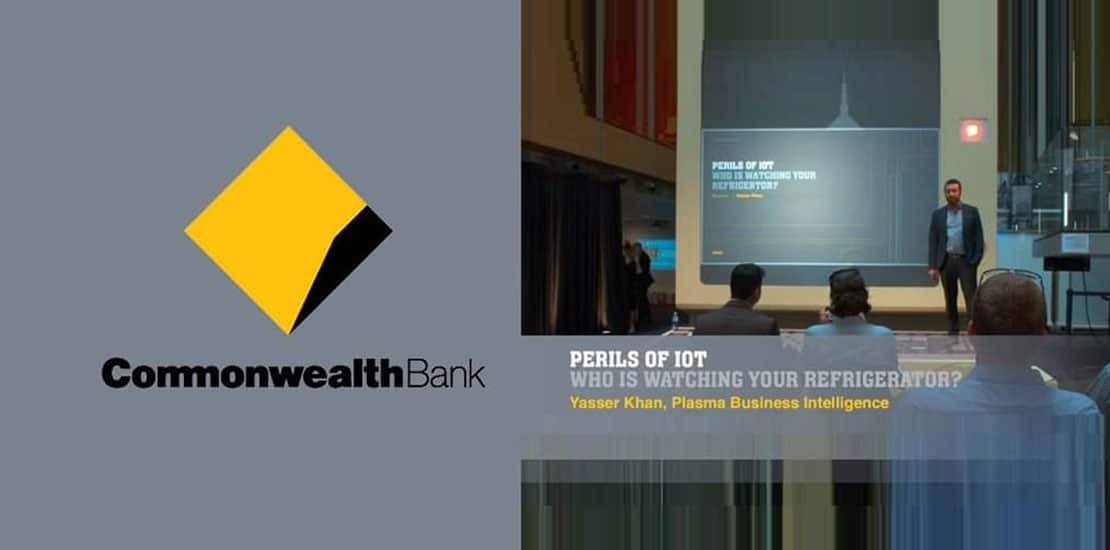
By February 2017, Khan was in Australia speaking at a Commonwealth Bank IoT security event. His subject was the peril that follows connectivity into the room. He asked: “Who is watching your refrigerator in your kitchen?”
It is an excellent question to give an appliance an identity crisis. It also makes an abstract security discussion wonderfully domestic. A refrigerator belongs to a world of groceries and leftovers. Add a network connection and it acquires another set of relationships, some of which its owner may never see.
Khan’s presentation covered the implications of connected devices for personal and business life. The same technology that makes equipment easier to reach also creates questions about who else can reach it. Connectivity brings obligations along with convenience. His public explanation put those obligations in a kitchen, where an audience could picture them.
This was a different register from the pineapple’s friendly replies. Together, the two episodes show how he presented a technical subject through familiar objects. Neither requires an audience to begin with a definition of an industrial protocol. First comes something recognizable. Then comes the consequence of connecting it.
A partnership with two kinds of capital
The next substantial move involved a corporate structure. In October 2017, Systena outlined a planned joint venture with Plasma Business Intelligence. It named Khan as CEO of the proposed O.N.E business and described him as Plasma Business Intelligence’s founder and CEO. The venture would combine Plasma’s IoT technology with Systena’s mobile and robotics capabilities.
The transaction closed in January 2018. Its announced value was $6 million, divided evenly between the partners. Systena contributed $3 million in cash. Plasma contributed $3 million in technology through licensing C2M. Khan became CEO of ONE Tech.
The distinction between cash and licensed technology matters. This was a partnership built around something Plasma had already developed. The platform provided a starting point for a separate business pursuing AI, robotics and connected digital experiences. Years of software work had become part of the capital structure.
Two equal contributions to the announced $6 million deal. Technology value is distinct from cash investment.
There is a practical lesson in that arrangement for understanding Khan’s career. The company names change, but the work accumulates. A platform, a distribution partnership and a new venture belong to successive stages of the same effort to turn connected equipment into a business proposition.
When the machines talk too much
Khan has described an industrial deployment that helped draw him toward AI. Equipment spread across a large geographic area produced data faster than people could usefully review it. Programmable controllers were being sampled every 50 milliseconds. Sensors added more readings. Moving everything to a server for someone to inspect was an unhelpful answer to abundance.
His proposed response was to let software learn at the equipment itself. In 2020, he described MicroAI running on microcontrollers and microprocessors, with models trained locally. The ambition was to turn streams of measurements into usable warnings and maintenance information while reducing the supervision required.
“We train the model directly on the asset itself.”
Yasser Khan, 2020
This is the point where the story’s emphasis shifts. Connecting a machine makes it observable. Understanding its behavior demands another layer of work. Khan was trying to make that work happen close to the thing producing the data, with less dependence on sending everything elsewhere first.
The underlying management problem is easy to recognize. A business can improve its ability to collect information without improving its ability to act on it. More readings can become more obligations for an already occupied person. An alarm earns its place when it helps someone decide what deserves attention.
Khan took that argument into technical events. At Embedded IoT World in April 2021, his presentation examined AI-enabled microcontrollers, cloud dependence and the advantages of embedding intelligence in equipment. He also joined a panel with Edgeworx’s Kilton Hopkins and the Eclipse Foundation’s Frederic Desbiens. The questions had become architectural: where should the work happen, and what should a device do for itself?
A smaller name for a larger assignment
In September 2021, ONE Tech adopted the MicroAI name. The company linked the change to a broader market for its edge AI products, including AtomML. A business initially focused on the industrial Internet of Things was presenting its technology for use across more industries.
The new name placed the technical approach on the front door. For Khan, the public-facing job now included explaining why intelligence belonged inside or beside equipment. A small computing footprint could be commercially significant if it made a system easier to deploy and operate. Size, in this story, was a design consideration with consequences for adoption.
His preparation spans computing and management. His professional biography lists a computer engineering degree and executive education at MIT in applying AI to business strategy. A 2022 industry presentation identifies earlier work as a product manager at Telelogic. Plasma also announced his selection as a 2016 EY Entrepreneur of the Year finalist in the Emerging Technology category.
Those details place him across several responsibilities: product development, explaining technology to customers, and leading a business built around it. The award was recognition of the Plasma and C2M work. The subsequent company demanded that he keep translating technical choices into reasons an organization would buy.
Back to asking the equipment a question
On March 2, 2026, AT&T introduced Connected AI for Manufacturing in collaboration with MicroAI, NVIDIA and Microsoft. The offering combines connectivity, edge processing and generative AI so operators can ask questions of machinery using natural language. Its intended applications include maintenance, production analysis and access to operational knowledge.
There is a pleasing continuity here with Las Vegas in 2015. The pineapple replied through configured software. The manufacturing offering brings a different set of technologies and responsibilities to communication with equipment. What connects the episodes is an interface that lets a person begin with a question.
The distinction matters as much as the resemblance. A demonstration has a controlled setting and an audience waiting to be surprised. A factory has production commitments and people who must decide whether an answer is useful. Such conversations earn their place by helping operators complete practical work.
Khan’s current public writing returns to that problem through the idea of operational context: knowledge of the equipment, its history and the circumstances around a decision. At an AgExcellence gathering in Minneapolis, he described an “Ag Harness” grounded in the particular economics and operating knowledge of agricultural retailers. The business details have to travel into the software.
He has carried this question from a trade-show demonstration into enterprise platforms, an international partnership and edge AI. Along the way, the objects became less amusing and the decisions became more consequential. The pineapple could afford to be entertaining. The production line needs an answer someone can use.