A crop-protection product has a price. That sounds like the easy part. Then come the rebates, local discounts, supplier programs and inventory costs. What looked like a straightforward sale becomes a small accounting puzzle. In a testimonial published by Plasma, NovusAG president and CEO Tommy Warner describes how difficult it is to track margins in this business. The useful software, it turns out, may be the software that tells you what you actually earned.
This is a revealing way into Plasma, the Texas enterprise software company founded in 2003. Its language includes artificial intelligence, connected devices and digital transformation. Its practical territory is more familiar: the spreadsheet between two systems, the report someone assembles by hand, the decision held up while somebody finds an answer. Plasma connects those pieces, builds applications around them and automates the work that follows.
- The job: connect business data and automate the handoffs.
- The proof point: inventory, rebates and margin visibility in agriculture.
- The platform: C2M, with custom software and integration services.
01The rebate is the story
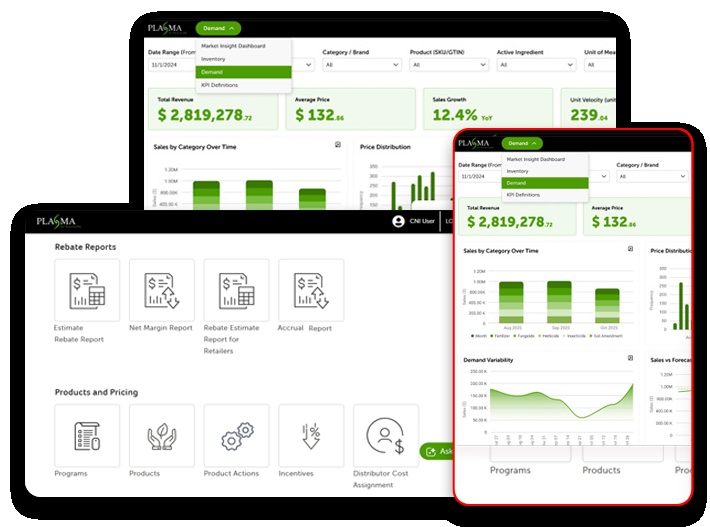
Plasma says its agriculture solutions support more than 800 retail branches and locations. The offering covers seed, fertilizer, crop protection and livestock, serving businesses such as distributors, retailers and cooperatives. Inventory, pricing and rebate management sit beside sales tools and accounting integrations. This is agricultural software concerned with the business around the crop, including the paperwork that determines whether selling it makes money.
Its published customers make the point more clearly than the technology vocabulary. Nutrien operations executive Kym Gunn describes hundreds of locations and joint ventures using Plasma Ag, integrated with CRM, ERP and accounting systems. Warner highlights the transparency of margin information. CniAG finance executive Keith Thomas points to inventory, average costs, rebates and accruals. These are customer testimonials hosted by Plasma, but their specificity matters: the recurring attraction is seeing the commercial machinery clearly.
“It is quite difficult to track margin information on crop protection products in our industry”Tommy Warner · President & CEO, NovusAG
From a testimonial published by Plasma
02A dashboard should have somewhere to go
The platform underneath this work is C2M. It combines data connections, analytics, visualization, application building and workflow automation. Its connectors take in information from APIs, databases, files and devices. A visual workflow builder lets teams define how work moves. Dashboards make operational measures visible; event triggers and role-based assignments turn changes in those measures into tasks.
That combination explains its position in the market. A reporting tool can show a problem; a workflow tool can route a task. Plasma sells the work of joining these capabilities to the systems a company already uses. Its proposition spans configurable software and implementation services, with custom portals, CRM, asset management and ERP augmentation among the applications. The alternative for a buyer is to extend an existing enterprise suite, commission a custom application, or assemble separate integration, reporting and automation tools.
03What went wrong before the software arrived
Plasma’s agriculture analytics use case describes a chain of ordinary failures. Data sources are disconnected. Reports arrive slowly. Visualization is limited. Manual access controls delay information reaching the people authorized to use it. Employees spend time preparing the evidence for a decision while the conditions behind that decision keep changing.
Its proposed sequence is concrete: aggregate the data, combine it, establish live performance measures, route information through workflows, then present dashboards suited to different users. In procurement, the same logic reaches vendor qualification, contract development, inventory and spend allocation. The lesson a reader can copy is to follow one decision from beginning to end. Identify the information it needs, the person who owns the next step and the delay between the two. Automate that handoff before adding another report.
04The expensive part can come before the experiment
Plasma addressed a different bottleneck in 2017 with a C2M Prototype License. Its announcement described enterprise teams struggling with the cost of acquiring a platform, additional software and a hosting environment merely to demonstrate an idea. The license offered monthly or quarterly access to a cloud-hosted platform, avoiding the need to acquire hosting hardware for the prototype.
The interesting change was commercial: make a working experiment easier to buy. That announcement establishes a leasing approach for that historical offer; today’s site directs prospective customers toward demos and consultations. For a buyer evaluating this kind of project, the useful comparison is the whole job: integration, process design, access controls, training and ongoing operation. A prototype becomes valuable when it tests those requirements alongside the attractive screen.
05Before agents, there were sensors
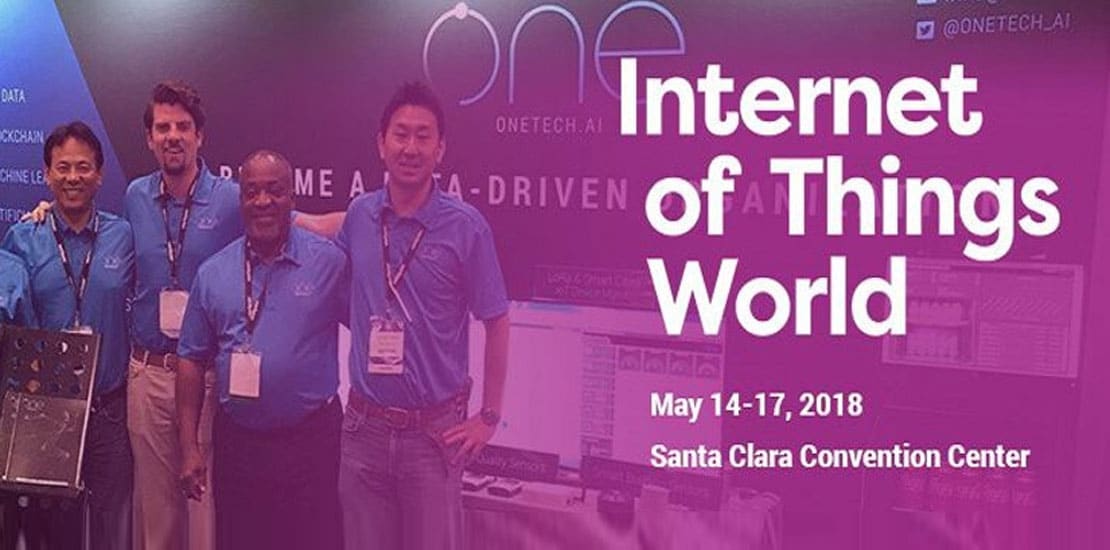
C2M’s connected-device roots predate the current enthusiasm for generative AI. Plasma announced an IoT cloud partnership with Texas Instruments in February 2016. That year it also described a Systena partnership to bring C2M into Japan through SmartAttach. By 2018, Plasma and Systena America were presenting their joint venture, ONE Tech, at IoT World in Santa Clara.
The history helps explain why device connectivity and business processes occupy the same product. A sensor reading becomes more useful when it reaches an operational decision. Plasma’s current partner directory includes GeoTraq, Libelium and Sigfox. Its careers page, meanwhile, lists roles in Irving and Noida and describes training and a collaborative culture. Delivering these systems involves people who can integrate and maintain them, alongside the platform itself.
06Give the answer a memory
Telecommunications brings the same problem into a different room. A service team may already possess the answer to a network issue, scattered across old tickets, documents and diagrams. Plasma’s generative AI knowledge-management offering uses retrieval-augmented generation to search that material with language models. Its described process includes loading, indexing, storage, querying and evaluation; it also supports retrieval of relevant images and diagrams.
Plasma’s 2026 publishing agenda extends that direction into agentic agriculture inventory, AI-enabled ERP workflows and telecom service delivery. The appeal is understandable: let a system retrieve useful knowledge and move work forward. The practical condition is equally clear. Automation needs usable records, appropriate permissions and a process whose decisions can be checked. For a small business with a simple workflow, extensive integration may add more machinery than the job needs. For an enterprise losing time between systems, that neglected handoff can be a sensible place to begin.