A board of engineered wood looks reassuringly uneventful. Flat. Brown. Ready to disappear behind a wall. Making it consistently is another matter. Wood arrives with different moisture levels, densities and chemical characteristics. The press wants predictability. The tree has made no such promise.
For Hexion, the adhesive supplier, that mismatch has become a business opportunity. A mill can buy the right resin and still struggle with how much to apply, how quickly to run and whether the next board will pass inspection. Hexion’s answer is to get closer to those decisions.
- Hexion supplies the chemistry holding engineered wood together.
- Buying Smartech added AI and systems designed to reduce resin use and production variability.
- The test is cost per good board, with quality intact.
The expensive part is uncertainty
Consider the temptation to add a little extra resin. It buys reassurance. So does slowing the line. Each decision can look sensible in isolation. Together, they can leave a factory paying for uncertainty in material, time and energy.
Smartech, which Hexion acquired in December 2024, addresses that problem through process intelligence and application systems. SmartMDI targets how resin reaches wood. SmartQuality, introduced at LIGNA in 2025, gives operators real-time quality insights. Its launch announcement described potential line-speed gains of up to 3%.
Hexion’s broader Smartech materials advertise resin-use reductions of 10-30%. Those are supplier-reported results, dependent on the application. The interesting detail is the direction: a chemical maker is offering customers ways to consume less chemical.
Hexion’s published Smartech range. A vendor claim to test on a specific line, rather than a universal forecast.
The balance sheet came first
Hexion did not arrive here through an uninterrupted parade of clever products. In April 2019, it filed for Chapter 11. It emerged that July. Its financial filings describe the constraints substantial debt placed on investment and flexibility. The historical failure was financial, even while factories continued operating.
The portfolio subsequently narrowed. In February 2022, Hexion completed the sale of its epoxy business to Westlake for approximately $1.2 billion. American Securities affiliates acquired Hexion Holdings the following month for $30 a share. Treating those former epoxy products as today’s Hexion catalogue would tell the wrong story.
Michael Lefenfeld joined as chief executive in early 2023. By December 2025, Hexion had also sold its U.S. Gulf Coast formalin operations to Ancala. It retained formalin supply elsewhere. These were concrete changes in what the company owned, alongside its argument for a different way to earn money.
A supplier inside the process
Hexion calls the newer approach Chemistry-as-a-Service: material knowledge, AI process optimization and resin formulations connected to operating conditions. The business still makes industrial materials. It is adding a role in how customers use them.
Its customers buy inputs for other products: panel makers, coatings formulators and manufacturers serving construction, furniture and industrial markets. Alongside wood resins, Hexion supplies VeoVa monomers, Versatic acids and Cardura glycidyl esters for adhesive and coating formulations. Agriculture is another outlet, including slow-release fertilizer chemistry. The mill strategy sits within that broader materials business.
“Selling chemicals is no longer enough. Customers are buying performance.”
Michael Lefenfeld · President and CEO
The distinction matters for buyers. Resin price is visible on an invoice. Scrap, downtime and unnecessary energy can be harder to attribute. A more expensive ingredient could conceivably produce a cheaper finished board. That is the procurement question Hexion wants customers to ask.
Its 2025 collaboration with Kadant Carmanah brings equipment into the argument. The ambition is connectivity from the strander, which cuts logs into strands for oriented strand board, through drying, blending, forming and pressing. Fixing variability upstream can change what happens downstream.
Measured results inform the next run ↗
This is a competitive market. Arclin supplies resins for OSB, MDF and plywood; Dynea supplies industrial wood adhesives and application expertise. Hexion’s proposition is the combination of chemistry, systems and operating intelligence. A customer should judge how well those pieces work together.
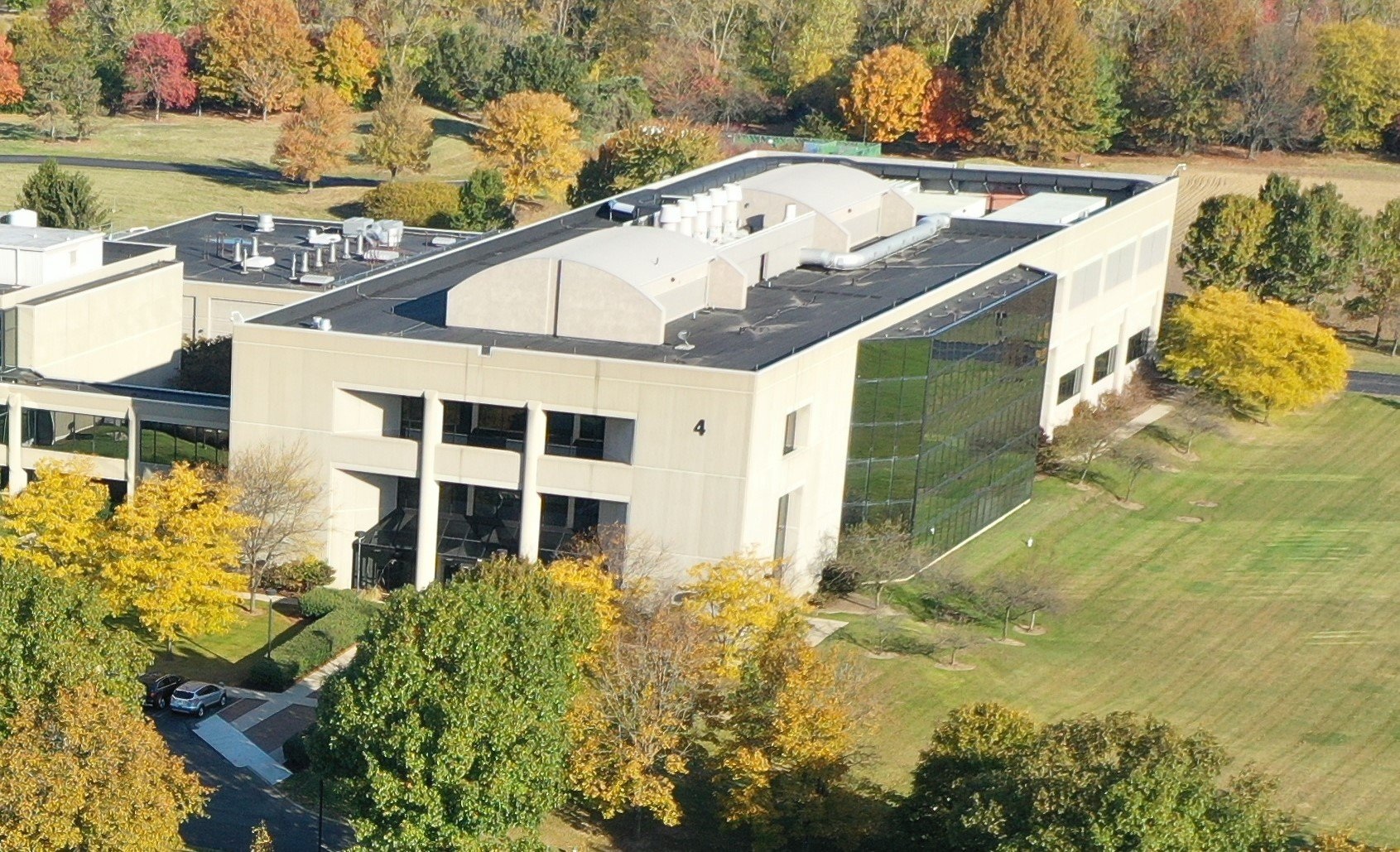
The laboratory plan gives that combination a physical address. Hexion’s Dublin, Ohio hub is intended to consolidate five existing laboratories, bringing chemical engineering, manufacturing and materials science together. Planned capabilities include timber testing, coatings tests, gas purification and mining-related work. The company brought intended users into the building before finalizing the design. Shared equipment and reconfigurable workspaces are part of the plan.
The tree already had an adhesive
The company’s other intriguing wager begins inside wood itself. Lignin helps give plants their structure. Conventional extraction can damage the reactive groups useful for bonding. In June 2025, Hexion partnered with Switzerland’s Bloom Biorenewables to develop adhesives using lignin whose useful chemistry is preserved during extraction.
The partners described a route toward fully plant-based adhesives. Their announcement also identified a remaining task: making adhesive-grade lignin ready for manufacturing at scale. A promising chemical route still has to become a dependable industrial input.
There is an appropriate family resemblance here. Hexion’s modern combination dates to 2005, but its predecessor story reaches back to Borden’s condensed-milk business in 1857. Its history describes casein, a milk byproduct, finding uses in adhesives. Looking for useful chemistry in biological material is an old company habit.
Fire protection still has a finish line
In April 2026, Hexion and CitroTech formed the 50/50 HexiTech venture for fire-retardant wood products. The arrangement combines CitroTech’s intellectual property with Hexion’s manufacturing and commercial capabilities. CitroTech investor materials describe up to $6 million of Hexion support toward its partner’s venture contributions if needed.
That commitment supports the venture’s commercialization. The same materials target a commercial partner by the end of 2026 and initial venture revenue in early 2027. Those are forward-looking milestones. Fire-retardant chemistry must still travel through product testing, adoption and purchase orders.
Count the good boards
For a mill considering Hexion, the useful next step is a bounded trial: establish material consumption, output, rejects and energy use, then compare performance without relaxing the product specification.
The approach needs usable measurements, integration with equipment and operators able to act on the results. Where those conditions are missing, software cannot simply manufacture consistency. The attractive idea is straightforward: sell customers a better result, even when getting there means putting less of your own product into every board.
Keep following the experiment
Hexion website ↗ · Company news ↗ · Explore Smartech ↗