Sanjit Biswas has a habit of inspecting ceilings. At Starbucks, or at his children's school, he looks for the wireless access points. Sometimes he recognizes a Meraki device, a small piece of the company he helped build and sold years ago. Most people want their Wi-Fi to disappear into the background. Biswas likes to check where it ended up.
It is an oddly domestic way to measure a career that includes a $1.2 billion acquisition. A box above the coffee queue can tell him something a valuation cannot: somebody installed the thing, somebody uses it, and it is still doing its job. His second company, Samsara, has taken that interest in useful, inconspicuous technology into truck depots, construction sites and warehouses.
His route there contains the customary institutions, investors and large numbers. The more revealing passages involve a school email server, an academic adviser with practical advice, and two friends who discovered that having time for brunch was pleasant but insufficient as a retirement plan.
The school needed an email address
Biswas grew up in Texas before his family moved to California in the mid-1990s. Around ten or eleven, he began experimenting with early Linux software. In high school in the South Bay, he and friends set up a Linux server and worked on getting their school online. They called themselves the Web Team. The branding budget appears to have been modest.
They wanted classmates to have email and web pages. Asking everyone to master a text interface would have defeated the purpose, so they built a web email client and a simple page editor. Already, the interesting engineering problem included the person expected to use the result.
Biswas went on to earn a bachelor's degree in computer systems engineering at Stanford and a master's in electrical engineering and computer science at MIT. Academic research offered an appealing future. He thought he might become a professor or research scientist. A startup was something he arrived at through the work.
A research project leaves the roof
At MIT in 2002, Biswas met John Bicket. Both were graduate students, trying to work out what was worth investigating in computer systems and networking. Their adviser, Robert Morris, suggested they build something useful and see what they learned along the way. It is excellent advice, although less comforting than being handed a research topic with a tidy conclusion.
The project was Roofnet, an experimental wireless network. Its questions concerned how data could travel across a mesh of connections. Building an actual network gave the researchers a useful complication: people who expected it to work. The world outside the paper had opinions.
Making that research available did not automatically make it easy for others to deploy. There was a gap between software an academic could download and equipment someone could plug in. Meraki, founded in 2006, grew out of the effort to close it.
The early financing had a pleasing directness. The team secured prepaid orders for routers, then used the money to get the devices manufactured. Customers were helping fund the product they wanted to receive. Biswas had to learn to sell because circuit boards and components required payment. A research budget had become a business problem.
Meraki's proposition made networking equipment easier to manage through the cloud. For the customer, the attraction was practical: equipment on the premises, management from a central place. The complexity could remain inside the system rather than becoming a second occupation for whoever had to operate it.
Cisco announced its agreement to acquire Meraki in November 2012 and completed the transaction that December. The closing announcement put the cash price at approximately $1.2 billion. Meraki's team became Cisco's Cloud Networking Group.
There is a temptation to make the sale the final scene, with the founders walking away while the credits roll. It was also a change of workplace. Biswas stayed to help the business grow inside Cisco. The first company had taught him to build an organization; the larger one offered lessons in what happens when an organization already has scale.
at MIT
Cisco
Samsara
Brunch, then the warehouse
By 2015, Biswas and Bicket had finished their integration work and took time off. They had gone from graduate school into Meraki without much room for a holiday. Now there were San Francisco restaurants to explore and coffee meetings with no urgent company attached.
Eventually they got bored. Their next company acquired a name with a little self-awareness: Samsara, a Sanskrit term associated with the cycle of life and rebirth. A second passage through startup life seemed to qualify.
Their experience selling Wi-Fi had introduced them to industrial businesses. These customers offered a view of work that software founders could otherwise miss. Inside warehouses and operations facilities, the tools could still include clipboards, paper records and maps on walls, even as smartphones and cloud services became ordinary elsewhere.
Biswas and Bicket understood networks. Running a warehouse was unfamiliar territory. That distinction mattered. Expertise can supply an answer rather quickly; entering another person's workplace requires enough patience to discover whether it answers their question.
Early conversations with Cowgirl Creamery and Revolution Foods helped shape a temperature sensor. Employees were recording temperatures by hand, producing piles of paper. An automatic reading could remove a repetitive task. Connecting that reading with other information, such as a delivery's location, made it more useful still.
The opportunity was easy to overlook precisely because the work was familiar to the people doing it. A recurring inconvenience can become part of the furniture. An outsider who asks about it may learn more than an outsider who arrives with a presentation.
“You kind of have to rehire yourself every year.”
Sanjit Biswas, on the changing job of a founder
The tour is part of the job
Samsara combines devices, connectivity and software so customers can see what is happening across their operations. Trucks, equipment and workflows generate information that becomes more valuable when it can be examined together. Location data can help explain a delay. Engine data can reveal avoidable idling. A report can become a reason to change tomorrow's route.
For Biswas, the hard part includes making the whole arrangement usable. A fleet operator has other work to do besides assembling sensors, databases and connections into a software project. The integrated product has to justify its place in an already crowded working day.
He has described setting aside two days a week for customers. The visits are a way to hear about changes before they become polished industry themes. An equipment shortage, a hiring difficulty or an awkward workflow can be obvious in a yard and almost invisible in a meeting room.
There is pleasure in it, too. He gets access to the machinery behind ordinary life: the businesses that move deliveries, maintain infrastructure and keep services running. His curiosity has acquired a travel schedule.
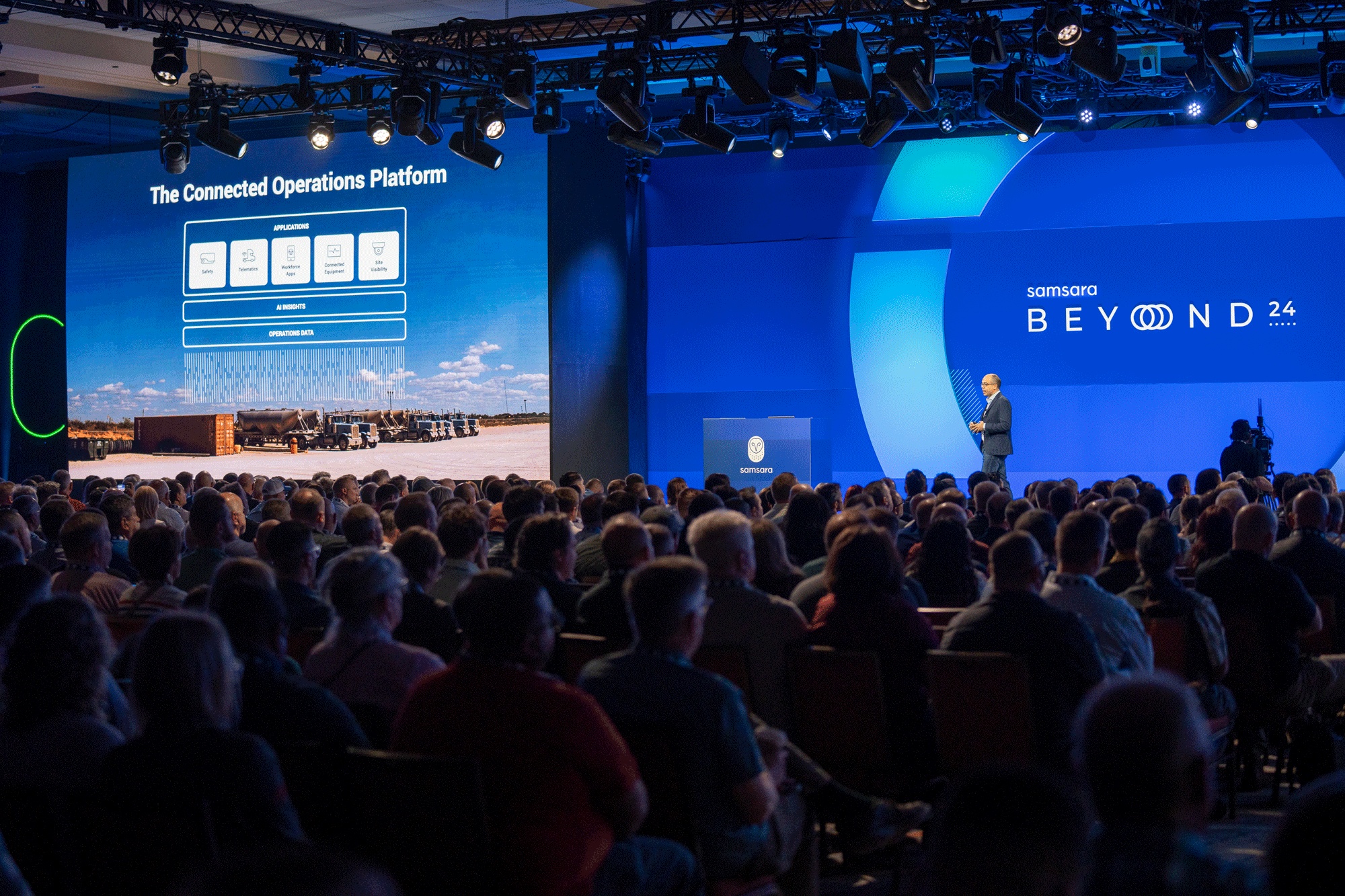
He has tried to put the same habit into the company's culture. In 2021, Samsara revised its values after feedback from employees and employee resource groups. The resulting commitments included customer success, curiosity, inclusion, teamwork and building for the long term. The mechanism matters as much as the vocabulary: even the description of how the company should behave was opened to revision.
Company values are easy to print and harder to make consequential. Here they express a recurring preference in Biswas's work: ask, build, watch what happens, adjust. It leaves room for a colleague or customer to improve the answer. It also creates a continuing obligation to listen after the initial enthusiasm has worn off.
The numbers get bigger. The questions stay practical.
Samsara went public on the New York Stock Exchange in December 2021 under the ticker IOT. Public markets added investors and analysts to the list of people who needed his time. A founder's calendar could fill quite efficiently without leaving much room to think.
Biswas protects unallocated blocks in his week. He has described using that time to reconsider whether a task still deserves his attention or is merely something he did last quarter. He is also comfortable admitting the limits of his knowledge. Knowing the products and customers does not create expertise in every subject on which a chief executive might be invited to pronounce.
In September 2026, Samsara reported $508.4 million in quarterly revenue and approximately $2.125 billion in annual recurring revenue, up 30 percent from a year earlier. ARR describes the annualized recurring business; it should not be confused with revenue collected during the quarter. The figures show how far the experiment has traveled since its first sensors.
Annual recurring revenue
Same quarterly measure, one year apart. ARR grew 30%.The next stage involves AI agents. After introducing agentic capabilities in June 2026, Samsara announced on October 13 that Agent Studio was available to all customers, with tools for building chat and voice agents. Its examples included reporting, fuel analysis and answering drivers' questions using company guidance.
For Biswas's career, the connection is fairly concrete. A school email interface, a manageable wireless network and an operations assistant all confront the distance between what technology can do and what somebody can conveniently use. New tools keep changing the possible answers. The requirement to understand the work survives.
At Stanford, he has described building a company as an engineering project, with problem selection, teammates and customer feedback among its essential ingredients. Bicket remains a central connection: the graduate-school collaborator is now Samsara's co-founder and chief technology officer. Their shared history has lasted through experiments, an acquisition and another company.
Biswas still has reason to look up at the ceiling. There is satisfaction in finding an old product quietly at work. But the newer questions tend to be at ground level, where a truck is waiting, someone has a form to finish, and a visitor might profitably ask for a tour.