Clifford Reid had a fairly specific idea of what his next company might be. He had already worked on enterprise search and digital video. Another software business would have made sense. Then a meeting at MIT drew his attention to systems biology, and the career plan acquired a laboratory.
The attraction was computational. A field he had disliked as a student now contained the sort of problems he knew how to approach: enormous amounts of information, difficult analysis, and the need to make the machinery work at scale. He described himself as a “big data and software guy.” Biology had become a place where that description could be useful.
It is an appealing beginning because it lacks the tidy inevitability of a founder legend. His account begins with a change of mind. The subject had changed; he changed his assessment of it. Familiar skills suddenly had an unfamiliar destination.
Complete Genomics would put that recognition into physical form. Its founding business proposition was to take in human DNA and deliver sequence data. The laboratory was essential, but the customer was buying its output. For someone whose earlier work involved helping organizations find and distribute information, the new alphabet offered a different version of a longstanding problem.
“big data and software guy”
Clifford Reid, describing his background
Search first. Then press play.
At Verity, Reid worked on enterprise information retrieval. His responsibilities included product development, and he was associated with the company's TOPIC product family. These were tools for organizations with documents to search and knowledge to recover. Finding the right material inside a business is a prosaic task until you have tried to do it badly.
Eloquent moved into internet video and rich media communications. Reid was its founder and chief executive, as well as chairman. In a 2001 interview, he described the business in terms of product launches; the company had worked on more than 250 launches for 50 Fortune 1000 companies. Video here had a job to do, helping businesses communicate material that could otherwise remain trapped in a room.
Open Text completed its acquisition of Eloquent in March 2003. The progression from search to video gives Reid's later career some continuity. Both ventures concerned information inside organizations: how people retrieve it, how they communicate it, and how a technical system turns it into something another person can use.
His education also crossed disciplines. He earned a physics degree at MIT, an MBA at Harvard Business School, and a doctorate in management science and engineering at Stanford. The combination offers three ways to examine a venture: what the underlying system does, what a customer might pay for, and how the operation can be organized. His companies would give those questions plenty of exercise.
Three founders, one deliberate choice
Reid's move into sequencing depended on collaborators. John Curson introduced him to Radoje Drmanac, the molecular and computational biologist who became Complete Genomics' scientific co-founder. Curson was the third co-founder. The introduction joined commercial experience with a body of technical work already years in the making.
Drmanac later recalled that Reid returned to MIT to learn molecular biology. The founders licensed sequencing intellectual property from Callida, and a $6 million financing round in 2006 supported the new company. Drmanac credited Reid's ability to raise money with allowing the team to remain quiet while it developed the technology.
Their first demonstration was deliberately demanding. They chose to sequence a human genome rather than begin with a much smaller bacterial one. They also selected a research cell line rather than a famous person's DNA. Celebrity, for once, was not invited to improve the product.
Those choices reveal what the team wanted to prove. A smaller demonstration could show that pieces of a process worked. A human genome could test the scale of the intended product. The decision put the commercial destination into the development work from the beginning. Reid's contribution belongs beside the scientific contribution: the venture needed both technology worth building and enough time and money to build it.
The customer gets the data
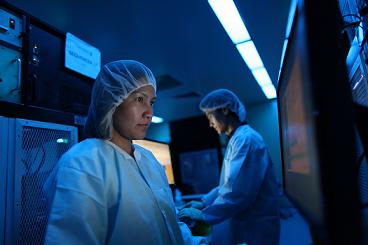
Complete Genomics began with a service model. Researchers sent samples; the company handled sequencing and analysis. Customers could buy the results without buying and operating the company's proprietary instruments. That placed a substantial part of the technical workload inside the supplier's own facility.
The service also had a narrow focus: whole human genomes. During a 2010 interview, Reid borrowed the shape of Henry Ford's old joke about car colors: “We'll sequence any organism, as long as its human.” The line made an operating choice sound pleasantly inhospitable. A mouse arriving at reception would have had a disappointing afternoon.
Specialization gave the company a defined task around which to organize its workflow. The machines, preparation procedures and analysis could be developed for that task. The bargain was clear enough: customers surrendered some flexibility in exchange for a supplier concentrating its effort on the result they wanted.
The factory metaphor mattered because a factory has to repeat its achievement. One successful run is a demonstration. Many successful runs, delivered predictably, are a service. A sequencing operation must therefore answer the ordinary questions that follow any impressive piece of engineering: how long does it take, how much does it cost, and can the next order go through the same process?
A target is a future tense
In early 2010, Reid discussed plans for 5,000 genomes that year, 50,000 in 2011 and a million by 2014. These were ambitions. Even then, a delay in the first large sequencing center's opening had reduced the company's near-term target. The future arrived with a production schedule attached.
The public listing followed on November 11, 2010, under the Nasdaq symbol GNOM. For a founder, an IPO changes the audience. A plan that once belonged in an investor meeting becomes something that can be examined quarter by quarter. Capacity, orders and delivered work acquire different meanings when they sit next to financial results.
The distinction between aspiration and delivery is particularly useful in Reid's story. His language was expansive, but the business left a trail of specific operating numbers. Reading those numbers alongside the targets produces a more interesting portrait than either a celebration or a dismissal. He was asking the company to grow into an industrial scale while still learning the rhythms of its customers.
By July 2014, BGI reported that more than 15,000 human genomes had been sequenced and analyzed on the Complete Genomics platform. That was a concrete measure of work performed. It also stood at a considerable distance from the earlier million-genome ambition. The two figures belong to different columns: one records an achievement, the other records a goal.
The arithmetic behind the ambition
The first-quarter 2011 earnings call brought the practical detail into view. Reid reported more than 600 genomes shipped during the quarter, bringing cumulative shipments to over 1,400 since the commercial facility opened the previous May. Median turnaround time had fallen to roughly 70 days. These were the units in which the enterprise was becoming real.
The same call described $6.8 million in quarterly revenue and a $12.5 million net loss. Progress in production and pressure on the business could occur together. A company could deliver more work while still spending heavily to develop and operate the system that delivered it.
The backlog contained another complication. Its estimated genome count had doubled from about 1,000 to more than 2,000, while its estimated value rose from $10 million to approximately $15 million. Lower pricing explained the difference. More volume did not automatically mean a matching increase in money. A falling price could help attract research orders while making each unit of growth work harder financially.
There was useful work outside the order book, too. In April 2011, the company released 69 complete genome sequences into the public domain. Making data available gave researchers material to examine and gave the company a way to put its output in other people's hands. A data business needs people who can actually use its data.
Reid also explained that orders arrived on different timetables. Some customers could send samples immediately; others planned to send them over several quarters. Equipment capacity and customer readiness therefore had to meet in the middle. There is a quieter version of entrepreneurship here, concerned with waiting, scheduling and deliveries. The grand presentation is only one part of the job.
The factory changes hands; the questions continue
BGI completed its acquisition of Complete Genomics on March 18, 2013. The cash offer was $3.15 per share, and the company became a wholly owned subsidiary. Reid remained chief executive when the transaction closed. The ticker was retired; the operation continued under new ownership.
The deal followed financial difficulties and layoffs. That context matters to the shape of the career. Building a working technology and building an independent business around it are related achievements, with different demands. Reid had brought the company into public markets and then through a sale. The result resists the clean upward curve that biographies often draw through years that were decidedly less clean to live through.
He left Complete Genomics in 2015. Genos Research followed, with Reid as founding executive chairman. In 2016, its chief executive, Mark Blumling, described an idea Reid had helped initiate: give individuals control over their sequence data, including choices about exploring, sharing or monetizing it. The entrepreneurial question had moved from producing information to deciding who could direct its use.
Reid subsequently became the founding CEO of Travera, an MIT spinout. In 2025, he joined Cancer Commons as CEO, a position reflected in his 2026 conference biography and public LinkedIn profile. His institutional connections also include MIT's biological engineering visiting committee. The software founder's return to a university had become a continuing association.
What holds these chapters together is the recurring attention to information as a practical product. Search made documents findable. Video made presentations distributable. Sequencing made another kind of information available as a service. Genos put control of the resulting data into the business proposition. Each chapter asked who would use the output and what had to happen before they could.
Reid's career began this particular turn with a willingness to reconsider a subject he thought he understood. Its most revealing image remains the sequencing factory: an ambitious promise translated into samples, machines, software, deadlines and invoices. Somewhere between the pitch and the shipment lies the work he kept choosing to do.