A doctor can be in a network and still be remarkably difficult to find. Start with the address. A group practice has several offices; a directory associates its physicians with those locations; a patient picks one. The list looks reassuring. The trip may be wasted. Somewhere between the practice and the insurer, an administrative convenience has become a patient’s problem.
THE STORY IN THREE POINTS
- HiLabs cleans healthcare data before other systems depend on it.
- Its buyers are health plans; its work reaches patients through directories and operations.
- The useful test is whether a correction survives the journey into production.
The address is the story
In March 2023, researchers affiliated with HiLabs and the University of Colorado published a study in JAMA comparing physician information across five large national insurers. They found inconsistencies in 81% of entries. The sample represented more than 40% of U.S. physicians. Much of the discrepancy concerned addresses, particularly doctors associated with multiple locations.
That number needs careful handling. Inconsistency does not prove that every conflicting entry is wrong, or that a physician cannot see a patient. The study acknowledged that some differences could be legitimate. But the finding changes the question. Before asking whether a network is big enough, ask whether its records describe the network that actually exists.
Inconsistent entries
Across five large insurer directories
2023 JAMA study. A consistency measure, not an appointment-availability test.
Two founders, one unfashionable problem
HiLabs was founded in 2014 by Amit Garg and physician Neel Butala. Garg is its CEO. Their pairing gives the business an appealing logic: engineering meets the messy particulars of medicine. The company’s name expands to Healthcare innovation Labs. Its chosen laboratory is the place where healthcare organizations receive information they cannot safely take at face value.

The customer is an organization, usually a health plan, rather than someone downloading an app. HiLabs sells its cloud-based MCheck platform into the machinery of payer operations. In September 2026, it reported serving six of the ten largest U.S. health plans. That is the company’s account of its footprint, not a count of people personally using its software.
The economic proposition is straightforward: fewer manual corrections, less rework, more dependable information. A $39 million Series B, announced in March 2024, financed further technology development and product-team expansion. Eight Roads Ventures and Denali Growth Partners co-led, with F-Prime Capital participating. Capital raised is not the cost of a customer installation; those are separate questions.
Follow the correction
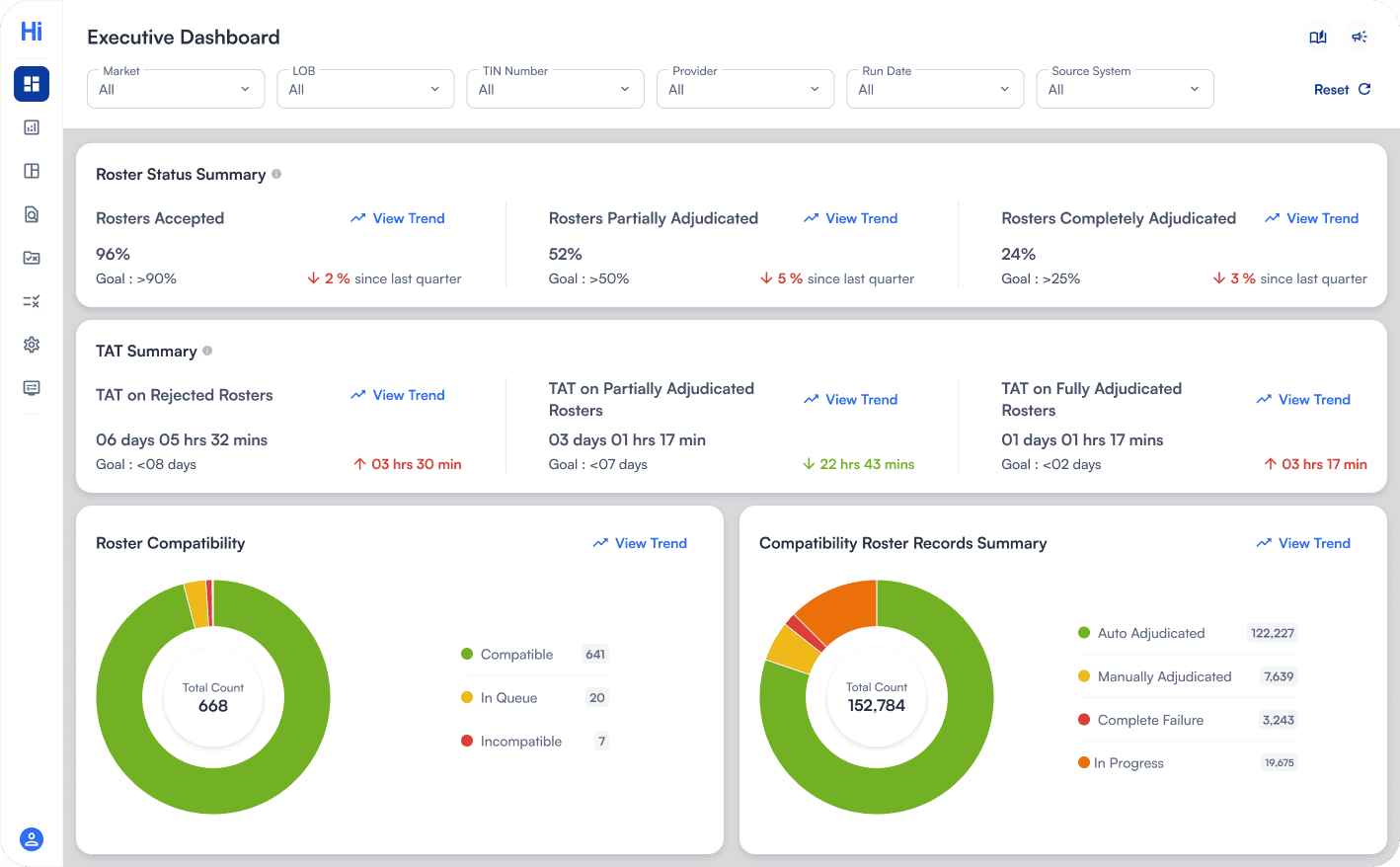
Consider a provider roster: a file describing clinicians, locations and other details a plan needs to maintain. MCheck Roster Automation ingests the file, standardizes fields, applies configurable business rules, checks completeness and feeds updates into downstream systems. Its reconciliation workflows let users inspect and correct discrepancies. The job extends past making the spreadsheet look tidy.
A CORRECTION’S ROUTE
- 01Receive
Rosters and records - 02Resolve
Mappings and rules - 03Validate
Evidence and exceptions - 04Deliver
Operational updates
Directory Accuracy addresses the provider information itself. NetworkIQ uses validated data for network analysis and planning, including identifying gaps and modeling changes. This places HiLabs in territory also occupied by Quest Analytics, which offers network adequacy and data-integrity tools. HiLabs’ pitch emphasizes healthcare-trained AI and the connection between incoming data, correction and execution. That positioning is not a public head-to-head performance result.
The same idea appears in ContractsAI, which extracts contract terms and rates and supports pricing configuration. MCheck Clinical maps and validates clinical information for uses such as quality measurement and risk adjustment. VBC CareSphere tackles contract economics, attribution and payment reconciliation in value-based care. Across the suite, HiLabs occupies the space between information arriving and an organization acting on it.
That space requires domain expertise. A plausible-looking address is not enough. Neither is a correctly extracted rate if it belongs to the wrong agreement. The practical advantage of specialized software is its ability to carry context along with the data. Buyers should test that claim on their own exceptions, rules and destinations.
The pilot that earned the next market
A February 2026 HiLabs case study describes an unnamed plan with 5.8 million members. Partially processed rosters generated downstream cleanup despite large manual teams. An earlier data-accuracy engagement helped persuade the plan to try automation. It piloted in Texas and California, with market experts tailoring business rules and integrations into existing systems.
HiLabs reports average turnaround falling from 21 days to under five and manual tickets declining 34% in the first year. Successful pilots supported expansion to additional markets. The document projects $4.1 million in savings by year two; that forecast belongs in a different column from the reported operational improvements.
REPORTED AVERAGE ROSTER TURNAROUND
HiLabs customer case, February 2026. Includes upload through final production approval.
The transferable lesson is to test the whole journey. Count what reaches production, and bring local experts into configuration. A demonstration that processes an easy file answers a smaller question than a pilot that deals with the rules people actually work under.
A network has to answer the phone
Better evidence matters, too. In November 2024, HiLabs and CAQH announced an exclusive go-to-market agreement combining MCheck cleansing with provider-attested data. The arrangement ties automated interpretation to information supplied by providers. It gives the software another basis for deciding which record deserves trust.
“Solving the widespread challenge of access to care starts with accurate provider data.”Amit Garg · CAQH partnership announcement, 2024
In June 2026, HiLabs announced a multiyear research collaboration with Harvard researcher Thomas Tsai to study ghost networks and actual access in Medicare Advantage. In August, it announced a top-ten health plan’s selection of its voice outreach platform, initially for quality surveys. The extension is logical: conversations can produce structured updates rather than another isolated call log.
Here is the limit: a clean record cannot manufacture an appointment. Automation also depends on trustworthy evidence, current rules and systems that accept the result. Read HiLabs’ story as an argument for repairing the information supply chain. The patient at the other end needs something wonderfully ordinary: the right number, the right location, and a doctor who can help.