A firefighter needs more air. William Lambert’s early contribution to that problem was a fitting: a way to replenish a breathing apparatus quickly. The invention was called Quick-Fill. Long before his name appeared beside chairman or chief executive, it appeared in the history of a piece of equipment designed to be useful when the person wearing it had rather more pressing concerns than its designer’s résumé.
That is a good place to begin with Lambert. Corporate biographies usually climb toward the largest office. His contains a small mechanical idea worth stopping for on the way up. He joined MSA in 1981 as a design engineer, became its chief executive in 2008 and retired from that job in 2018. Across those years, the scale of the decisions changed considerably. The customer still had to be able to depend on the result.
A fitting before a corner office
Quick-Fill became a patented accessory for MSA air masks, allowing firefighters to replenish their air supplies in emergency and routine situations. Explaining the device, Lambert put the engineering ambition plainly: “The fitting enables air transfers to be safe, secure, and fast.” There is a pleasing lack of ceremony in that sentence. A fitting has work to do; adjectives should wait their turn.
His contribution received recognition beyond the company. Design News gave him its Special Achievement Award in 2002 for his work in firefighter safety. By then he had already spent two decades at MSA. The future chief executive had a technical accomplishment that could be described without recourse to a stock chart, an acquisition multiple or the phrase “transformational leadership.”
His education followed a similarly practical path. He graduated from Penn State Harrisburg in 1980 in mechanical design engineering technology, then earned a master’s in industrial administration at Carnegie Mellon in 1990. Engineering and business would both become part of his working vocabulary. One concerned how an object should function; the other concerned how an organization could keep making useful objects.
The long apprenticeship
There was a substantial apprenticeship between the drawing board and the executive suite. Lambert worked as a project engineer on self-contained breathing apparatus and as a product line manager for air-line respirators. He also worked as a nuclear industry specialist and directed marketing for safety products. Each role brought him to a different part of the same exchange: what a customer needed, what engineers could build and what a manufacturer could deliver.
In 1997 he became general manager of the Safety Products Division. Election as vice president followed in 1999, then the presidency of MSA North America in January 2003. The progression matters because it makes his later authority less mysterious. By the time he was asked to oversee the whole company, he had worked through products, markets and regional operations.
MSA created the president and chief operating officer position for him in March 2007, with responsibility for North America, Europe and International operations. He joined its board that December. John T. Ryan III was preparing to retire as CEO, and Lambert’s appointments formed part of an announced succession plan. This was a handover assembled in stages, with time for responsibilities to move before the title did.
A new job, an uncooperative economy
Lambert became CEO in May 2008. The calendar supplied little opportunity for a leisurely settling-in period. The financial crisis soon made the questions facing an industrial manufacturer considerably harder. His response included bringing forward a review of corporate strategy, concentrating attention on the company’s core and reconsidering where growth and investment belonged.
In his later account of that period, the recurring concerns were customers, focus and dependable execution. He had an unusually modest example of the last of these. His first job had been delivering the Pittsburgh Press and Pittsburgh Post-Gazette. Bad weather did not cancel a customer’s expectation of a newspaper. He remembered an obligation to turn up reliably. A paper route is an unforgiving little introduction to service: everyone knows when you have failed to turn up.
It would be too tidy to credit a childhood job with an entire management philosophy. Still, Lambert chose that memory when asked what early work had taught him. The connection he drew was between doing the job consistently and satisfying the person waiting for it. In a career filled with technical specifications and financial decisions, that was the lesson he chose to describe.
“I had to be dependable and reliable.”
William Lambert, on delivering Pittsburgh newspapers
Growth with a reason to belong
The acquisitions of his CEO years show what focus meant in practice. In October 2010, MSA completed the purchase of General Monitors, a developer of fixed gas and flame detection systems. The announced transaction value was $280 million. It added technology and a geographic footprint that complemented MSA’s existing business, particularly in oil, gas and petrochemical markets.
Buying the company was only the opening move. MSA prepared a joint integration team covering nine functional areas. General Monitors’ management remained involved. That detail belongs in a story about Lambert because it puts the less photogenic work back into the acquisition: arranging for people, systems and products to function together after the announcement has ceased to be news.
Latchways followed in October 2015. The United Kingdom business made fall protection systems, including horizontal lifelines and vertical fall arrest equipment. At approximately $190 million, the transaction broadened MSA’s products for work at height. Lambert said it effectively doubled the company’s fall protection business. The commercial logic was specific enough to picture: more ways to serve customers working on structures where a misplaced step has consequences.
Then came Globe Manufacturing in July 2017. Globe’s firefighter turnout gear and boots sat alongside MSA’s helmets and breathing apparatus, with little product overlap. Lambert described the combination in terms of being able to equip firefighters from head to toe. Three acquisitions, three different technical specialties, and a recognizable thread: extending what MSA could provide to customers it already understood.
- 2010General MonitorsFixed gas + flame detection
- 2015LatchwaysFall protection systems
- 2017GlobeFirefighter turnout gear + boots
Making room for the next person
Succession appears twice in Lambert’s MSA story, first as an opportunity offered to him and later as a responsibility he helped carry out. In December 2017, he announced plans to retire as CEO the following May. Nishan Vartanian, then president and chief operating officer, joined the board as part of the transition. The timetable was public months before the change took effect.
Vartanian had led the integration of General Monitors and subsequently held larger operating roles. Lambert’s successor therefore brought direct experience of an acquisition central to the company’s strategy. The connection gives the handover more substance than the familiar photograph of two executives smiling beside a company name. The incoming leader had already been entrusted with consequential work.
When Vartanian was elected CEO in May 2018, Lambert pointed to the leadership team as a particular source of pride. He moved to non-executive chairman, serving in that capacity until May 2020, and continued as a director. His relationship with the business outlasted the executive job. For someone who had arrived as an engineer in 1981, leaving daily management involved changing his place in an institution he knew over decades.
Pittsburgh has other stages
Outside manufacturing, Lambert’s commitments include institutions whose products cannot be worn on a worksite. He has served as chairman of the Senator John Heinz History Center and president of Pittsburgh Civic Light Opera. A museum and a musical theatre organization add a welcome twist to the industrial résumé. A useful city needs places to remember its past and places where people can enjoy an evening.
His connections to education have also continued. Penn State Harrisburg lists support for the Lambert Family Diversity and Inclusion Scholarship, the Sandy and William Lambert Open Doors Scholarship, the Lambert Family Honors Fund and the Lambert Advising Center. These are specific forms of assistance, attached to students’ experience of getting through college rather than to an abstract celebration of education.
Recognition has followed across several chapters: a Penn State Alumni Fellowship in 2012, induction into Junior Achievement of Western Pennsylvania’s Business Hall of Fame in 2019 and Carnegie Mellon’s Tepper Alumni Lifetime Achievement Award in 2020. In 2025, the Heinz History Center honored him as a History Maker in Leadership. The list spans engineering, business, education and civic life, much as his commitments do.
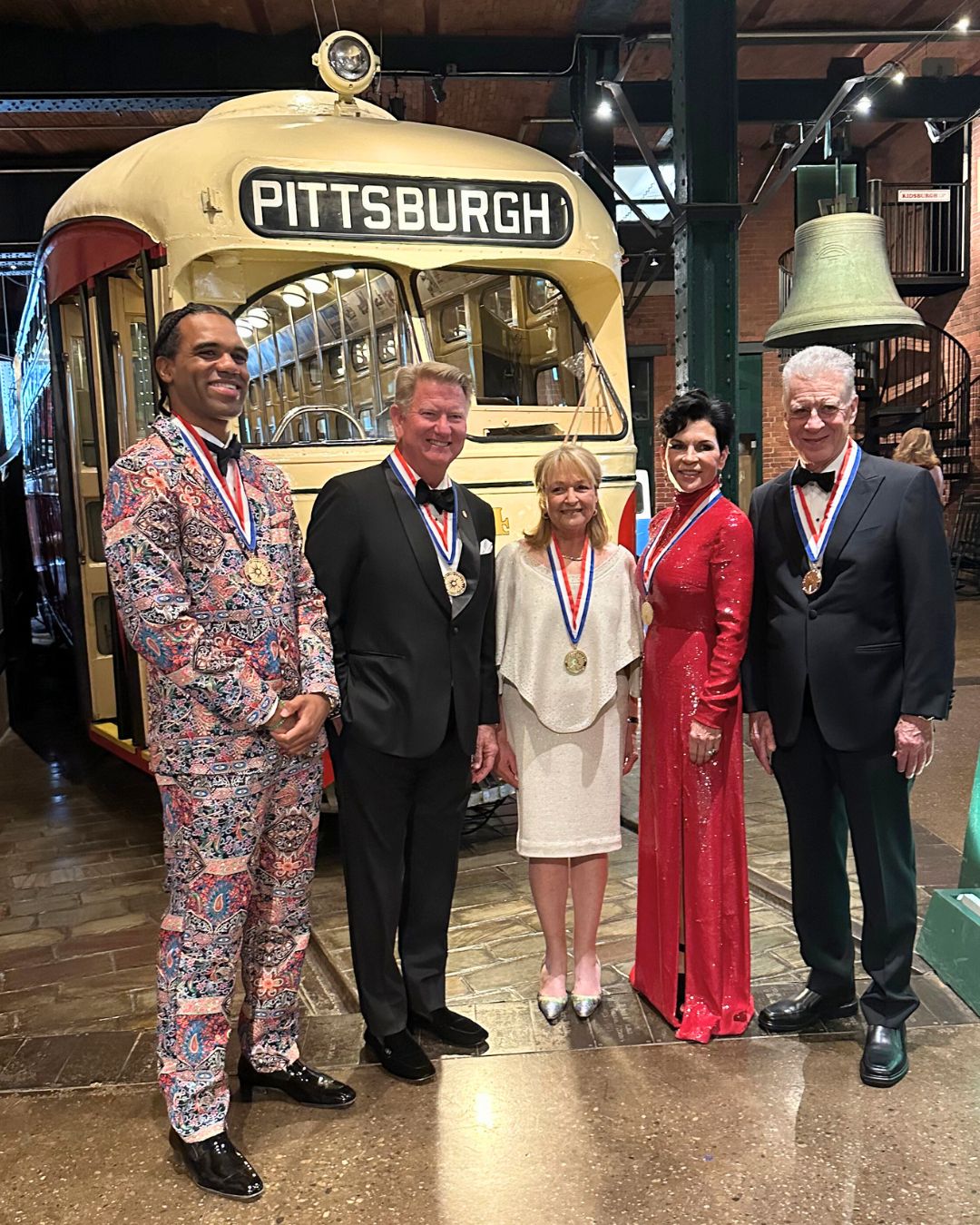
Another carefully timed handover
Kennametal brought Lambert onto its board in 2016. He chaired the audit committee from 2019 and became board chairman on November 1, 2023. The company’s work in tooling, materials science and wear-resistant solutions offered another setting for experience accumulated in global manufacturing, product development and business oversight.
As of October 24, 2026, he remains its chairman, with a further handover approaching. Kennametal has announced that he will retire from its board at the close of the October 27 annual meeting. Joseph Alvarado is due to become chairman on October 28. The distinction between an announced departure and a completed one matters, particularly for a career in which transitions have been planned so explicitly.
There is an appealing continuity here, from a device that helps replenish a firefighter’s air supply to the work of preparing another person to take responsibility. An engineer needs to consider the person who will use the finished product. In management, Lambert had products, operations and eventually a leadership handover to prepare. Quick-Fill gives that long working life a tangible starting point: a small piece of engineering, built for a very particular need.