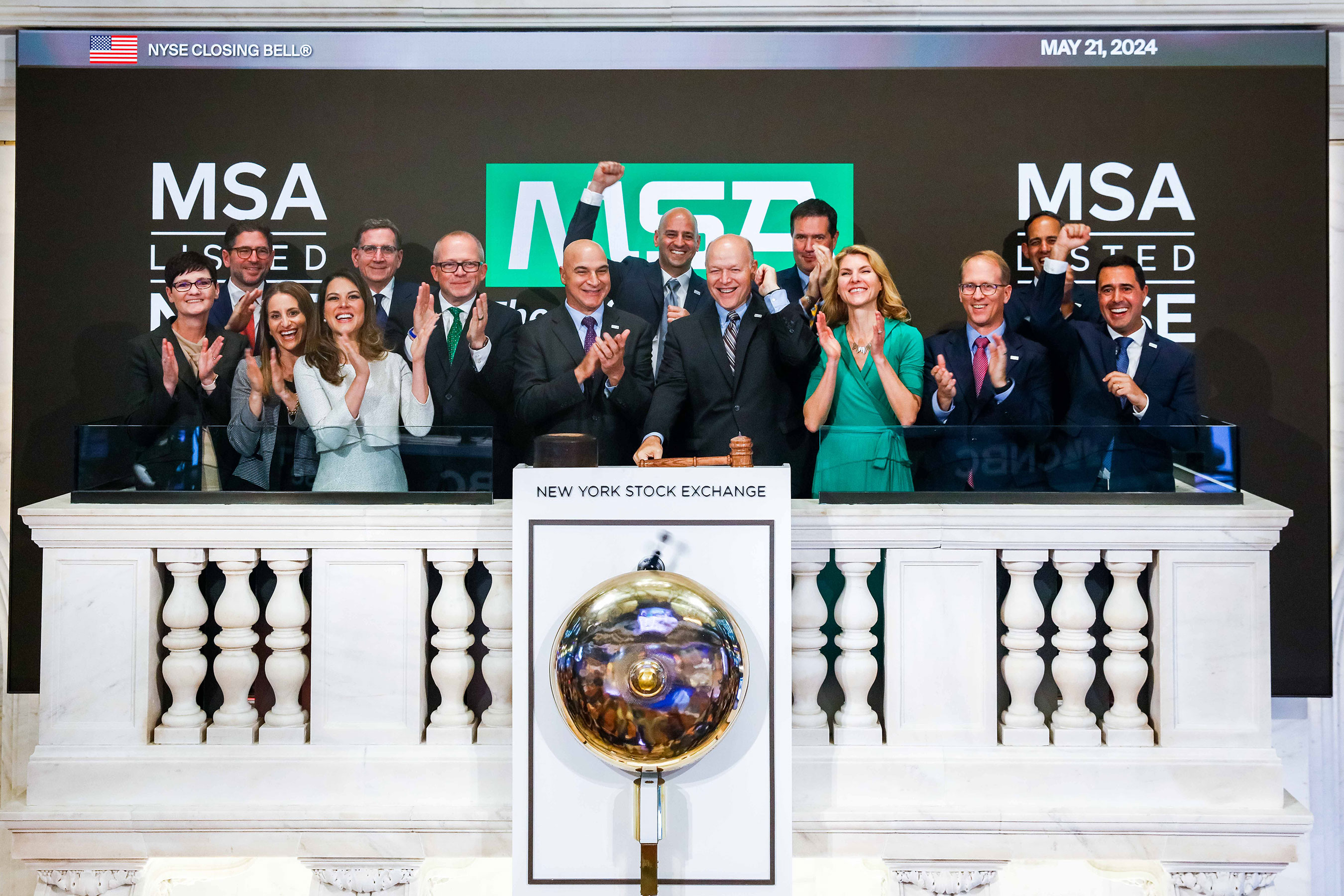
The bell was the easy part. On May 21, 2024, Steve Blanco stood with his MSA Safety colleagues at the New York Stock Exchange, smiling above the brass instrument that announces the end of the trading day. A gavel rested in front of him. Around him, hands were raised and people were applauding. For once, an industrial executive’s work came with its own sound effect.
Eleven days earlier, Blanco had become president and chief executive officer of MSA Safety. He was the tenth person to hold the CEO job in a business then marking its 110th year. The following day brought an investor presentation and a set of financial targets for 2028. A new chief executive could hardly ask for a more neatly arranged opening sequence: take the job, ring the bell, explain the plan.
The interesting part of Blanco’s story happened before the cameras arrived. His route to that balcony ran through engineering, plant management, manufacturing and regional business leadership. At MSA, he had already spent twelve years working inside the machinery of the company. The title changed in May. His acquaintance with the problems was considerably older.
The long apprenticeship
Blanco earned a bachelor’s degree in mechanical engineering technology at Purdue University and an MBA at Indiana Wesleyan University. The pairing supplies a useful outline of his professional life: making things, then taking responsibility for the business that makes them. His early career included nearly twenty years at Ford Motor Company and Visteon, in engineering, plant management and operations positions.
He then spent five years at Eaton. By the time MSA recruited him in 2012, he was vice president of manufacturing for Eaton’s Electrical Sector, a business with $7.2 billion in revenue at the time. He arrived with nearly a quarter-century of operations experience. This was a substantial apprenticeship for someone joining a company whose products must do their work in places where customers have little appetite for surprises.
His first MSA title was vice president of global operational excellence. The assignment covered manufacturing practices, processes, systems and the team responsible for improving them around the world. Such work rarely offers a photogenic breakthrough. Its results accumulate in the less theatrical parts of a business: how a plant runs, how reliably an order moves and how well a process survives repetition.
There is an appealing lack of glamour in that job description. Corporate life has plenty of opportunities to announce a new direction. Blanco’s brief required people to make the existing operation work better, across borders and across factories. He joined MSA’s executive leadership team as an officer, but the substance of the appointment remained close to the practical work of production.
A bigger map, one promotion at a time
In 2015, his responsibilities expanded to MSA’s U.S. and Canadian business. Two years later came the presidency of MSA Americas, adding Latin America to the territory he oversaw. The progression matters. Before he was asked to manage the whole company, he had to move beyond manufacturing and take responsibility for a regional business, its customers and its commercial performance.
The 2017 promotion followed work on operating margins and the delivery ramp-up of MSA’s G1 self-contained breathing apparatus. The Americas segment also recorded more than 20 percent growth in fall protection revenue during the first six months of that year. These were different kinds of operating tasks, from getting equipment out the door to expanding a product business. Together they describe a widening remit.
Between 2018 and 2022, revenue in the Americas segment increased by more than 40 percent under his leadership. That is a segment result over a specified period, rather than a claim about the entire company or a promise about its future. It nevertheless helps explain the next promotion. In May 2023, MSA announced that Blanco would become president and chief operating officer, with responsibility for strategic initiatives across its global portfolio.
Revenue growth in MSA’s Americas segment during Blanco’s leadership.
Index illustration: 2018 = 100. Endpoint comparison, not annual results.Acquisitions were part of that education, too. He helped oversee the acquisitions and integrations of Globe Manufacturing, Sierra Monitor and Bacharach. Buying a business introduces another sort of manufacturing problem: the organization itself acquires new parts. The announcement is a milestone; integration asks whether the pieces can work together. Blanco’s experience included both sides of that divide.
The system behind the title
His most revealing contribution may be the MSA Business System. Blanco led its development and deployment before becoming CEO. The name has the modest ring of something filed between an expense policy and an organization chart. Its ambition reaches much further: to establish habits, processes and tools for continuous improvement across the company.
That scope is important. A manufacturing executive might be expected to improve a factory. MSA’s business system carries the idea into pricing, resource allocation, operations and the use of the balance sheet. It puts the way people work alongside the results they produce. A process that lives only in one department has a limited address book.
At the 2024 investor day, the company described the system’s evolution from an operating system focused on production to something applied throughout the enterprise. Its examples included bringing together specialists from four plants that made V-Gard helmets. Similar work was taking place in China, Brazil, France and the United States. Comparing those processes offered a practical way to share improvements rather than leave each factory to solve familiar problems alone.
“But what we do know is the resiliency of our business”
Steve Blanco · Investor Day, May 2024
When investors asked about his priorities as the incoming leader, Blanco acknowledged the change in his own career. Before MSA, most of his experience had been in operations and engineering, with some finance. At MSA, much of his time had been spent running the business. His answer connected that experience to growth, culture and service to customers. The factory specialist had spent years acquiring a wider field of view.
Ten days into the next chapter
Blanco succeeded Nish Vartanian through a planned leadership transition. He joined MSA’s board in February 2024 and took the CEO position on May 10. Vartanian became non-executive chairman that month. For a company with a long institutional memory, the handover offered continuity as well as a new person responsible for the results.
At the May 22 investor day, Blanco and the leadership team introduced financial targets for 2028: organic revenue of $2.1 billion to $2.3 billion, an adjusted operating margin of 23.5 to 25 percent, and adjusted earnings per share of $10 to $11. These were targets announced in 2024. They give the ambition a date and a measuring stick, rather than turning aspiration into an accomplished fact.
- 2012Joins to lead global operational excellence
- 2015Takes responsibility for the U.S. and Canada business
- 2017Becomes president of MSA Americas
- 2023Moves to president and chief operating officer
- 2024Becomes president and CEO on May 10
The strategy placed connected solutions and recurring revenue alongside the familiar disciplines of product development and capital allocation. For an executive formed in manufacturing, the task now includes a growing software dimension. Equipment still has to work in the field. Increasingly, the information that equipment produces is part of what the customer buys.
A larger set of connections
That direction was visible in Blanco’s January 2026 conversation with Gaurav Batra on the Titanium Economy Podcast. Their discussion covered close customer relationships, connected devices, software and AI, as well as the difficulty of growing internationally while preserving company culture. The topics fit the arc of his career: physical products remain central, while the systems around those products become more extensive.
In July 2026, MSA completed its acquisition of Autronica Fire and Security for approximately $555 million. Based in Trondheim, Norway, Autronica makes fire detection, gas detection and alarm systems. It reported about $160 million in 2025 sales. For Blanco, the deal extended an acquisition record that predated his CEO appointment and gave MSA a broader detection portfolio.
He described the rationale in practical terms when the transaction was announced: participating earlier in project design and providing more integrated systems for critical infrastructure, energy and marine applications. The ambition reaches beyond selling a single piece of equipment. It involves being part of how a facility’s safety systems are planned and connected.
MSA’s second-quarter 2026 sales were $503.3 million, up 6 percent on a reported basis and 3 percent organically from a year earlier. Those results preceded the July closing of the Autronica deal. Keeping that sequence straight matters: an operating result and a completed acquisition are separate entries in the record, even when both appear in the same corporate update.
Beyond the organization chart
Blanco’s commitments also include manufacturing and community organizations. His public biography lists board service with the National Association of Manufacturers and Catholic Charities in the Diocese of Pittsburgh, and a trusteeship with the Manufacturers Alliance. They place him in overlapping circles: the company he leads, the industry in which he learned his trade and the region where he works.
Outside those responsibilities, the details become pleasantly ordinary. He and his wife, Pam, have two sons and a daughter; his Manufacturers Alliance biography also lists six grandchildren. He enjoys fishing and time with family. There is no need to turn a fishing rod into a management theory. Some pursuits deserve a day off from the quarterly presentation.
The closing-bell photograph offers one version of executive life: a balcony, applause, a precisely timed celebration. Blanco’s career supplies another, longer version, measured in plants, regional assignments and the work of getting an organization to improve. The bell rings once at the appointed hour. The rest of the job begins again the next morning.