Shawn O’Connell has an English literature degree and a company full of people who know things he does not. At EnerSys’s June 2026 Investor Day, he made that arrangement sound like common sense. There were specialists working on batteries for space. Expecting the chief executive to supply every answer would be a peculiar use of everybody’s time.
“If we’re all looking for O’Connell to solve every problem, we’re wholly and truly screwed.” It was an unusually brisk sentence for an investor event. It also contained a theory of management: hire and develop people who understand the work, then give them enough authority to do it.
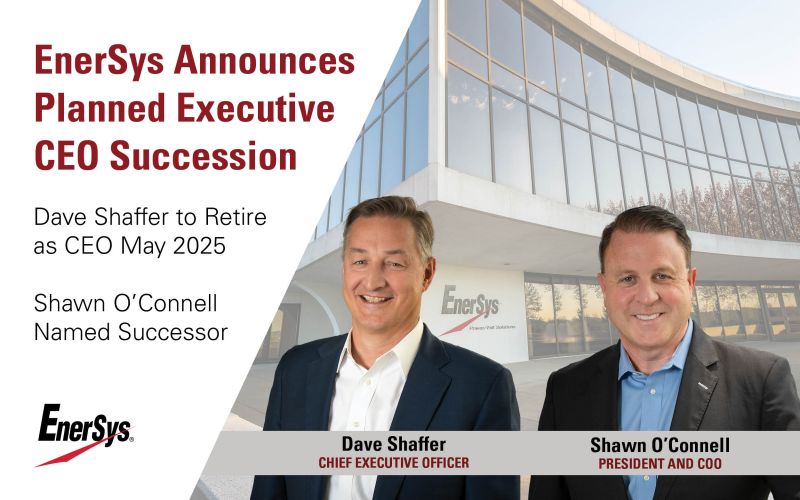
O’Connell became EnerSys’s president and CEO on May 23, 2025. By then, he had known the company for more than two decades, first from outside and then from within. His route to the top had taken him through a reseller business, sales and marketing, industrial vehicles and infrastructure power. The customer’s door turned out to be a useful entrance.
A supplier, seen from the other side
His energy storage career began in 1997. In 2003, he founded U.S. Energy Systems, a contracted EnerSys reseller in the western United States. Years before he received an EnerSys employee badge, he was working with its products through another business.
That distinction matters in an industry where the equipment has to fit somebody else’s operation. Selling a system puts a person between a manufacturer’s capabilities and a customer’s requirements. The product must make sense at the point of use, where specifications meet schedules, space and the consequences of a stoppage.
O’Connell joined EnerSys in March 2011. His early work inside the company involved sales and marketing across different parts of the business. The relationship had already lasted eight years. He arrived with an outside perspective on an organization he would eventually lead.
The literature graduate learns the whole business
O’Connell’s education includes a BA in English Literature from California State University, San Bernardino, and an MBA in International Business from the University of Redlands. His military service adds another distinct chapter: the U.S. Army’s 82nd Airborne Division, where he worked as a signals intelligence analyst and Spanish linguist.
Those details make an interesting résumé without requiring a tidy explanation for every subsequent decision. Literature did not secretly teach him battery chemistry. His public remarks suggest a more practical accommodation: respect the specialist, understand the customer and avoid confusing the chief executive’s authority with universal expertise.
Inside EnerSys, the assignments widened. Advanced Systems came first among his senior divisional roles, followed by Reserve Power sales and service in the Americas. In 2019 he took charge of Motive Power Americas. The following year his remit became global.
By November 2023, he was leading Energy Systems Global. A year later, EnerSys named him president and chief operating officer and announced him as David Shaffer’s intended successor. It was a progression through several kinds of responsibility, rather than a single specialty enlarged until it covered the company.
The succession announcement attached numbers to that preparation. EnerSys credited his Energy Systems tenure with nearly $50 million in annual cost reductions. It credited initiatives during his Motive Power leadership with 20 percent operating earnings growth and 210 basis points of margin expansion. These were company-reported business results, earned before the CEO title arrived.
The homework behind the town hall
There is a less conspicuous episode in O’Connell’s career that helps explain his approach to leadership. While running Motive Power, he pursued certification in corporate governance at UCLA Anderson School of Management. The subject included how organizations make decisions, disclose information and establish accountability.
It is easy to imagine governance remaining safely inside a course binder. O’Connell connected it to the routine of informing colleagues. He described quarterly town halls for a team then numbering more than 1,700, intended to explain what the board and senior leadership were considering.
The relationship between those two activities is practical. Giving people discretion works better when they understand the direction. A town hall can become another meeting to attend; it can also give someone far from the executive office the context to make a useful decision. His stated aim was alignment across business levels, with the team moving together.
“friends don’t let friends down”
Shawn O’Connell, discussing customer relationships, March 2026
The customer has a bigger problem than a battery
In a March 2026 conversation with Jefferies, O’Connell described customer relationships in the language of friendship and family. The phrase above could sound sentimental until placed beside the environments he was discussing. When power continuity matters, a supplier’s promise carries an operating consequence.
His examples were concrete. A warehouse operator has limited options for finding more power. Batteries and energy management have to work alongside the forklift fleet. A broadband operator needs to expand capabilities while managing energy consumption. Customers are buying equipment, but they are trying to keep an operation viable.
There is a useful discipline in that way of describing a market. It begins with the person who needs the system to work. The chemistry, charging equipment and controls follow from the application. A customer has little reason to admire an elegant component if the larger operation cannot do its job.
energy+Power
electronics+Software &
monitoring+Service &
support
Different applications require different combinations. The operating result is what the customer experiences.
In his public posts, O’Connell has similarly encouraged a broader conversation about batteries: conversion equipment, monitoring, technical expertise and service all matter. That is a commercially useful position for EnerSys, and it also reflects the outside-in path of his own career.
Three businesses, organized around the work
In May 2026, EnerSys announced that four operating segments would become three. The new names were Network & Infrastructure Solutions, Industrial Mobility Solutions and Precision Power Solutions. Each described a group of customers and applications.
Network & Infrastructure brought together the work serving communications, data centers and utilities. Industrial Mobility combined the former Motive Power business with Transportation, joining forklift and material handling applications with transport needs. Precision Power covered aerospace, defense and specialized products.
O’Connell explained the combination of lift truck and transportation businesses in terms of alignment, cross-selling and deeper relationships with warehousing and logistics customers. Aerospace and defense would receive clearer visibility. An organization chart is rarely gripping reading, but it reveals where a chief executive wants colleagues to look.
Here, the emphasis was on following the customer through design, implementation and ongoing performance. The names placed the intended outcome in view. They also gave O’Connell a structure against which his language about focus could be judged.
The revealing choice to build something smaller
A more tangible expression of that focus arrived in July 2026. EnerSys revised its planned lithium cell facility in Greenville, South Carolina. The initial capacity would be approximately one gigawatt-hour, compared with an earlier plan for roughly four to five.
The revised purpose was more specific: aerospace, defense and specialized industrial applications requiring a secure supply chain. EnerSys estimated approximately $500 million of net investment and described a revised federal grant of about $150 million, subject to final documentation and conditions.
This remained a future factory. Construction was anticipated in the first half of fiscal 2028, subject to approvals and other conditions, with full production expected about three years after construction began. The distinction between a plan and a working plant deserves to survive even the most attractive presentation slide.
For O’Connell, the decision makes the strategy legible. A smaller initial facility can be evaluated against a more clearly defined customer requirement. Capacity alone tells only part of the story; the intended application explains why the company wants to make the investment.
The next test is in the operating details
By August 2026, EnerSys’s first-quarter fiscal 2027 results offered an early view of the business under his leadership. Sales were $935.6 million, up 4.8 percent from the comparable quarter. Growth in data centers, communications, aerospace and defense helped offset a delayed recovery in material handling demand.
O’Connell pointed to the company’s diversified business and its EnerGize strategic framework. The mix matters: customers do not all move through their spending cycles together. Leading across those markets means paying attention to their differences while finding useful capabilities they can share.
October brought another operating decision. Navi Grewal became chief digital, AI and information officer, reporting to O’Connell. Her responsibilities include global business systems, cybersecurity, enterprise data and an AI strategy. He connected the appointment to simpler operations, productivity and better decisions.
The work inside the company has to support the promises it makes outside. Information systems can help people see a problem, coordinate a response and decide what to do next. For a chief executive asking colleagues to take responsibility, the quality of those tools becomes part of the job.
His sustainability message adds another measure of intent: efficiency, resilience and operational excellence are priorities he wants embedded across the enterprise. They are substantial ambitions for an organization whose products serve many different environments. They will be tested through repeated decisions about investment, manufacturing and how people work together.
O’Connell’s career supplies an unusually grounded vantage point for that test. He has been the reseller, the employee and the divisional operator. Now he has the executive title and the responsibility for choosing where the company goes. Around him are people who know the specialist answers. Keeping that arrangement productive may be the most consequential system he runs.