The interesting thing about Briggs & Stratton’s 100 millionth engine is where it was made. In July 2026, the company celebrated that number at its Poplar Bluff, Missouri, factory. One plant, operating since 1989, had produced roughly a fifth of all the engines the company says it has built in America. That is a remarkable amount of repetition. It also makes the company’s other ambition, selling batteries, more interesting.
- The work: engines, outdoor equipment, commercial batteries and home backup power.
- The reset: a $550 million bankruptcy asset sale to KPS in 2020.
- The wager: customers will still need help applying power when the power source changes.
For a homeowner, Briggs & Stratton might be the name on a mower engine. A landscaper may know Ferris or Billy Goat. An equipment manufacturer might buy a Vanguard power system. These are different purchases, connected by an unglamorous question: will this machine do its job when somebody needs it?
01 / First, make the engine lighter
Inventor Stephen Foster Briggs and investor Harold M. Stratton founded the business in 1908. Early small engines found work in washing machines, cultivators and generators. The company also produced the Motor Wheel, which could motorize a bicycle. Before the familiar suburban soundtrack came a fairly eclectic collection of chores.
The useful turning point arrived in 1953: a lightweight aluminum engine. A lawn mower has to cut grass, certainly, but someone also has to push it. Reducing the burden of the engine made the whole machine easier to handle. This was engineering aimed at the experience of doing the work.
That distinction helps explain today’s portfolio. Briggs & Stratton supplies power to other manufacturers and sells finished equipment through its own brands. Parts, maintenance products and service support extend the relationship beyond the original sale. Its expertise includes the awkward business of fitting a power source to an actual machine.
02 / The machinery kept its value. The finances didn’t.
A long manufacturing history did not protect the balance sheet. Briggs & Stratton entered Chapter 11 in July 2020. EY, which advised the predecessor company, describes mounting debt followed by pandemic disruption. Sales suffered, inventory rose and liquidity tightened. The operating squeeze arrived at a business already carrying too much financial weight.
The distinction matters. An engine design can remain useful while the company that owns it runs out of financial room. Efforts to improve cash flow and pursue strategic alternatives preceded the bankruptcy. COVID-19 made execution harder. This was a financial and operational crisis, not evidence that every customer had stopped needing an engine.
Aggregate asset purchase price, with adjustments and assumed liabilities. A historical transaction - not today’s valuation.
KPS acquired substantially all of the predecessor’s assets through the bankruptcy sale. The announcement described an acquired business freed from more than $900 million in legacy obligations. Those figures measure different things; subtracting one from the other would tell you very little. The consequential change was a new ownership and financial structure around an operating business.
03 / One battery. Three machines.
The electrical expansion became tangible in 2021. Briggs & Stratton bought a minority stake in Accelerated Systems, which develops electric drive and control systems, then acquired energy-storage company SimpliPhi Power. The latter deal’s price was undisclosed. These were specific additions to its capabilities, rather than a declaration that combustion was finished.
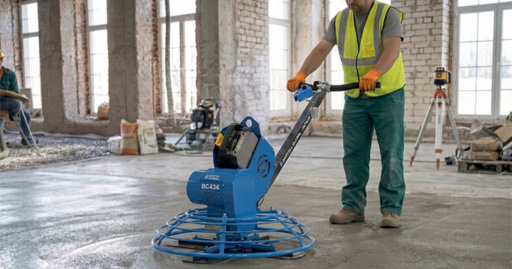
Consider Bartell Global. In May 2026, Vanguard announced that its 48V, 1.5kWh Si1.5 swappable battery would power two Bartell trowels and a plate compactor. For a contractor, sharing a battery platform across machines offers a practical attraction: fewer separate power arrangements to manage as work moves around a site.
Compatible Bartell equipment announced May 2026. Not a universal battery interface.
For an equipment maker, buying the power system can also narrow the engineering task. It can concentrate on what the machine does, while working with a supplier on how to power it. The June 2026 partnership with i3 Product Development makes that division of labor explicit: battery hardware comes with access to integration expertise.
Other customers expose other needs. Classen selected the same platform for a turf rake. FIRSTGREEN uses Vanguard’s larger Fi7.0 battery in its MiniZ loader. The applications differ, but both require more than a battery specification. Packaging, controls, durability and engineering support determine whether a machine becomes useful equipment.
“This is an important technology investment for Briggs & Stratton”
Steve Andrews, then president and CEO, on the Accelerated Systems investment, July 2021
There are limits to the proposition. A shared battery helps within a compatible fleet; it does little for incompatible machines. Charging access, spare packs and workload still matter. Vanguard’s October 2026 Rental E-Summit focused on integration and fleet deployment, a useful acknowledgement that electrification has operational homework.
04 / The lights are another business
At home, the problem changes from moving a machine to keeping electricity available. Briggs & Stratton offers standby generators and SimpliPHI storage. A generator produces electricity from fuel; a battery stores energy supplied earlier. That difference determines how each serves a household during an outage.
The SimpliPHI 6.6 separates the battery from an external inverter, allowing storage capacity and power output to be sized separately. Its RapidStak connections simplify assembly between modules. The installer still has to design a compatible system. An appealing battery stack does not, by itself, establish how long a particular home can run.
For buyers, the sensible comparison begins with the job. A contractor needs a machine that fits a working day. A homeowner needs specified loads covered for an intended duration. In either case, purchase price is only one consideration alongside installation, charging or fuel arrangements, maintenance and local support.
Competition follows the application. Generac and Cummins are alternatives in standby power; Tesla and Enphase compete in home storage. Honda and Kawasaki are engine alternatives. Briggs & Stratton’s breadth gives it several routes to customers, although breadth alone does not establish better performance or a lower installed price.
05 / Keep the customer. Change the power.

Kristina Cerniglia became CEO in July 2024, after serving as CFO and interim CEO. By September 2026, the company was also expanding its Google Cloud partnership for supply-chain work. The announcement described employee-built agents and easier access to operational data. These are company-reported initiatives, not proof of a completed transformation.
The lesson worth copying is modest: carry useful customer knowledge into the next product. Briggs & Stratton already understands equipment makers’ need for integration and support. Batteries create another opportunity to supply both. Poplar Bluff’s engine milestone keeps the ambition in perspective. The company is serving an enormous existing business while learning what else its customers will buy.