Taking over a family business is an unusual kind of promotion. The job comes with a balance sheet, a customer list and somebody else’s history. When Ryan McMonagle became chief executive of Custom Truck One Source on March 20, 2023, the history belonged to Fred Ross and the family that had started the Kansas City truck business in 1996. McMonagle had one useful advantage: he had spent the previous eight years working there.
He had arrived as chief financial officer, moved into operations, and become president. By the time he took the top job, he had already occupied three different positions from which to understand the same company. The succession announcement was a change in authority. His introduction to the business had happened years earlier.
There is something pleasingly practical about this arrangement. A company that supplies bucket trucks, digger derricks and other specialized equipment allowed its next leader a lengthy period of assembly. No ribbon-cutting ceremony could substitute for that preparation. Nor could a business-school degree, although McMonagle had one of those too.
Eight years beside the founder
Custom Truck began in a three-bay Kansas City shop. The Ross family built a business around vehicles adapted to the needs of people doing particular jobs. A contractor working above a power line and a crew working along a railroad may both need a truck. The resemblance becomes less useful once the work begins.
By McMonagle’s arrival in 2015, Blackstone had invested in the enterprise. His first title placed him in charge of finance during a period of expansion. In 2017, he became chief operating officer. President followed in 2021, the year the combination with Nesco Holdings brought Custom Truck onto the public market.
Those steps enlarged the assignment. Keeping track of a business and running its operations bring different responsibilities; combining companies adds another set. In his first CEO message in the company’s 2023 environmental, social and governance report, McMonagle described the Nesco combination as having doubled the rental fleet and added several hundred employees. Integration was a substantial part of the work surrounding his promotion.
The board announced the succession in December 2022, ahead of its March effective date. Ross would remain involved as Founder, assisting the transition and taking on special projects. That gave the handoff a clear date while preserving a role for the person whose experience had shaped the company.
McMonagle’s stated priorities were recognizably continuous with that history: customer service, opportunities for employees to develop, and a stronger position in North American specialized equipment. The promise was to build on an existing business. That is a considerable enough assignment without adding a theatrical reinvention.
Burgers, speakers, bucket trucks
The route that brought McMonagle to Kansas City makes a more varied reading list than the usual single-industry executive biography. He began at Bain & Company. He later served as chief financial officer and chief development officer of Smashburger. Consumer electronics followed, through finance leadership at Sound United and DEI Holdings.
At the audio business, his responsibilities included the continuing integration of Polk Audio, Definitive Technology and Directed Electronics. These were businesses with their own products and identities. His work concerned how they fit together. When he later joined an expanding truck company, the nouns changed rather more than the organizational problem.
Restaurants, speakers and vocational trucks do not share much shelf space. They do share the need for decisions about capital, operations and growth. McMonagle’s career invites that comparison without requiring the unlikely claim that serving a burger teaches someone how to build a bucket truck. The transferable work sits in the organization surrounding the product.
His formal education included a bachelor’s degree in finance from Southern Methodist University and an MBA from Harvard Business School. SMU also supplied a connection more enduring than a line on a résumé: he met his wife, Lauren, there.
The family’s geography was similarly varied. Before their move to the Kansas City area in 2015, Ryan and Lauren had lived in Dallas, Boston, Denver, Santa Fe and Encinitas. The move to the area coincided with his arrival at Custom Truck. A new corporate chapter and a new home appeared on the same page of the calendar.
- 2015Chief financial officer
- 2017Chief operating officer
- 2021President
- 2023Chief executive officer
Four roles. Eight years inside the business before the CEO appointment.
The work after the sale
One revealing example of McMonagle’s work concerns something less photogenic than a new truck. In 2024, he discussed the opportunity in aftermarket parts and service. Custom Truck already rented and sold equipment. The question was how deliberately to pursue the needs that continued after a customer had acquired it.
He brought in Maven Associates to examine the market and develop an implementation plan. The engagement covered choices about which opportunities to pursue and how to turn those choices into operations. It lasted 12 weeks. The implementation, he explained, would take considerably longer.
His verdict was succinct: “This was a good project, with good results.” As executive endorsements go, it leaves little for a copywriter to inflate. Its appeal is the emphasis on usefulness. A recommendation needs a route into the business, and that route needs people, capacity and time.
The episode offers a concrete view of his operating agenda. Selling or renting another piece of equipment is an immediately visible event. Improving support for equipment already working in the field is a continuing assignment. Both belong to a company offering customers several ways to acquire, use and maintain a specialized vehicle.
For the customer, these stages occur across the working life of an asset. For McMonagle, they create a coordination problem inside one organization. The service department cannot be merely an agreeable sentence in the sales pitch. It has to function when the truck needs attention, which is seldom scheduled for the convenience of a presentation.
“It all starts with the trucks.”
Ryan McMonagle, ACG Kansas City presentation
A business that has to weather the calendar
The first year of his tenure brought a favorable headline. Custom Truck reported approximately $1.87 billion in 2023 revenue, a record for the company. Yet the following year illustrates why a leadership story needs more than the number attached to a promotion.
In his letter to shareholders about 2024, McMonagle described an unexpected slowdown in utility markets during the first half, followed by improving rental conditions and strong equipment sales later in the year. It was an uneven period inside a business exposed to customers’ project schedules.
Long-term infrastructure needs do not arrange themselves into tidy quarterly intervals. Customers can require more equipment over time and still delay decisions within a particular year. The fleet, inventory and workforce have to be managed through that gap. This is where a finance background and an operations background meet in the same chair.
By the second quarter of 2026, the reported figures had improved. Revenue reached $563.4 million, up 10.2 percent from the corresponding quarter a year earlier. Average rental fleet utilization was 81.6 percent, compared with 77.6 percent. Those percentages describe the fleet working harder as demand strengthened.
McMonagle connected performance to demand in electric transmission and distribution. The company raised its full-year revenue outlook to $2.1 billion-$2.2 billion. That was guidance, with the year still unfinished, rather than a completed result. His accompanying priorities included managing working capital, generating cash and reducing leverage.
Those priorities deserve a place beside the growth figures. Equipment costs money before it earns money. A larger fleet creates possibilities, along with obligations. The executive’s job includes judging how much capacity to add and how much financial flexibility to preserve. An expanding market does not make those choices disappear.
The next chapter has a Kansas City address
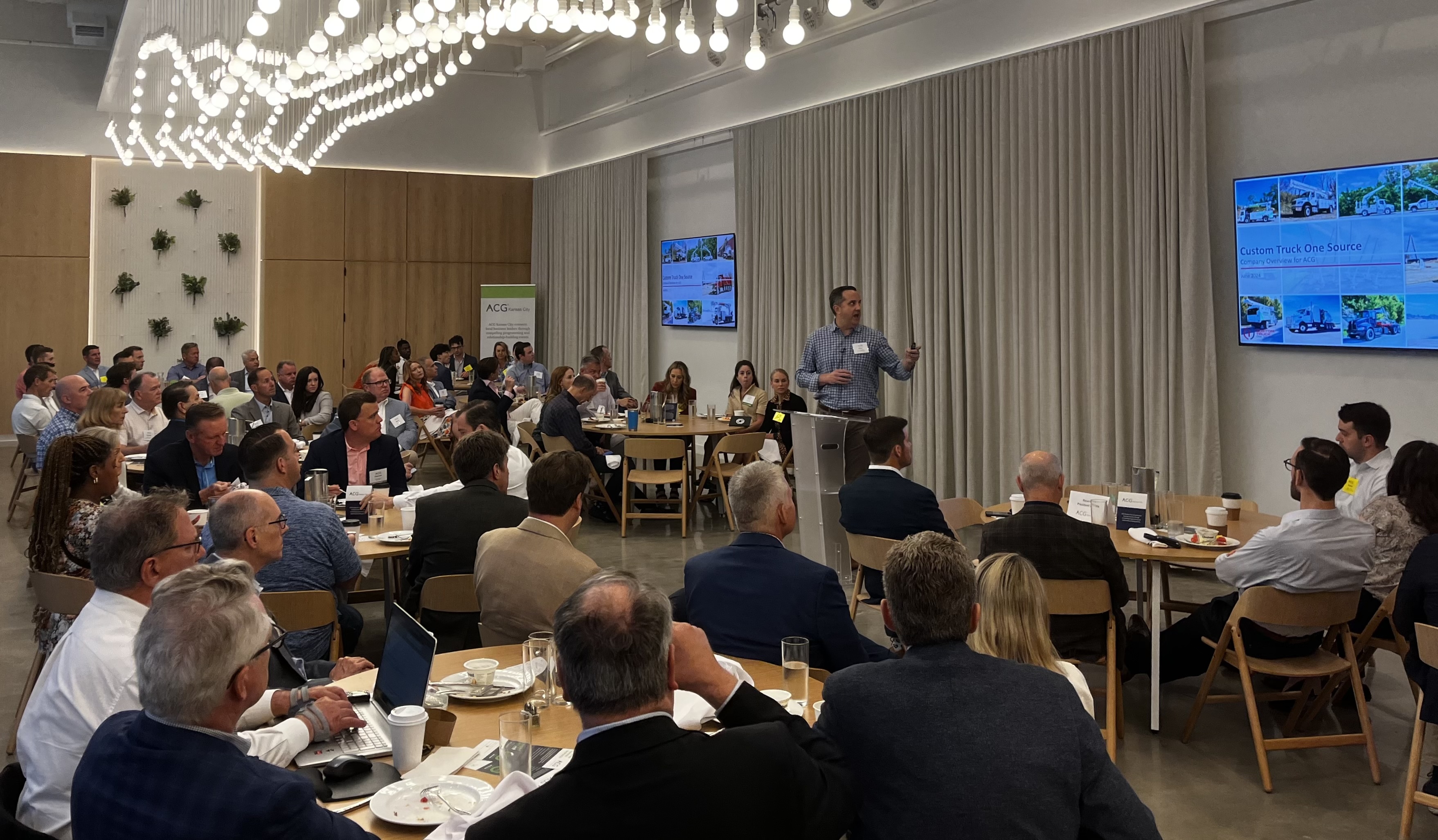
McMonagle’s presentation at an ACG Kansas City breakfast in June 2024 put the company’s story before a local business audience. The event photograph catches him beside screens filled with trucks, facing tables of listeners. A career with stops across the country had brought him to explaining this particular business to this particular city.
The local attachment has a civic expression too. He serves on the board of trustees of United Way of Greater Kansas City. It is a separate responsibility from leading Custom Truck, and a reminder that his public role extends into the community where he and his family settled.
In 2026, the company’s growth plans pointed homeward again. A proposed $42 million Kansas City expansion included renovation of an existing industrial property into manufacturing space, with more than 200 additional jobs expected. Those were plans, with future work attached, rather than a completed opening.
That distinction fits the larger story. McMonagle took responsibility for a company whose history was already substantial. His own preparation involved years of finance and operating work, followed by the patient accumulation of responsibility inside Custom Truck. The next chapter involves the same tangible ingredients: people, space, equipment and the customers who need them.
A successor can inherit a title on a single morning. Learning what to do with it generally takes longer. In McMonagle’s case, the learning had an eight-year head start.
Follow the story
Custom Truck One Source · Ryan on LinkedIn · Company videos on YouTube