Tim Knavish arrived at PPG with an engineering degree and an insufficient wardrobe. The job required a suit and tie every day. “I had one suit,” he recalled. More suits had to be purchased. It is a pleasingly practical beginning for someone who would eventually run the company: before the grand questions of corporate strategy came the smaller question of what to wear on Tuesday.
He joined in 1987, in the flat glass business. The chief executive’s job arrived in January 2023. Thirty-six years is a considerable interval between joining an organization and receiving its keys. In Knavish’s case, those years contained factories, supply chains, coatings businesses and repeated changes of address. His career moved around even when the employer stayed the same.
Now chairman and CEO, he has a more uncomfortable assignment than learning the place. He must decide which parts deserve further investment and which should leave. A long apprenticeship gives those decisions context. It also means that the business being rearranged is full of places and people he knows.
A Pittsburgh education, continued
Knavish grew up in the Pittsburgh area, graduated from Baldwin High School in 1983 and went to the University of Pittsburgh. His mechanical engineering degree came in 1987; an MBA followed in 1993. The education and the employer share a city, but the resulting career would require considerably more travel than a trip across town.
The early jobs were the sort that make production tangible: process engineering, technical services, operations planning, scheduling and production supervision. In 2000 he became plant manager at PPG’s architectural coatings facility in East Point, Georgia. By 2004 he was directing manufacturing and supply chains globally for automotive refinish coatings. Each move changed the problem he was responsible for solving.
Australia followed in 2005, with responsibility for coatings in Australia and New Zealand. Then came automotive coatings in the Americas, protective and marine coatings, industrial coatings and architectural coatings. His later responsibilities stretched across regions and included digital and information technology. A résumé this crowded requires the reader to stop occasionally for water.
- 1987Engineering
Flat glass - 2000Plant leadership
East Point, Georgia - 2005Country leadership
Australia & New Zealand - 2023Chief executive
Then chairman
The sequence helps explain why Knavish is an interesting industrial executive. The businesses differ, but the work keeps returning to production, delivery and customers. A shipment can be late in any language. A coating has to work on the customer’s line. The increasing size of a title does little to abolish such facts.
Knowing a company well enough to change it
Knavish became chief operating officer in March 2022, joined the board that October and succeeded Michael McGarry as CEO at the beginning of 2023. The chairmanship followed on October 1. In announcing that appointment, the board emphasized his knowledge of PPG and his ability to connect management with directors. The insider’s familiarity was central to the case for giving him the job.
What followed included a deliberate narrowing of the portfolio. In December 2024, PPG completed the sale of its architectural coatings business in the United States and Canada to American Industrial Partners at a transaction value of $550 million. A business responsible for roughly $2 billion in 2023 sales was leaving the group.
That was a substantial change in the company’s relationship with familiar paint brands and retail channels. It also belonged to a broader set of decisions. PPG completed the sale of its silicas products business to QEMETICA in November 2024, following a strategic review announced earlier that year. This was a leadership team making choices about the boundaries of the company.
The process carried costs for employees. In October 2024, PPG announced a multiyear restructuring program affecting approximately 1,800 positions, primarily in the United States and Europe. The company linked the program to structural costs, business conditions and its changing portfolio. Those job cuts belong in any account of the period alongside the investment announcements.
For Knavish, the personal complication is plain enough without inventing his private feelings. He had spent much of his career learning PPG’s businesses. Leadership now required deciding how those businesses should fit together. Knowledge can help a chief executive make a choice; it cannot spare the people affected by that choice.
The clock inside a can of paint
A useful place to understand his approach is the customer’s working day. Paint has a color, a formulation and a price. It also has an application process. Matching, mixing, spraying and curing occupy time, equipment and people. Change one part of that sequence and the consequences can extend beyond the material itself.
At PPG’s Coatings Innovation Center in Allison Park, Pennsylvania, a 2025 analyst event put that argument into products. The demonstrations included an automotive application system designed to avoid overspray, coatings that reduce energy requirements and a digital ecosystem for refinish shops. The common concern was how customers get their work done.
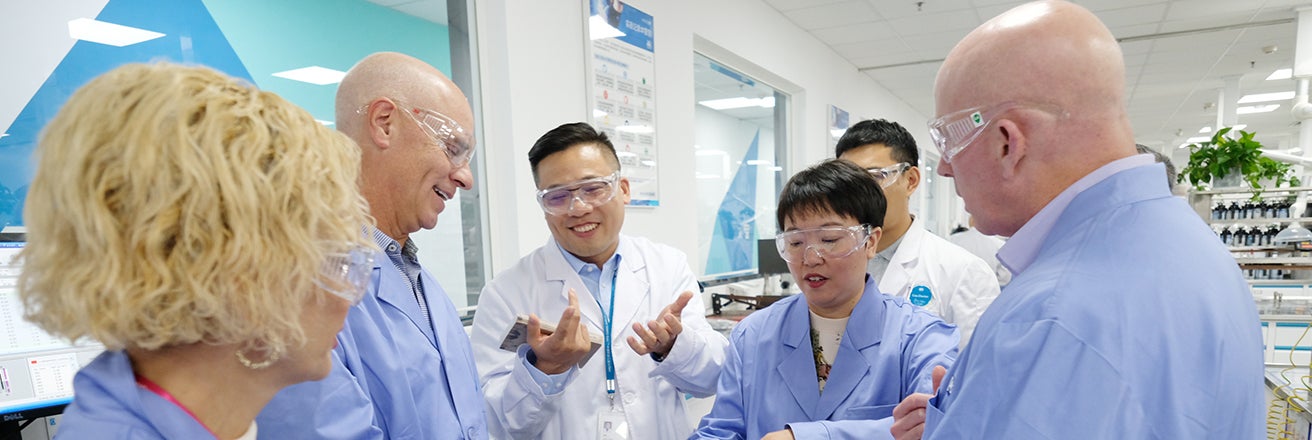
This gives the strategy a useful test. A chemical improvement should be able to explain its place in a production process. A digital tool should make some part of a customer’s work easier. An elegant presentation is pleasant; a shorter queue of unfinished work has a more immediate audience.
In his message accompanying the 2025 Sustainability Report, Knavish described PPG’s use of digital twins to evaluate promising chemistries before laboratory work. He also identified an automotive refinish clearcoat as the company’s first product developed using AI and machine learning to meet full commercial specifications. Here, the technology discussion ends with a material someone must apply.
His stated ambition is to use those capabilities to shorten development cycles and bring products to customers more efficiently. The link between energy use and productivity matters to that argument. Faster curing can be valuable in a shop’s schedule as well as in its energy bill. The science must answer to both.
A process diagram, not a time comparison: chemistry, application methods and digital tools can address different steps.
PPG reported that products it classifies as sustainably advantaged accounted for 43% of 2025 sales. That category uses the company’s own methodology, including environmental improvements relative to benchmarks. The definition matters. So does the distinction between a reported result and a future target. Its 2030 goal is 50%.
Room for more airplanes
Aerospace gives the investment story a physical address. In May 2025, PPG announced a $380 million coatings and sealants manufacturing facility in Shelby, North Carolina. The planned site covered 62 acres, with a 198,000-square-foot facility expected to employ more than 110 people. Completion was expected in the first half of 2027.
The announcement described capacity, warehousing and transport links as part of serving growing demand. For an executive with manufacturing and supply chain experience, these are familiar ingredients. An attractive market still needs actual production. Orders have to become material, and material has to reach the customer.
Planned aerospace coatings and sealants facility in North Carolina. Expected completion: first half of 2027.
By July 2026, PPG was reporting its sixth consecutive quarter of organic sales growth. Second-quarter net sales reached $4.495 billion. Organic growth was 4%, divided equally between higher volumes and higher selling prices. The company reported growth in eight of nine businesses, with aerospace among the drivers.
The earnings figures add necessary texture. Reported earnings per share from continuing operations were $1.96, compared with $1.98 a year earlier. Adjusted earnings per share were $2.23, compared with $2.22. Rising sales and nearly flat adjusted earnings can occupy the same quarter. A profile of the CEO should leave room for both.
The result keeps the question open: how much of the portfolio’s promise will become sustained earnings growth? Knavish has made decisions about where to concentrate. The numbers offer a continuing test of those decisions, rather than a tidy ending for them.
The friends who predate the job title
There is another measure of continuity in Knavish’s life. In a March 2026 school alumni profile, he said his closest friends included people he had met in kindergarten more than 50 years earlier. He described himself as curious and committed to continued learning. His advice to students included building friendships and finding mentors.
“You can't do it alone!”
Tim Knavish, to students in his school district
His professional connections extend beyond PPG. Rockwell Automation elected him to its board in February 2024, citing experience in acquisitions, people leadership and global manufacturing. His other affiliations include the American Coatings Association and the Allegheny Conference on Community Development. These relationships place him among industrial and civic institutions as well as within his own company.
Pitt has recognized him from both sides of his education: its business alumni award in 2024 and the Swanson School’s mechanical engineering and materials science distinguished alumni honor in 2026. At the latter celebration, the department highlighted his progression through the enterprise. The former student had accumulated a rather extensive set of practical assignments.
There is a limit to what a promotion can explain. It records who received responsibility, while leaving the reader to ask what prepared that person for it. In Knavish’s case, the assignments offer a more revealing answer than the final title alone.
The appeal of his story lies in that accumulation. One employer supplied him with many careers. Now the engineering graduate who needed more suits must judge a business whose history he has helped make. The wardrobe problem was easier. The habit of learning, at least, remains useful.