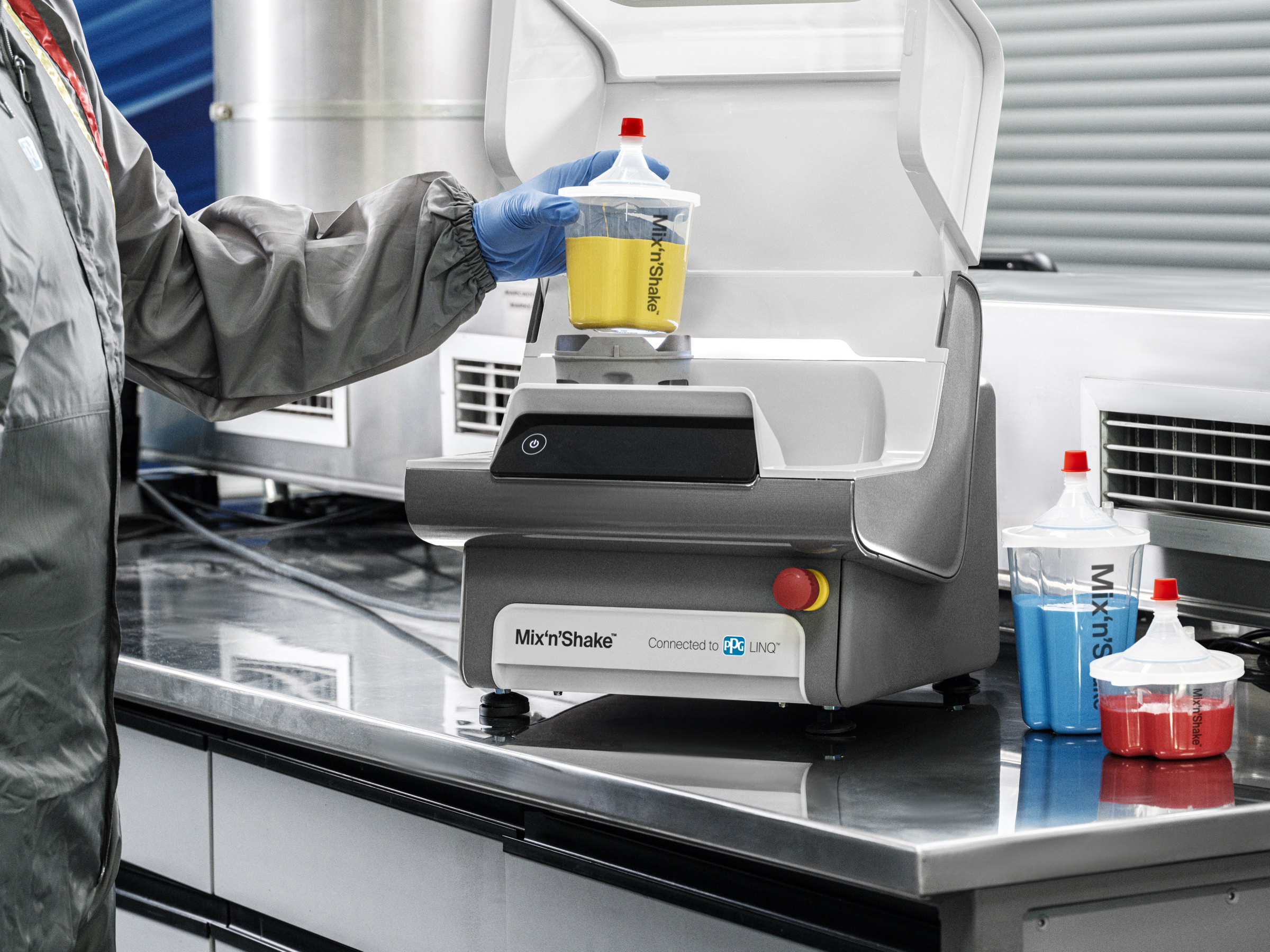
Consider the last stir. A collision repair shop has identified a car’s color, selected a formula and measured the paint. Someone still has to stir it. It is a small task, easy to overlook, repeated across working days. In October 2025, PPG introduced a machine for precisely that moment. Mix’n’Shake prepares the mixture in a cup that subsequently attaches to the spray gun. A company founded to make plate glass had found another business problem at the bottom of a paint cup.
- The business: coatings and specialty materials for vehicles, aircraft, ships, factories and buildings.
- The proposition: help customers use less material, avoid rework and keep equipment working.
- The strategic turn: leave a weak-margin house-paint business while investing in aerospace and repair-shop automation.
01 / The minutes around the material
PPG’s claim for Mix’n’Shake is specific: a ready-to-spray mixture in less than 90 seconds, with up to 6% more productive working hours, according to company data. Those are conditional benefits, not a promise to every shop. Their significance is the unit of measurement. PPG wants the buyer to think about minutes recovered, rather than simply liters purchased.
Its earlier MoonWalk system tackles dispensing and mixing. By August 2025, PPG had announced the 3,000th installation, at Wren’s Collision Group in Auburn, Alabama. Repair centers in more than 60 countries were using it. Alongside these machines sits LINQ, PPG’s collection of digital color and workflow tools. Together, they extend the sales conversation from a tin of paint into the sequence of decisions surrounding it.
02 / A very thin business, everywhere
PPG makes the layers that protect, finish or change the performance of things other companies build. Its customers include carmakers, aircraft manufacturers, ship operators, can producers, equipment makers and contractors. Its range reaches from pavement markings to optical materials. A shopper sees color. An industrial buyer also sees adhesion, corrosion resistance, curing time and consistency.
In aerospace, the offering includes sealants and aircraft transparencies as well as coatings. Packaging coatings serve cans and closures. Automotive products run from factory finishes to collision repair. Architectural paints remain part of the portfolio outside the U.S. and Canadian business sold in 2024. This breadth explains why a company associated with decorating can also matter inside a manufacturing line. PPG reported $15.875 billion in 2025 net sales. That scale rests on many specialized purchases rather than a single product everyone buys.
“We protect and beautify the world.”PPG’s stated purpose
The business model follows those different buyers. PPG sells directly to manufacturers, through distributors and dealers, and through retail and company-owned networks where appropriate. Technical service and application support help turn chemistry into a usable finish. The commercial logic is straightforward: a material that performs reliably inside a customer’s process has reasons to be bought again.
03 / The old distribution trick
John B. Ford and John Pitcairn founded the original business in 1883. Its initials preserve Pittsburgh Plate Glass. The revealing turn came in 1900, when it acquired an interest in Patton Paint. PPG’s own history gives a wonderfully practical explanation: glass and paint reached customers through the same distribution channels. A route to market became a route into a new industry.
The company adopted the PPG Industries name in 1968. Much later, in 2016, Vitro acquired its flat-glass business. Read those events together and the apparent contradiction disappears. PPG kept the initials while changing what sat behind them. The transferable idea is to examine what a company already knows about reaching customers, then ask which adjacent problem that access makes economical to solve.
Digital color tools
MoonWalk
Mix’n’Shake
Spray-gun cup
04 / When $2 billion isn’t enough
The awkward chapter is house paint in the United States and Canada. In October 2024, PPG agreed to sell that architectural business to American Industrial Partners at a transaction value of $550 million. The business had generated roughly $2 billion in 2023 sales, with a low-single-digit EBITDA margin. Sales were substantial; the earnings left behind were much less impressive.
That margin is the clearest answer to what stopped working. Management publicly framed the exit around improving growth and financial returns, then completed it in December. The accompanying cost-reduction program initially contemplated about 1,800 affected positions and approximately $250 million in fourth-quarter pretax charges. Portfolio changes have an operational bill, paid through factories, organizations and people.
Elsewhere, PPG chose to spend. In May 2025, it announced a $380 million aerospace coatings and sealants facility in Shelby, North Carolina, with completion expected in the first half of 2027. These are different kinds of dollars: sale consideration, anticipated restructuring charges and planned capital investment. Together, they show where management wanted the business to go.
- $550m
- U.S./Canada architectural sale transaction value
- ~$250m
- Initially anticipated Q4 2024 restructuring charge
- $380m
- Announced Shelby aerospace plant investment
05 / The customer’s spreadsheet
PPG competes with Sherwin-Williams, AkzoNobel, Axalta, Nippon Paint and other specialists, depending on the application. Its useful distinction is the combination of coatings, color tools, technical support and equipment. Rivals have their own systems and expertise. A buyer still needs to compare the complete process: training, application, throughput, repair quality and ongoing material consumption.
Marine coatings make the calculation particularly tangible. PPG’s silicone-based Sigmaglide 2390 is designed to limit fouling and drag. The company advertises power savings of up to 20%, while explicitly saying results depend on ship model and operating conditions. Here, a surface treatment earns its place through the vessel’s operating economics. A headline percentage alone cannot settle the purchase.

The human side matters here. PPG’s stated culture emphasizes customer partnership, employee trust and continuous improvement, supported by eight global employee resource networks. Those are the company’s descriptions of itself. For customers, the practical test is whether technical knowledge travels from the laboratory to the people who actually apply the coating.
06 / Count the bottleneck first
For a repair-shop owner, the sensible next step is a demonstration against real work. Measure mixing time, wasted material and rework, then check whether saved minutes can become completed repairs. If another stage constrains the shop, faster mixing may leave the queue untouched. Factory buyers need the same discipline around substrate preparation, curing requirements and production conditions.
PPG’s October 2026 FABTECH announcement extends that argument with primers, powder coatings and curing technologies aimed at industrial finishing. The lesson for readers is pleasingly concrete. Watch a customer work. Find the repeated inconvenience. Price the consequence. Then improve the material and the method together. The paint is visible; the value often appears on the clock.