Craig Kesby occupies an unusual pair of positions: co-chief executive of a company that connects industrial data, and vice president of a basketball association where he also referees. One role involves machines reporting what they are doing. The other involves people who are quite capable of reporting what they think the referee should be doing. Both put him close to the arrangements that let everyone else get on with the job.
At Inauro, the Sydney business he co-founded with Angus Kennard, that job is making information useful inside an operation. A machine’s location, its working hours and the contract attached to it may sit in separate systems. Bringing those details together sounds like administrative housekeeping. For someone trying to dispatch equipment or arrange a service, it can decide how the day goes.
Kesby’s public career runs through telecommunications, equipment hire and industrial software. It has a recurring practical question: once information has arrived, who can use it? A network delivers a signal. An operation needs a next step. His work has increasingly concerned the distance between the two.
A network is only the beginning
In May 2003, ITXC appointed Kesby its regional sales director in Sydney. He had previously managed IP development at Optus Communications. These were roles in the business of moving information, years before Inauro’s founding. The early career detail is a useful starting point because it places communications, rather than the rental yard, at the beginning of his documented working story.
He later held a vice president role at Ericsson Australia. His work there included industry and government engagement around the National Broadband Network. That required attention to the organisations surrounding a network as well as the network itself. By 2015-2016, his education also included the University of Sydney Business School, where he completed a Global Executive MBA.
The distinction between technical capability and organisational use follows him into his later work. A connection can be available without making a process easier. In equipment hire, that question becomes very specific: how does a piece of machinery’s information help the person responsible for it?
The rental yard’s education
At Kennards Hire, Kesby became general manager of strategic projects. He oversaw development and implementation of the company’s EasyTRAK IoT platform, along with new technology capabilities and business modelling. The work placed connected devices inside an established rental operation, where equipment, customers and paperwork already had their own schedules.
By 2019, he was describing a widening ambition. The company’s interest in IoT had developed from exploring ways to improve its own operations into finding ways to improve customers’ businesses. That broader opportunity brought more attention and resources. A machine reporting its location was becoming part of a larger conversation about how work happened.
The initial attraction of tracking equipment is easy to understand. Finding an excavator is a useful accomplishment. But location only answers one question. Usage, servicing and the surrounding business records can determine what should happen to the excavator next. The useful unit of attention becomes the whole task.
Kesby discussed enriching telemetry with other information to improve workflows. Kennards’ connected-equipment work also reached beyond conventional mobile coverage through a partnership with Fleet Space Technologies. Australia’s patchy connectivity was a practical constraint. Before anyone could make better use of a signal, the signal had to get home.
An idea leaves the depot
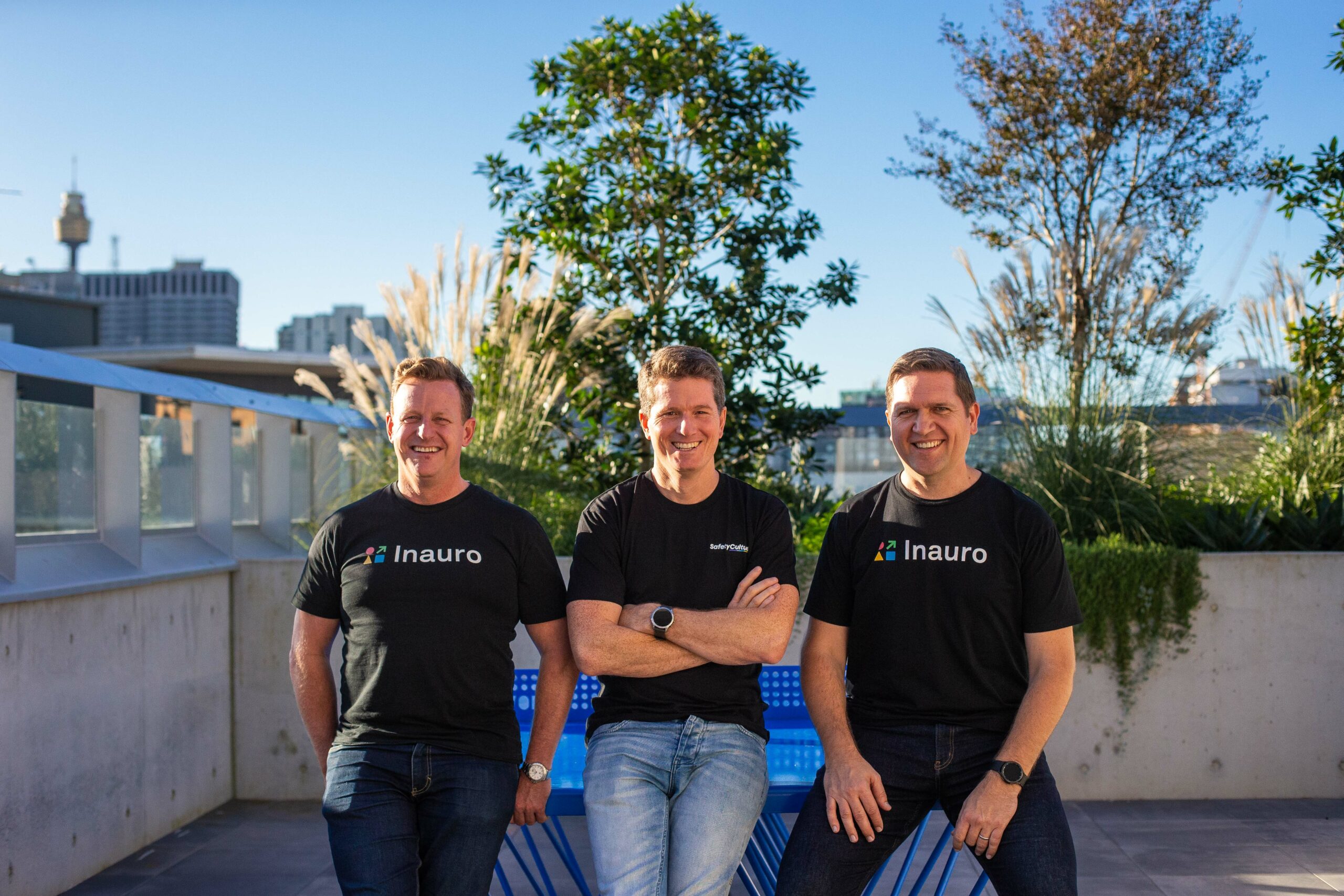
In July 2020, Kesby and Kennard founded Inauro. Kennard had been Kennards Hire’s chief executive; Kesby brought his communications and strategic-projects experience. The new business took an opportunity developed within the rental industry and pursued it as a separate technology company.
Kennard explained that interest in the software had spread beyond the business and into other industries. Inauro’s platform, Perspio, was designed to combine real-time information from different places and put recommendations into the systems people used. The founders were offering their operational experience to businesses with their own assortment of machines and software.
In 2022, SafetyCulture invested A$3 million. That was a company milestone, with a product relationship attached: Inauro and SafetyCulture were integrating their technologies. The partnership connected the data business to another company working on everyday workplace processes. Funding supplied room to develop; integration gave the development a practical destination.
SafetyCulture’s investment in Inauro, alongside integration between the companies’ products.
First see it. Then suggest it. Then do it.
In a Texada interview, Kesby described a progression with three levels: awareness, suggestion and control. Awareness means bringing information together so that people can understand what is happening. Suggestion uses that understanding to identify what could work better. Control follows when a business has enough confidence to let a particular task happen automatically.
The sequence gives human judgement a place in automation. People who know the business help establish what a useful response looks like. A system can propose something before being entrusted to carry it out. Confidence is attached to a task, rather than assumed for an entire operation.
That concern also appears in his explanation of industrial AI. He describes bringing machine and system data together so people in different roles can obtain useful information in the language of their own work. It is an ambition directed at the person trying to complete a task, rather than the person demonstrating the software.
“Industrial AI helps businesses interact with their data in a non-technical way.”Craig Kesby
Inauro’s chief commercial officer, Max Girault, has explained applications such as catching an incorrect equipment selection before dispatch. A location signal becomes more useful when it can be compared with the contract. The achievement lies in joining the details soon enough to change the action.
A quiet sensor can tell the wrong story
There is a less glamorous requirement beneath all this: the devices have to keep reporting. Kesby has warned that a business can believe it has visibility while some of its monitoring equipment has stopped working. An absent reading leaves a gap that a busy person may never notice.
His discussion of device monitoring concerns recognising those gaps and getting them addressed. A device that fails to check in can be flagged, with the issue brought into the operational process. Even the machinery that watches the machinery needs someone watching it. The repetition would be comic if the consequences were not so practical.
Networks also change. In his commentary on Australia’s 3G shutdown, Kesby pointed out that successive mobile generations have finite working lives. Businesses with older equipment had to consider the connectivity their devices depended on. A perfectly serviceable machine can carry a communications component whose surrounding network has moved on.
This is the durable, slightly awkward side of connected operations. Installing technology creates responsibilities that continue after installation. Someone must know which device is reporting, what it depends on and what to do when it stops. An impressive interface cannot supply a reading that never arrived.
Back in the rental business, at a different scale
Uphire offers one example of how Kesby’s approach meets a customer’s ambition. The rental company wanted technology to help it distinguish its service and improve efficiency. Inauro began by assessing connectivity across its equipment, with Perspio bringing information together without requiring an internal technology team.
In October 2025, Inauro announced a contract with Coates to connect fleet information and automate workflows across its branch network. The arrangement combined existing telemetry with business and maintenance systems. Customer-facing capabilities included equipment usage and fuel reporting. Kesby’s company was working again in the industry that had helped form it.
The contract followed trials with construction and mining customers. The operational emphasis was familiar: reduce background administration and give teams more room to attend to equipment use, servicing and customer uptime. The announcement described benefits from those trials, rather than publishing an audited percentage improvement. The concrete fact is the agreement and its intended work.
In March 2026, Kesby returned to a plain-language account of the same problem. Telematics itself had existed for decades. Difficulty arose when a business had several systems to administer and needed to make them useful together. The person receiving the information remained central to his explanation.
“There’s nothing particularly complex about telematics.”Craig Kesby
The other court
Basketball gives this working biography a different setting. Norths lists Kesby as vice president. His involvement includes playing, refereeing and helping coach and manage teams. His family participates too. This is an association he experiences through several roles, including one in which a decision can receive immediate and enthusiastic feedback.
In his 2021 board nomination, he set out priorities including facilities, court access, developing referees and improving how the association operated. He wanted participants to have a voice and more people to have opportunities to play. Corporate support and sponsorship were part of his thinking about member fees.
Those ambitions have an everyday texture. More court access means room for participation. Referee development helps a competition function. Supporting the organisation involves details that people may notice most when they go wrong. The current board biography continues to emphasise referee support, game-day experience and facilities.
There is a useful connection between these two parts of his public life, without pretending a rental yard and a basketball court are interchangeable. Both make his priorities visible through specific work. At Inauro, that work joins information to an operational response. At Norths, it supports the people and arrangements that let a community play.
Kesby’s career gives the space between knowing and doing a practical shape: a network, a hire fleet, a software connection, a referee ready for a game. Each depends on more than information being available. Someone has to arrange what happens next. That is where his public work keeps returning.