Southern Nevada Health District had a problem that no spreadsheet could charm away. During the pandemic, it needed to hire 100 people in 30 days. Applications, scoring, and hiring still depended on manual entry and spreadsheets. The machinery of recruitment was consuming the time that recruitment was supposed to save. A public health emergency had made an ordinary administrative inconvenience suddenly consequential.
- The job: connect the people processes behind public service.
- The evidence: one health district reported 130-day hiring falling to 61 days.
- The catch: staff adoption took persuasion, too.
NEOGOV’s customer case study reports that the district subsequently cut time to hire from 130 days to 61 over eight months. The useful detail comes after the improvement: employees resisted changing how they worked. Analytics helped show the effort imposed on recruiters and candidates, making the argument for adoption more tangible. The purchase of software and the acceptance of software were two separate events.
The rules are part of the product
NEOGOV occupies the space between a government’s promise to serve people and its ability to employ them. Its customers include government agencies, educational institutions, and public safety departments. They need to recruit, pay, train, evaluate, and retain employees while keeping records of what happened. The work sounds universal. The details get wonderfully particular.
Consider a ranked eligibility list. Or a canvassing letter. Neither sounds like the opening act of a technology company. Both appear in Insight, NEOGOV’s applicant tracking product. Insight supports minimum-qualification screening, applicant scoring, and civil service hiring workflows. These are the little procedural obligations that can make a general recruiting system feel like a suitcase packed for somebody else’s trip.
That specificity is NEOGOV’s pitch. It competes in human capital management, alongside alternatives such as Tyler Technologies’ Enterprise HR Management and Workday’s government offerings. Tyler connects HR with its public-sector ERP; Workday offers a broad cloud HCM platform. NEOGOV emphasizes the recurring requirements of public employers. The buying question is which system fits an agency’s rules, existing software, and capacity to implement it.
- 01ApplyInsight
- 02ArriveOnboard
- 03WorkHRIS
- 04DevelopLearn + Perform
Different jobs for the software. Fewer handoffs for the humans.
The product family follows the employee. Attract helps build candidate relationships; GovernmentJobs.com supplies a public-sector job board. Onboard handles forms and assigned tasks after hiring. Learn manages training, Perform supports evaluations, and eForms and Policy address documents and procedures. These products give an agency several possible entry points rather than requiring every purchase to start with payroll.
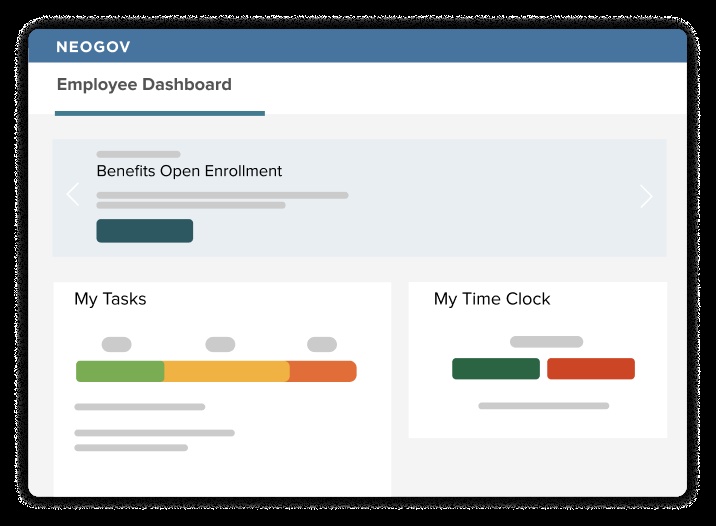
HRIS connects core employee records, benefits, timekeeping, and payroll. Its public-sector details include bargaining-unit eligibility rules and grade-and-step compensation structures. Employees can view paystubs, request time off, or change direct-deposit information. A useful system lets an employee answer a small question without generating another small task for HR.
The expensive part is making it work
NEOGOV sells software subscriptions with scoped services and implementation. A public record from Banning, California, makes the economics unusually concrete. Its 2023 HRIS amendment covered March 28, 2023, through June 30, 2026, for $371,537.71. Of that, $133,200 was implementation. This was one city’s purchase with its own scope and incentives.
Banning already used NEOGOV for recruiting, hiring, and onboarding. City staff argued that keeping employee data in NEOGOV and transferring financial data to NetSuite for Governments made integration easier. The report also acknowledged that combined maintenance costs would rise after initial incentives. Convenience had a price, and the city put the tradeoff on paper.
“We serve the people who serve the people.”
NEOGOV’s stated mission
The Southern Nevada experience adds another budget item, even when it never appears on an invoice: attention. Someone must explain the change, teach the process, and show employees why it is worth learning. A dashboard can reveal delays. People still have to agree to act on what it reveals. That is a management task with a software component.
Follow the next handoff
Founded in 2000 by Ward Komers and Damir Davidovic, NEOGOV has expanded beyond its recruiting roots. Warburg Pincus invested in 2016; Carlyle joined a growth investment in 2021. EQT and CPP Investments announced an agreement to acquire the business in July 2025. CPP subsequently reported investing approximately US$700 million for a minority position. NEOGOV now identifies both as its backers.
The 2026 moves show where the company sees more work to connect. It acquired PowerDetails for off-duty public safety scheduling, then Miller Mendel, maker of the eSOPH background investigation platform. There is a pleasing corporate loop here: PowerDetails began inside PowerDMS, later spun off, and returned to the broader family through NEOGOV.
In October, a HireRight integration brought background screening initiation and status tracking into NEOGOV and NEOED recruiting workflows. It requires accounts with both providers. The immediate appeal is practical: recruiters can follow screening without treating another disconnected system as an extra clerical assignment.
NEOGOV also puts practitioners in front of the microphone. Its Public Voices podcast, introduced in May 2026, pairs retired police chief Doug Shoemaker with HR veteran Nicole Carlson. Carlson began as an emergency dispatcher before moving into HR. That career path supplies a useful perspective on this market: the person processing employee paperwork may already understand the operational consequences of a vacant shift. Software advice becomes more interesting when someone has lived on both sides of the form.
Steal the measurement
The transferable lesson is to measure the waiting. Map each recruiting stage, find duplicate entry, and make the burden visible to the people doing the work. Demonstrate the improvement before expanding the rollout. NEOGOV itself describes a staged HRIS implementation, typically starting with Core HR and ending with payroll.
That approach has limits. As an operational inference, software will do less when hiring delays come mainly from frozen budgets or a shortage of qualified applicants. An agency also needs implementation capacity and agreement about its process. Southern Nevada’s numbers are a useful case, not a forecast. The question worth copying is simple: where, exactly, are the days going?