A baby monitor can show a parent a sleeping child. It has traditionally been less helpful with the question waiting at breakfast: what on earth happened last night? Nanit built its business in that gap. Its camera watches the crib; its software assembles a version of the night that an exhausted adult can read.
The distinction explains both the attraction and the bill. Live video is part of the hardware experience. A longer memory, more analysis and personalized guidance sit inside optional subscriptions. Nanit sells to the household that wants to check in from another room or another location, then return later to understand the pattern. The same camera can be a lookout, a logbook and a family album.
That is a substantial assignment for an object hanging above a mattress. It also gives this New York company a business question that grows alongside its customers’ children: once a family has settled into a routine, what makes the next year of software worth buying?
A researcher brings the camera home
Co-founder Assaf Glazer had spent years working on computer vision when becoming a father gave him a more personal subject. His son, Udi, was not sleeping conveniently. Glazer began considering how a camera could help explain infant sleep. Fellow co-founder Tor Ivry had worked with him at Applied Materials; Andrew Berman joined the founding team.
The academic bridge mattered. Glazer developed Nanit with support from the Jacobs Technion-Cornell Institute’s Runway Startup Postdoc program. Cornell Tech records the public launch on June 15, 2016, with $6.6 million in startup funding. This was an attempt to carry technical research into a familiar consumer purchase.
“Research is really the DNA of our company.”
Assaf Glazer · Co-founder, in Nanit’s founder interview
Glazer’s early customer conversations were gloriously mundane: where parents put monitors, how they used them and why they chose one model. Those observations informed the product’s overhead perspective and physical design. The transferable lesson begins there. Before asking software to interpret a room, understand how people actually arrange it.
The mount is part of the machine
The Smart Baby Monitor uses a Pro camera to deliver 1080p video, audio and notifications through Nanit’s app. Temperature and humidity readings add context. A parent can check the nursery remotely, speak through two-way audio or share access with another caregiver. These are recognizable monitor jobs, made accessible through a phone.
Sleep tracking has a stricter address. Nanit requires the Floor Stand or Wall Mount for its sleep algorithms; moving a compatible camera onto the portable Flex Stand does not preserve those analytics. A good view for a human is not automatically the view the software needs. The stand is part of the measurement setup.
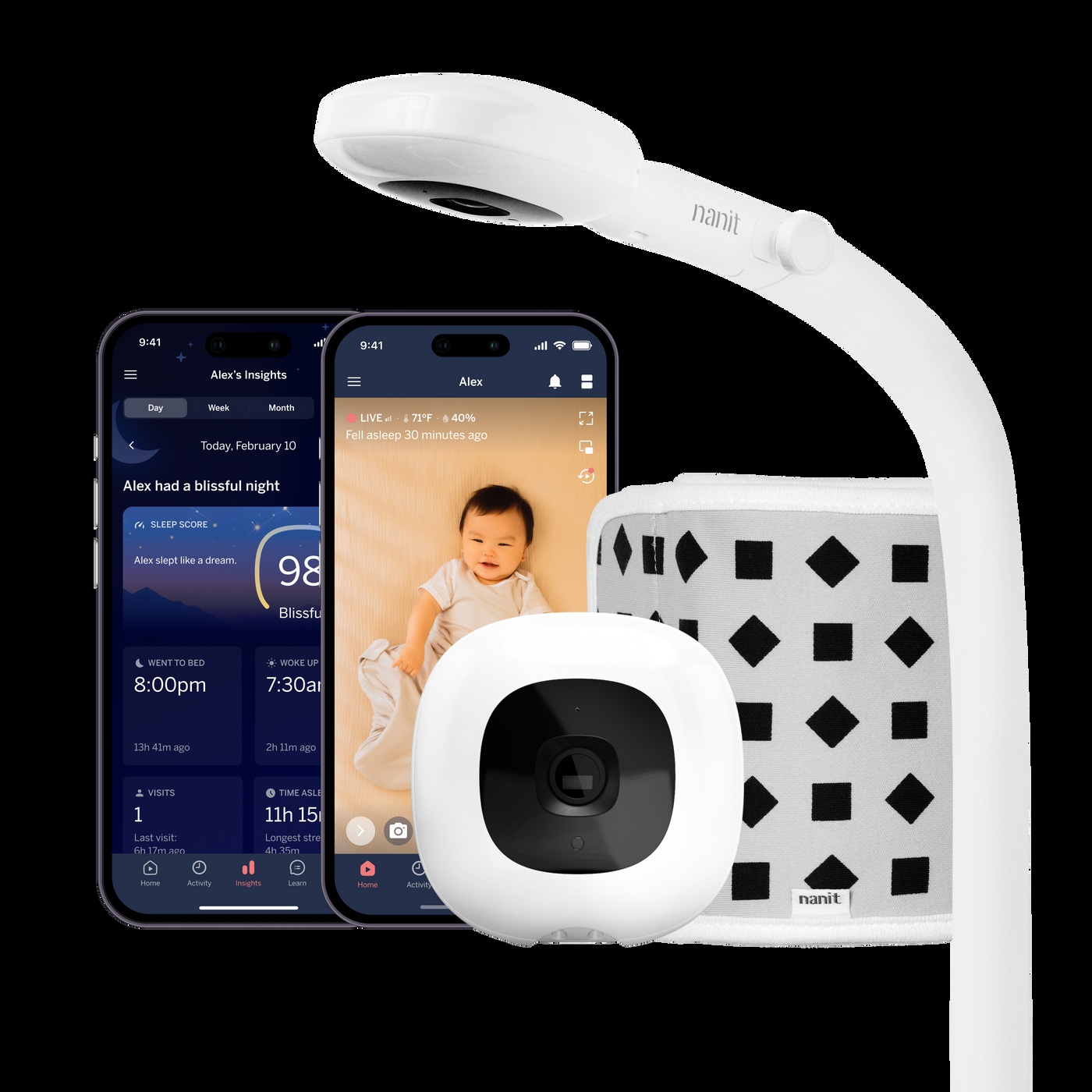
Breathing Wear adds a different trick. The camera follows movements in a printed pattern as the baby’s chest rises and falls. The band or garment contains no electronics, wires or sensors. Parents can wash it; they do not charge it. The product is wearable fabric, despite the absence of a wearable electronic device.
That distinction also separates Nanit from an alternative such as Owlet’s Dream Sock, which uses a sock sensor to report pulse rate and oxygen saturation within its specified use. Nanit’s breathing-motion reading is a different measurement. Its own labeling says the consumer product is not a medical device, does not diagnose or treat disease, and can produce false positive or false negative readings.
What the morning costs
At the September 8, 2026 check, Nanit listed the Smart Baby Monitor system from $289.99 before promotions. Its storefront was also running a temporary discount. The useful long-term calculation starts with the regular hardware price, then adds the features a family expects to renew.
The published annual Insights prices were $100 for Sleep, $120 for Memories and $300 for Milestones. These are annual bills, even when the marketing presents monthly equivalents. A three-month Sleep trial introduces buyers to the service. Core live viewing continues without a paid membership, so the subscription decision concerns what the camera remembers and interprets.
How much memory do you want?
Memories includes two days of continuous video history; Milestones extends that window to seven. Sleep-analysis history also grows with the plan. Those are separate benefits: an archive of footage is different from a record of sleep patterns. Choosing between them is easier when parents know whether they are buying a replay button, a longer trend line or both.
Some of that history has emotional value. Nanit announced its Membook service in 2020 to capture pictures, clips and special moments automatically. Today’s memberships continue that family-album proposition. A first roll can be a developmental event and a video worth sending to a grandparent. Both can make a renewal feel more useful than another set of numbers.
The newer Sleep Coach Cards make the interpretation more explicit. May 2026 documentation describes three morning cards drawn from the latest night and up to 14 days of history, pairing an observation with a practical tip. Eligibility has edges: a subscription, overhead mounting, an English-language app and a child aged two or younger.
The app acquires a living-room screen
Nanit’s Home Display gives the household an eight-inch touchscreen of its own, listed at $179 when checked. It pairs with a Nanit camera and offers a dedicated place to watch. That is a recognizable domestic convenience: a shared screen can stay available while someone’s phone goes elsewhere.
The display extends the app rather than replacing it. July 2026 support documentation describes live viewing, split-screen monitoring and a tabbed interface for activity and settings. Buyers should still check which features are available on each device. A larger screen does not make every part of a connected system interchangeable.
The company is also widening the entry point. Its Walmart-exclusive Essential camera comes with an Anywhere Stand and an advertised $199 price on Nanit’s comparison page. It retains connected video and basic monitoring, but leaves out the Smart model’s breathing-motion monitoring and personalized sleep coaching. Portability has its own pitch.
Sound + Light stretches the system into bedtime routines, offering app-controlled sounds and lighting. The business logic is easy to follow: once parents use one app for the nursery, another compatible object has less explaining to do. Still, each addition must solve a task. Compatibility alone is a weak reason to buy a nightlight.
Fifty million dollars for the years after infancy
Nanit’s capital history reflects the ambition. It announced $14 million in Series B financing in 2018, $21 million in growth financing in 2020 and a $25 million Series C led by GV in 2021. The last of those announcements put total capital raised at $75 million at that time. These are financing figures, not a disclosed product-development budget.
In March 2024, Anushka Salinas became CEO after senior roles at consumer businesses including Rent the Runway. Nanit’s appointment announcement emphasized her experience with subscriptions. For a company combining a physical purchase with recurring software, that background is relevant to the work ahead.

A December 2025 announcement brought another $50 million in growth capital, led by Springcoast Partners with Upfront Ventures and JVP participating. Nanit said it had served more than one million families. That is the company’s reported reach, not a count of customers paying for a current subscription.
The proposed use of the money was more expansive than better nursery video. Nanit outlined a Parenting Intelligence System, planned for rollout in 2026, to examine developmental signals including language and movement. That announcement establishes an ambition; it does not establish that every promised capability has shipped or that the system can diagnose a condition.
There is a concrete research operation behind the broader interest. Nanit’s partnership with the Sleep Research Society Foundation supported four researchers in the United States and Canada in 2025. The listed questions include parental behavior, family circumstances and sleep. They recognize that what happens in a crib has a life outside the camera frame.
A nursery is an intimate data set
The operational limits are less glamorous than the product photography, and more useful at setup. Nanit’s troubleshooting guidance says a baby sleeping for fewer than five hours can leave insufficient data for a sleep summary. Missing analysis is therefore not necessarily a mysterious algorithmic verdict. Sometimes the system lacks enough usable observation.
Connectivity and access deserve similar attention. Remote viewing needs an internet connection. Nanit describes mandatory multifactor authentication, encrypted video and adjustable caregiver permissions. Those controls matter when the viewing audience includes relatives and paid help, rather than one person holding one receiver.
Its February 2026 privacy policy identifies the company as Udisense, Inc., doing business as Nanit, and describes the information handled by the service. The practical buying question includes retention and access as well as picture quality. A cloud-based archive of a child’s bedroom is a personal record, even when its immediate purpose is checking a nap.
For households that only want local video and sound, the market offers a simpler route. HelloBaby sells dedicated monitors without Wi-Fi or an app, including models with night vision and two-way talk. They answer a narrower question. Nanit has to justify the additional account, connection and potential annual bill through what a family gains from the history.
The useful lesson is the handoff
Nanit’s product sequence offers something other businesses can copy: arrange a reliable observation, make the result understandable, then connect it to a decision. Here the handoff runs from the overhead camera to the morning summary and, for eligible subscribers, a coaching suggestion. The parent still decides what to do.
The difficult part is keeping that sequence useful as the customer changes. A newborn’s household may want different information from a toddler’s. A family may treasure video memories while losing interest in sleep analysis. Nanit’s expanding range gives it more chances to meet those changes, and more features whose value it must explain.
For the reader considering a purchase, that suggests a plain test: identify the question you expect the monitor to answer tomorrow morning. Then check the mount, membership and history needed to answer it. The camera can keep watching all night. The renewal depends on what the family takes away at breakfast.