Mukundu Kumaran once explained an advertising technology integration by talking about a three-page document. The document laid out the details of connecting C1X with MediaMath. Within a month, the team was finishing tests and preparing the launch. This was June 2016, when much of the advertising business was finding increasingly elaborate ways to describe how quickly it could do things.
Three pages. There is something pleasingly unfashionable about that detail. The software might have to negotiate an intricate world of buyers, publishers and automated auctions. The people building it still needed to agree on what they were doing. Kumaran credited MediaMath’s engagement from the start for the smooth execution. Even in a business conducted in milliseconds, somebody had to write the instructions.
That small episode offers a useful entrance to his career. Kumaran is the co-founder and CEO of C1X, a company whose products span advertising and marketing technology. His recurring concern is the distance between what a complicated system can do and what a person can actually get done with it.
A career spent inside the machinery
Before C1X, there were years of engineering work. Kumaran’s career includes Autodesk, Compuware and Oracle, followed by Yahoo, where he became an engineering director. His professional background stretches across software development, customer relationship management and data systems. He studied engineering at Anna University. Advertising arrived within a longer working life spent building technology.
At Yahoo, he worked on advertising products and engineering. That combination matters to the story: the product side asks what a customer needs; engineering has to make the answer survive actual use. A diagram can keep these activities in separate boxes. A working business brings them into the same conversation, usually sooner than the diagram suggests.
He subsequently co-founded Dennoo and served as its chief product officer before starting C1X. The move into entrepreneurship followed experience inside large organizations. His résumé describes work assembling teams across countries, launching product lines and managing commercial responsibilities. The founder’s job would gather those concerns under one roof, along with the less glamorous obligation of keeping them in agreement.
- Autodesk
- Compuware
- Oracle
- Yahoo
- Dennoo
- C1X
Why an exchange needed a first class
C1X began in 2014 with Kumaran, Daisuke Dan Nagayama and Rajkumar Madhuram. Its name expands to Class One Exchange. The “Class One” language came from premium advertising inventory, a term familiar from Yahoo. Even the company’s initials carried an argument about what deserved to retain its value.
Advertising space on established media properties was being pulled into a rapidly changing market. Automated bidding offered another way to buy it. The founding team wanted high-quality inventory to move efficiently while preserving the value of the media carrying it. C1X developed products that could accommodate both reserved advertising and real-time bidding, bringing those purchasing approaches together.
For Kumaran, the attraction was practical. He had seen advertising technology accumulate complexity. He wanted better audience discovery, clearer pricing and software that marketers could use. Each concern sits at a different point in the transaction. Together, they describe a buyer who needs to understand the audience, understand the bill and complete the work without a private tutorial from an engineer.
“Without knowing the process how can you automate?”
Mukundu Kumaran, 2017
His question has a dry little sting. Automation can make a well-understood process faster. It also gives a confused process an excellent pair of running shoes.
Money, advice and a wider map
The company raised a $5.1 million Series A in 2015 and announced $8.5 million in Series B funding in 2016. Those are historical company financing figures. They mark the resources committed to building the business during its early expansion.
Japan formed part of C1X’s development early on. UTEC, the University of Tokyo Edge Capital, led the Series A, while Venture Labo Investment led the subsequent round. The company’s relationships stretched between Silicon Valley, India and Japan. Its geography helps explain why the founder’s work has so often involved joining teams and requirements across markets.
In April 2017, Gokul Rajaram joined C1X’s advisory board. Kumaran welcomed his advertising experience and the prospect of stronger products and further expansion. Rajaram, whose career included Google AdSense, Facebook and Square, described his interest in reducing waste and inefficiency across advertising. The shared concern was a rather ordinary business expense: effort that produces too little value.
The customer arrives in the data
Kumaran’s work later moved further into the connection between customer information and marketing. He announced C1X’s Customer Data Marketing Platform, or CDMP, with an emphasis on bringing customer data and marketing data together. For brands, he connected that work to selling directly to consumers.
The progression makes sense within his earlier experience with customer relationship management. Advertising asks how to reach somebody. Customer data asks what a business already knows about its relationship with that person. Connecting those activities changes the questions a marketer can ask before spending money.
His recruiting language invited people to learn how to put customer first-party data to use. It was a recruitment post attached to a data-engineering role in Chennai. The promise was participation in a specific technical problem. The work itself supplied the pitch.
The platform’s development also connects Kumaran’s concerns about interfaces with a larger organizational difficulty. Customer information and marketing activity can end up in separate systems. Bringing them together asks engineering to cross boundaries that a company’s departments may have spent years maintaining.
The shop floor gets another demand source
By March 2023, Kumaran was making a more specific argument about retail media. Retailers could give brands a chance to advertise while customers were shopping. But a retailer tied to a single retail-media vendor might admit only a limited set of advertisers. That arrangement could restrict recommendations and reduce competition for advertising opportunities.
His proposed answer was a mediation layer: a way for retailers to manage several sources of advertising demand and set priorities between them. The retailer would gain more choice over which demand source to use. His stated aim joined revenue with the usefulness of the recommendations reaching shoppers.
Here the programmer’s instinct appears in commercial language. Give the system more inputs, give the operator a way to set priorities, and ask whether the output improves. Kumaran framed that improvement around two parties who can otherwise disappear into an advertising diagram: the retailer earning revenue and the customer deciding what to buy.
A calendar with room for Pi
There is another side to the person running these systems. On LinkedIn, Kumaran celebrated a C1X team outing on March 14, 2022. “Brings everyone much closer!” he wrote. March 14 is a convenient occasion for a technology team to acknowledge both mathematics and the existence of an afternoon outside.
The outing was in Chennai. The accompanying team post welcomed five new colleagues and noted the absence of colleagues in the United States, Japan and elsewhere. It is a small picture of the coordination problem behind a company that works internationally. The same business can share a product roadmap while sharing very few ordinary afternoons.
Kumaran’s public posts also included invitations to developers and enthusiasm about remote work. Read alongside the outing, they give his professional presence some everyday texture: building products, finding people to build them, and enjoying the occasional chance to get those people together.
Flowers, faculty and future colleagues
On April 24, 2025, Kumaran joined a C1X leadership visit to St. Joseph’s Institute of Technology. Madhuram was there too, alongside data-science lead and project manager James Cannon, senior engineering manager Vishnu Kumar, and HR and talent-acquisition head Sathyanarayanan Reddipalli.
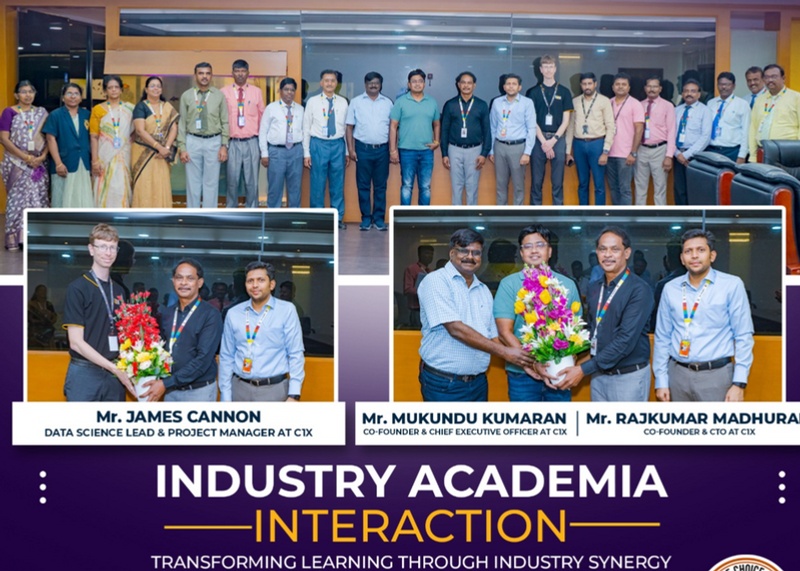
The visit brought students and faculty into discussions about industry expectations, internships, placements and collaborative projects. Those subjects sit close to the founder’s recurring recruitment messages. A company needs people who understand its technical work; students need a view of what that work asks of them.
The photographs are cheerfully ceremonial: a group assembled for the camera, bouquets presented, names printed beneath the guests. They place Kumaran among engineers, faculty and students, away from a product diagram. A career in software contains a surprising number of moments that require everyone to stop moving and look in the same direction.
The colleague who knew whom to call
By April 2026, another professional connection supplied a fresh chapter. Kimberly Perkins had worked with Kumaran at Yahoo and later at C1X. Through her, a relationship developed with Sol Consulting. The firms worked together on advertising technology, including support for Locality’s April 2025 launch of LocalX.
Kumaran described a demand from larger clients for platforms they could customize and control, including ownership of intellectual property, without rebuilding every component. Sol’s Arielle Bitton praised C1X’s accountability and willingness to adjust as projects changed. The partnership put engineering in Chennai alongside consultants working largely in the United States.
It is a fitting place to leave him: still dealing with complicated technology, still concerned with how people work together around it. The three-page integration plan belongs to an earlier decade, but its attraction survives. A shared understanding gives the machinery somewhere useful to go. Kumaran’s career keeps returning to that demanding, unshowy job of making the next step clear enough for somebody else to take.