A leaking tap gives software a useful examination. Can it get somebody to the house? A handsome dashboard will struggle to impress the person holding the bucket. In a home-maintenance app called One Home Solution, homeowners could request services, arrange work and keep records on their phones. Mitul Patel and the Bytes Technolab team helped build it. Years before his current emphasis on AI agents, there was already a practical question underneath the work: how much effort should a customer have to supply?
Designer Kaitlyn Taylor named Patel and his team among the collaborators on the project, alongside company leaders Peter Rosholt and Matt Hoppe. Patel responded by thanking them for trusting Bytes as a development partner. In another exchange with Hoppe, he credited the project's focused business goal, detailed requirements and guidance. The technology had a job description. The homeowner had enough jobs already.
That small exchange makes a useful introduction to Patel, the Toronto-area CEO and co-founder of Bytes Technolab. His professional story runs through commerce systems, mobile applications and now AI product engineering. Its recurring concern is the space between having software and getting something finished.
A company built around somebody else's problem
Bytes Technolab dates its beginnings to 2011, when a small team set out to build software for web, mobile and cloud platforms. Patel is one of its co-founders, alongside Bhavesh Surani and Bhavik Shah. The shared founding matters. This is a story of building a services business with colleagues, where the product changes with the client and the next brief may require a different set of skills.
The company's early account of its development describes expansion into Canada and the United States, and a commitment to learning from customer work. There is a particular discipline in that kind of growth. Each engagement arrives with an existing business attached: its habits, its expectations, its budget and the people who will eventually have to use what gets delivered.
For Patel, the title of CEO sits above that continuing obligation. A co-founder can explain an ambition in a sentence. A development team has to translate it into decisions, screens and working systems. His subsequent public comments keep returning to that translation.
The office gets a stage
Patel's working world also has an Ahmedabad address. In a public post, he invited people to see Bytes Technolab's new office there, sharing a video of the space. The expansion was presented as an investment in its offshore development centre. Behind the international client relationships was a physical place where the development work could happen.
Another glimpse comes from Vibrance 2022, the company's annual family event. Patel introduced the company; fellow directors discussed its accomplishments and plans. Then the programme found more entertaining uses for a stage: comedy, a drama about appraisals, a retro and Bollywood fashion show, singing and garba. An appraisal can apparently become theatre without much additional equipment.
The evening included awards for employees and best retro costumes. It is a modest but revealing detail in a career otherwise described through services and markets. A software company is also a group of people willing to watch their colleagues perform. The photograph in a leadership directory conveys less of that than a costume competition does.
Before the agent, there was the checkout
Patel's older writing gives the current AI emphasis some history. His December 2023 author archive includes articles on Adobe Commerce, Magento loyalty programmes and the integration of Magento with AI for analytics and insights. Another article considers Odoo event management. These are topics concerned with how a business actually runs: selling, retaining customers, understanding transactions and organising work.
The sequence is useful because AI has not arrived in his professional vocabulary from nowhere. Commerce already required decisions about customer behaviour, software integrations and the point at which interest becomes a purchase. His writing placed AI beside those existing concerns. The store came with questions before it came with a conversational agent.
There is also an appealing lack of glamour in a checkout. Nobody attends a dinner party hoping to hear a long account of abandoned baskets. Yet a customer who cannot complete an order gives the business a very concrete problem. That is the territory Patel's archive inhabits: technology judged against the business activity it is meant to support.
“The real advantage is faster learning, not simply faster development.”
Mitul Patel, on AI product development
Two days at stand SB12
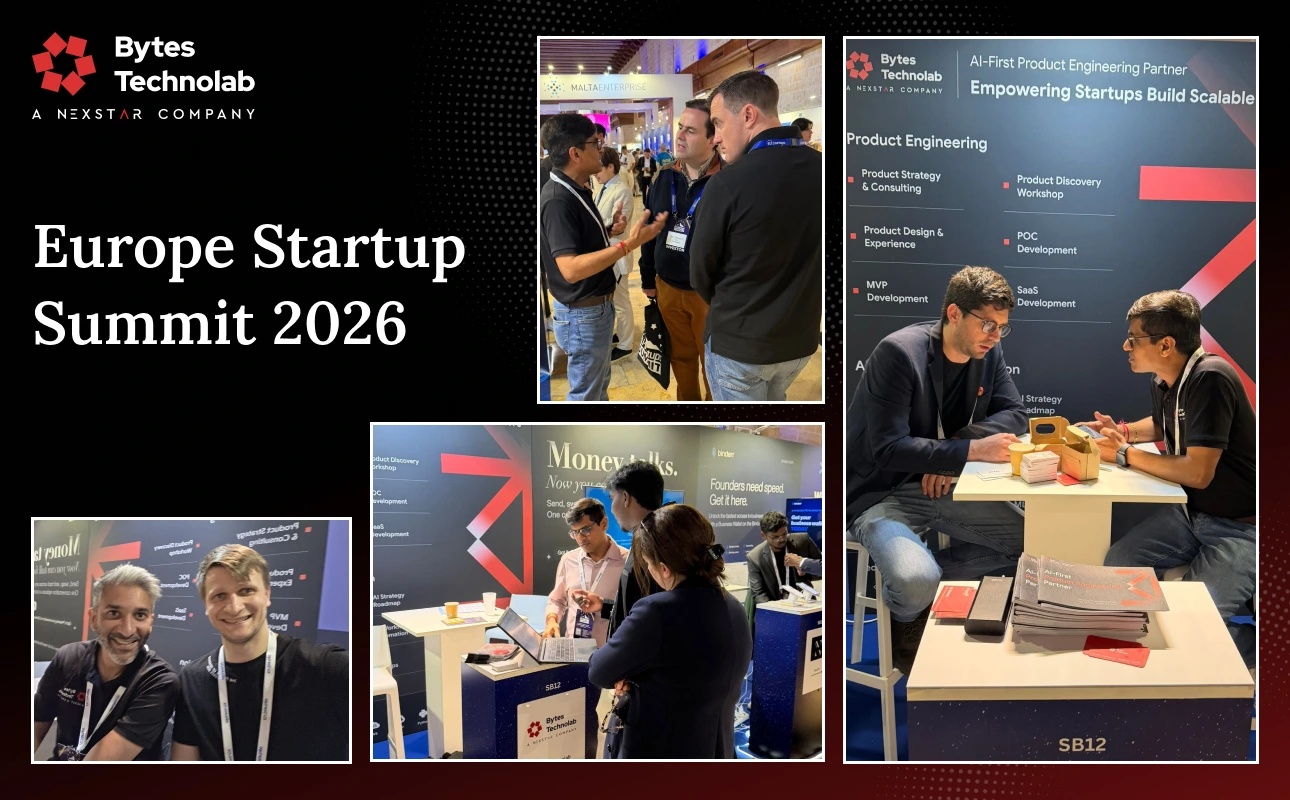
On May 7 and 8, 2026, Patel represented Bytes Technolab at the startup summit in Valletta, Malta, with Pritesh Vegad, a client partner and director. Their base was stand SB12 at the Mediterranean Conference Centre. For a business selling engineering expertise, a conference stand is a temporary office with an unusually high number of introductions.
The discussions they described centred on AI agents, SaaS architecture and the demand for development partners who could advise as well as execute. Patel's account also identified the constraints founders brought with them: limited budgets, tight schedules and older systems that were becoming difficult to extend. Ambition, in other words, had arrived with its luggage.
His stated aim was to help founders build products that could endure beyond their first release. That intention gives the conference appearance a place in the wider story. Patel was taking the engineering relationship upstream, towards product choices and architecture, before a team had committed itself to the wrong build.
The expense of doing it twice
In June 2026, Bytes announced an expansion of its AI MVP development services for the US market. The offer addressed a familiar development problem: an early product that reaches launch, then requires extensive rebuilding. Discovery, architecture and delivery were being sold together, with the next stages of the product considered before the first release.
An MVP, or minimum viable product, is supposed to test something. If the test is badly chosen, shipping it quickly provides an efficient route to a disappointing answer. Patel's position places more weight on identifying what must be learned and what the software will need to support later. Speed still matters, but so does the direction of travel.
He described the company's ambition as engineering for the AI era. The practical implication is a larger responsibility for the development partner: helping shape the initial decision, then staying involved as the product changes. For a founder buying the work, that makes the quality of the early conversation consequential.
One workflow, with the bill attached
Patel made a more qualified argument in his August 2026 essay on AI-native products. He discussed software that could complete parts of a task, alongside the costs and risks of doing so. Model usage has an operating cost. Output quality needs measuring. A product can grow and still have awkward economics.
His recommendation was to begin with a narrow workflow and test its largest uncertainty. That might be the data, the result's accuracy, user trust or the cost of delivering it. He also allowed for a focused AI feature when a fully AI-native product would add little useful value. It is an important qualification to his enthusiasm.
Read alongside the home-maintenance project, the argument has a consistent shape. Start with an activity people want completed. Decide what the software can reasonably take on. Then examine whether the result earns its place. The point is a workable product, with an intelligible bill at the end.
- 01 / TaskWhat needs doing?
- 02 / TestWhat could fail?
- 03 / BuildHow will it work?
- 04 / MeasureIs it worth running?
Riyadh, and a cart that starts with a conversation
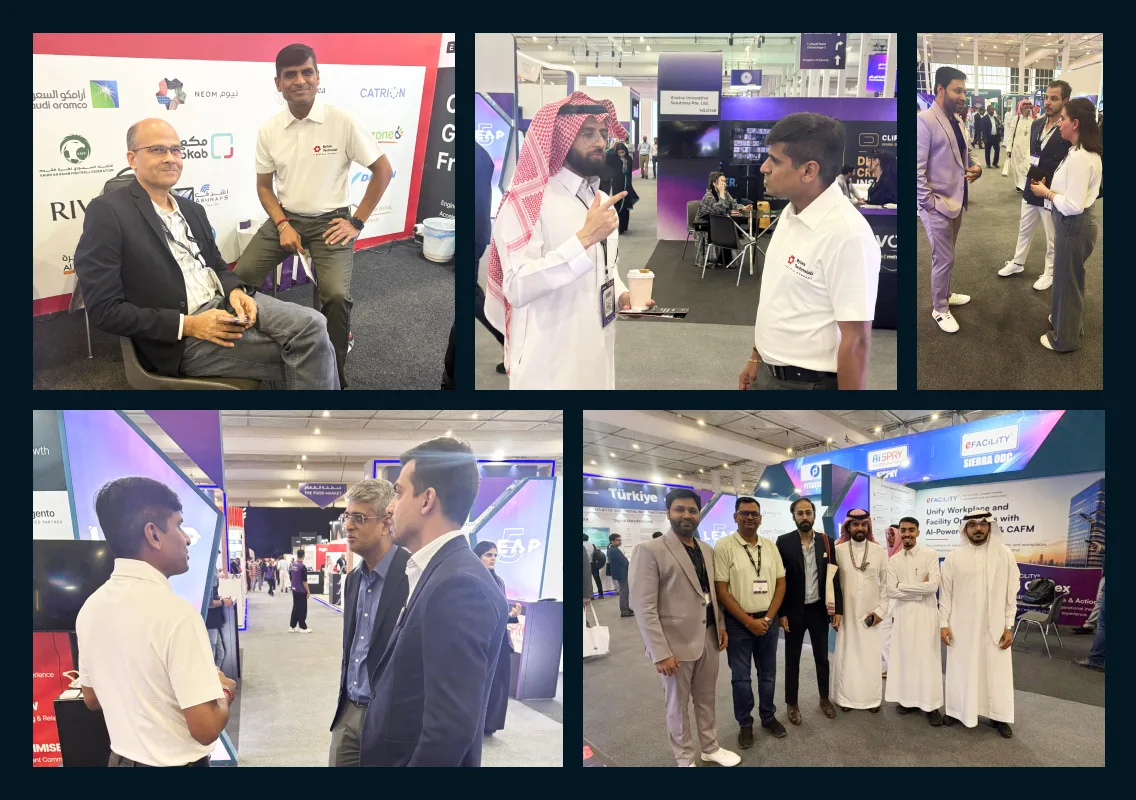
By late summer, the argument had a demonstration. Patel travelled to Riyadh with head of sales Ashish Kulkarni for LEAP, held from August 31 to September 3, 2026. Bytes brought NexShop AI, a conversational shopping agent. A customer could explain a need; the system was designed to interpret the request, find relevant products and assemble a cart.
The product took Patel back to commerce, with a different interface. Instead of moving through filters and product pages, shoppers could describe what they wanted. It was a concrete example of his interest in software that advances a task. The experience was being demonstrated, rather than left as an architectural proposition.
Afterwards, Patel singled out the conversations with business leaders and the questions about fitting AI into their operations. “What stood out was the quality of the conversations,” he said. The next step was follow-up work: testing which discussions could become useful engagements after the exhibition ended.
The work after the introduction
Patel's ambition now extends across product strategy, AI implementation and the modernisation of existing software. An August expansion brought more of those capabilities together, including AI agents, workflow orchestration and enterprise integrations. He described product engineering as the company's core strength and the AI work as an evolution of it. In October, Bytes announced an Anthropic partnership and OpenAI Select Partner status, adding further training and model-provider relationships to that work.
That leaves him with an interesting job as a founder. He has to carry a company into a changing market while keeping its attention on particular clients and particular tasks. The scope of the technology has widened considerably since Bytes began in 2011. The need for a useful brief has survived intact.
The most persuasive connection in his story runs from the homeowner requesting a repair to the shopper describing a purchase. Both want something to happen. Between that intention and its completion sits the work Patel and his colleagues have chosen to do.
Follow the work
Read more from Patel and explore the projects and conversations behind this profile.
Mitul Patel on LinkedIn ↗Patel’s commerce writing ↗His essay on AI-native products ↗NexShop AI and the Riyadh visit ↗Bytes Technolab website ↗Bytes Technolab on YouTube ↗