A buyer can spend six weeks interviewing software engineers and still learn less than FullStack wants to show in one screen. Inside its Connect platform sit hourly rates, work histories, recorded interviews, coding challenges, evaluator scores, time zones, and availability. Pick a candidate, book the conversation, and - if the fit is right - the company says work can begin within 48 hours. The promise sounds like speed. The machinery underneath is really about reducing uncertainty.
FullStack is a 2013-born software engineering company with two complementary businesses. FullStack Labs designs and builds custom software, AI systems, data platforms, mobile products, and modernization programs. FullStack Talent supplies embedded engineers, designers, QA specialists, DevOps practitioners, and pre-built pods. Connect is the software layer joining the two: an inspectable shelf of technical capacity drawn from the United States and Latin America.
That puts FullStack in an awkward but useful middle ground. It is more accountable than a freelancer marketplace, more flexible than hiring a permanent team, and closer to US working hours than the classic offshore shop. It also has more delivery structure than a pure staffing vendor. The company says 600 US businesses trust it, more than 300 projects have shipped, and its network now exceeds 1,100 vetted AI-native experts. LinkedIn describes more than 700 professionals in the operating company.
01 / The wedge
Nearshore stopped meaning “the cheaper developer”
The old outsourcing spreadsheet had three columns: hourly rate, location, and headcount. FullStack's argument adds the costs the spreadsheet misses. A bargain team twelve hours away can become expensive when product decisions wait overnight, requirements arrive garbled, or nobody owns delivery. FullStack mixes Latin American engineering depth with US-led project management, quality assurance, and client communication. The company calls a version of this structure “Nearshore Plus.”
The arrangement is not the lowest possible global price. It is meant to preserve overlapping workdays and cultural familiarity while still benefiting from lower nearshore costs. For an American product leader who wants to speak with the technical lead at 2 p.m., that distinction matters. It also makes the model easiest to copy: place scarce coordination roles close to the customer, draw implementation talent from compatible time zones, and make ownership explicit.

The staffing side tries to remove another hidden cost: interviewing. FullStack screens candidates through a phone conversation, timed skill assessment, asynchronous interview, and expert review. Clients can inspect much of that evidence instead of taking a recruiter at their word. The company also offers a two-week guarantee - if the client is not satisfied in that window, it says the client does not pay. The faster start is possible because the slow work happened before the requisition arrived.
02 / The change
AI became the product, but proof stayed the sales tool
FullStack's recent repositioning is unmistakable. Its homepage now leads with production AI, forward-deployed engineers, agentic systems, and AI transformation. In late 2025, Anton Tomchenko took over as CEO and began what the company describes as an AI-led transformation. In May 2026, it added a CFO, a chief delivery and technology officer, and CMO Abhishek Vanamali. The new language is fashionable. The better evidence is decidedly unfashionable: constrained workflows, baseline measurements, and short tests.
Paciolan is the cleanest example of what changed a client's mind. The ticketing company was modernizing three systems, including a third-party application with roughly 250 interdependent screens. Traditional work could not meet the desired schedule without raising delivery and customer-disruption risk. Rather than ask the organization to trust AI across the program, FullStack and Paciolan ran a 15-day proof of value with tight guardrails. The team modernized 20 representative screens in under two weeks, beating a four-week estimate.
That result earned a larger mandate. The workflow used Claude and Claude Code to propose React interfaces from legacy logic, wire repetitive APIs, and draft documentation. Engineers stayed responsible for architecture, correctness, and edge cases. Within four months, Paciolan's engineering organization was using the framework. Reported modernization timelines fell by more than 30%, with complex journeys delivered in roughly three to five weeks.
The pattern repeats elsewhere. A regulatory-compliance provider paid trained people to listen to expert-network calls or review transcripts for SEC risks. The manual system was the first thing to fail under scale: approximately 500 sentences demanded attention on each call. FullStack built a 14-week proof of concept with five people. Whisper transcribed audio; language tools removed sensitive data; multiple models identified and ranked possible violations. Humans still made the final call, but reviewed about five flagged sentences instead of 500. FullStack reports 93% average accuracy, 5,500 annual hours automated, and more than 90% projected savings.
03 / What it costs
The rate card is private; the bad workflow is expensive
FullStack does not publish a universal price list. Connect shows role-specific hourly rates to clients, and project work depends on scope. Historical Clutch data puts the minimum project at $25,000 and the average hourly band at $25 to $49, with reviewed engagements ranging from under $5,000 to nearly $1 million. Those figures are a directional snapshot, not a quote. FullStack's own current pitch is “50% typical cost savings” for AI-native talent, plus the two-week guarantee.
The more revealing cost belongs to the customer. One logistics provider had a legacy document-processing system costing more than $1 million a year. It took about 60 seconds per document and struggled as volume grew. In 90 days, a FullStack team built an AI proof of concept using document ingestion, classification, optical character recognition, extraction, and structured storage. It processed a document in 15 seconds and projected savings of up to 50%.
The honest number was not 50%
The prototype still trailed the legacy system on some accuracy measures: precision was within 10.4%, recall within 7%, and F1 score within 1%. That is a useful constraint. Faster and cheaper does not automatically mean ready for unsupervised production.
That caveat describes when the playbook works. The workflow needs enough volume to justify custom engineering. The business needs a reliable baseline. A human reviewer must remain available when errors carry regulatory, financial, or physical consequences. And the client must provide data access, decision-makers, and a product owner. Without those conditions, a 15-day proof becomes a demo and a 48-hour hire becomes an extra person waiting for direction.
04 / The portfolio
Boring internal software can have spectacular arithmetic
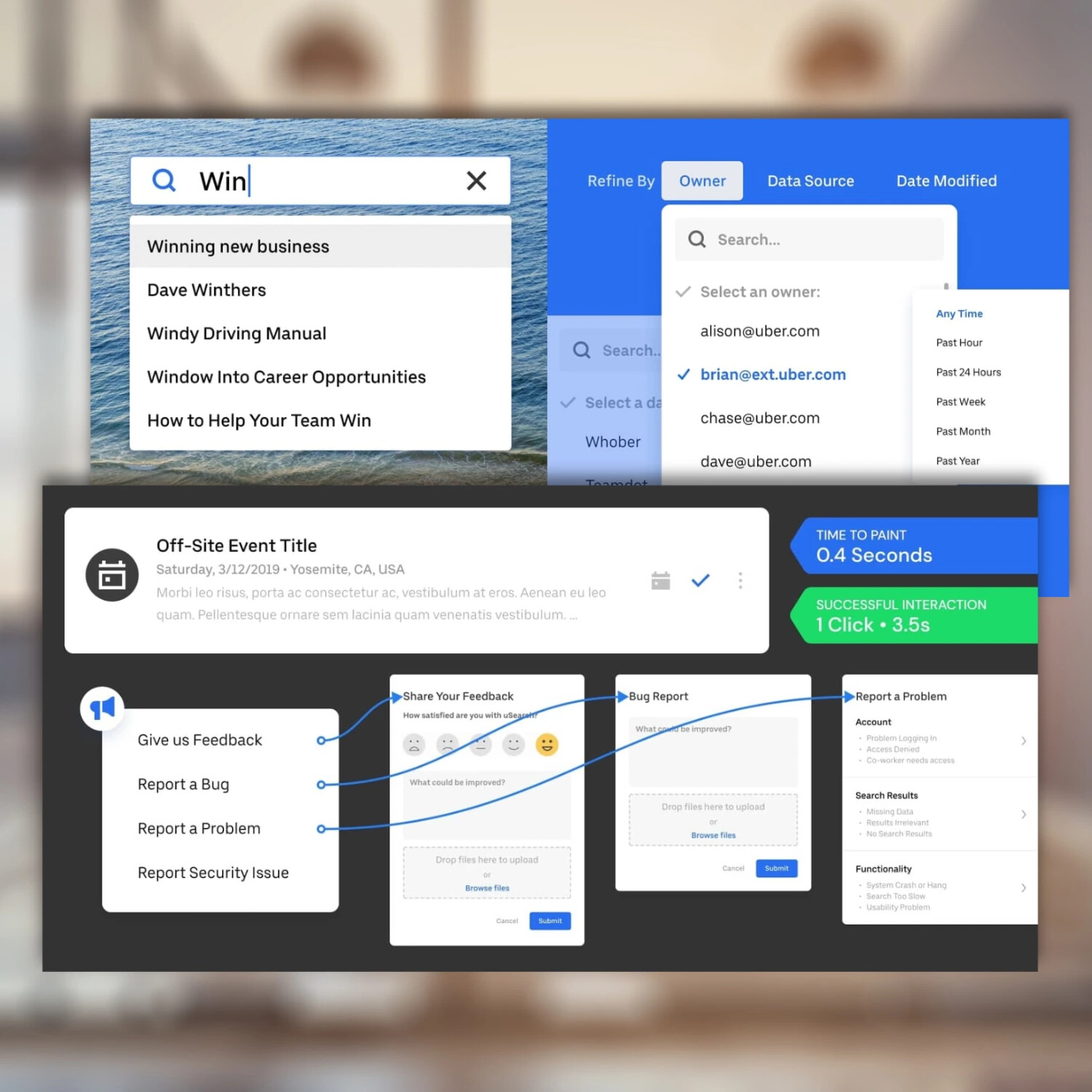
FullStack's range is easier to understand through irritations than industries. Uber employees searched across Google Drive, Confluence, Jira, Tugboat, and other systems. FullStack built uSearch, cutting the average hunt from 10 steps to three. The tool reportedly saved more than 15 minutes per employee per day and reached 50% adoption in its first month. Search is not glamorous; multiply a quarter-hour by a very large workforce and it becomes an executive problem.
At Lux Research, customers had access to more than 16,000 primary research documents and human analysts, but the handoff between them was clumsy. Clients searched and hoped, then emailed back and forth to schedule expertise. Seventy-five percent of inquiries took more than seven days to arrange. FullStack first built a proof of concept, then Luxer: an assistant constrained to Lux's proprietary library, with citations and self-service expert scheduling. During its first two weeks, 200 users submitted 900 queries. The share of inquiries scheduled within 48 hours rose from 10% to 35%.

The strangest proof sits in physical therapy. Ekso Bionics' robotic exoskeleton collected rich session data, but therapists received it after the session on printouts and controlled the device with hard buttons. FullStack built a web dashboard, a new controller interface, and a Bluetooth mobile sync app. EksoPulse 2.0 reached more than 270 rehabilitation centers. In selected cases, therapists who once helped a patient take around 20 steps reported 100 or more in a session.
This is where FullStack fits in the market. It is not selling a single SaaS application that every customer uses the same way. It sells the ability to assemble people and software around a stubborn workflow, then remain as a delivery team or hand over capacity. Competitors include nearshore firms such as BairesDev and Globant, talent networks such as Toptal and Andela, large consultancies, and the internal recruiting team. FullStack's differentiator is the combination: visible vetting, nearshore overlap, managed delivery, and an institutional bench under one roof.
05 / The copyable bit
Do the interview before the requisition arrives
Three ideas travel well beyond FullStack. First, inventory capability before demand appears. A 48-hour promise is credible only when skills, rates, assessments, and availability are already structured. Second, sell the avoided cost, not the technology. “GPT-4 Turbo plus RoBERTa” is trivia; “five sentences instead of 500” is a budget conversation. Third, let a small proof buy the right to scale. Paciolan did not begin with an enterprise mandate. It began with 20 screens and a clock.
The model is less convincing for a founder with a tiny budget, a company that needs the absolute lowest worldwide rate, or work that requires constant physical presence. It also weakens when the customer cannot define success or give an outside team access to the people who know the workflow. Nearshore alignment reduces communication friction; it does not cure indecision.
FullStack has changed shape without changing its basic raw material. It still sells engineers, design judgment, delivery habits, and time. AI gives those ingredients a new headline and sometimes a multiplier. The durable part of the business is quieter: turning a vague wish for “transformation” into a test small enough to run, a number plain enough to believe, and a team the buyer can inspect before saying yes.