The first obstacle was a bill. In 2009, Michael Barrett and Mario Di Vece had landed work supplying three software testers to MedAssets, a healthcare company. A customer was good news. Its payment schedule was another matter. Barrett says Unosquare had neither the equipment nor the cash to carry the work while waiting 60 days to be paid.
So he asked the customer to pay immediately. The initial answer was no. He explained that the business might otherwise disappear. MedAssets agreed to a temporary arrangement. In Barrett’s telling, those fast payments helped keep the company alive as the account grew. Before Unosquare could solve anyone’s software problem, it had to solve the distance between an invoice and a bank balance.
- Unosquare builds and supports custom software with nearshore and onshore teams.
- Its work ranges from patient portals to banking operations and field-service tools.
- Buyers can add engineers, embed a team, commission a project, or outsource ongoing operations.
01 / A smaller distance to an answer
That concern with proximity still runs through the business. Unosquare’s nearshore model places much of its engineering delivery in Latin America, within working hours that overlap with US clients. A question can become a conversation while both people are at their desks. For a changing software project, that is a practical advantage: fewer decisions have to sit overnight.
The founders brought complementary skills. Barrett understood customers and selling; Di Vece brought software delivery experience in Mexico. They built a services business around connecting the two. Today the company reports more than 1,000 delivery professionals and over 100 active clients. Its customer work spans financial services, healthcare, technology, and other industries where systems accumulate rules, dependencies, and inconvenient history.
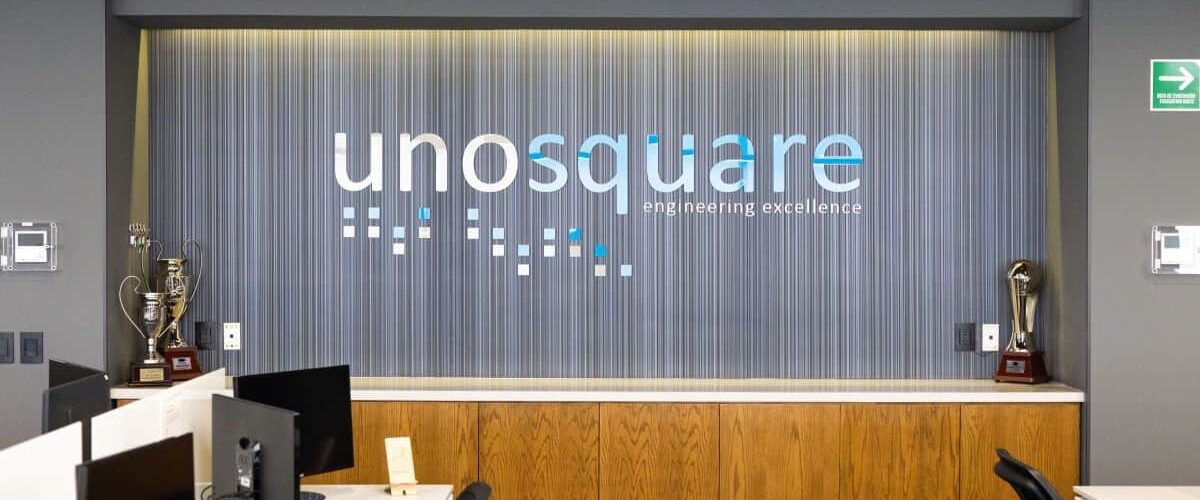
Shared hours alone will not distinguish it from every rival. Nearshore firms such as Globant, Encora, and BairesDev occupy the same broad buying landscape. Unosquare’s case rests on how the team works after it arrives: engineering combined with design, testing, data, cloud infrastructure, and production support. The useful comparison for a buyer is the responsibility each provider will actually accept.
02 / The software meets the job site
Consider Groundworks, the foundation and waterproofing business. Its regional brands had separate ways of managing proposals and cases. Growth brought more workflows to reconcile. And technicians needed software that could function at remote job sites, including when connectivity was unavailable. A handsome screen that stopped working without a signal would have missed the assignment.
Unosquare describes rebuilding the platform across roughly 120 screens, unifying proposals, contracts, scheduling, and back-office processes. The technology included Electron, Ruby, and Rails. Its case study reports that the platform supported expansion from 13 to 29 brands within a year, and associates the launch with a 10% first-year sales increase. Those are the provider’s reported results, rather than proof that software alone caused the growth.
Aetna presented a different version of fragmentation. Teams and sub-brands had developed inconsistent behavioral health experiences. Unosquare began with a UX audit, then developed two design systems with brand variants and redesigned more than 100 patient-portal screens. The engagement lasted 14 months. The work was partly visual, but its deeper purpose was agreement: reusable components gave different teams a common starting point.
These projects explain where Unosquare fits. It is an engineering partner for organizations whose existing operations make software difficult. A contractor must quote underground work. A patient must navigate care. The system has to respect those circumstances before anyone can celebrate the technology.
03 / Pick who owns the work
Buying that help requires a decision about control. With staff augmentation, a client adds capacity and retains responsibility for directing it. Embedded teams take on a continuing stream of work. Scoped project delivery assigns a defined result to Unosquare for a fixed fee. Managed services cover what happens after release: monitoring, incidents, maintenance, and infrastructure operations.
The website offers indicative project bands: $50,000-$150,000 for an MVP, $100,000-$600,000 for a scale project, and $300,000 to more than $1 million for enterprise work. These are planning ranges, not customer invoices. The spread makes sense. A limited product and an integration-heavy enterprise system consume different amounts of design, security, testing, and coordination.
For a prospective buyer, the lesson is to name the bottleneck before naming the team. Extra developers will struggle if nobody can settle priorities. A fixed fee needs a scope both sides understand. An inexpensive packaged application may suit a straightforward requirement better. Nearshore delivery works best when the client can provide access, context, timely decisions, and someone accountable for the business result.
04 / More capability, more coordination
Unosquare has expanded what it can take on. Trivest invested in 2020. In 2022, acquisitions added Catalyst UX’s design expertise and Airship’s US product-development team. Ridgemont led a recapitalization in June 2025, with founders and management retaining significant investment. Those moves widened the offering from supplying engineering talent toward handling more of a product’s life.
The current emphasis includes AI and data systems. In October 2026, Unosquare appointed Peter Carlson CFO, responsible for financial planning, capital strategy, and acquisitions; Eduardo Arias became Chief Administrative Officer. Expansion now requires its own infrastructure of legal, financial, and operating controls. The company buying other companies faces a coordination problem familiar from its customer projects.
The first obstacle was a bill. The enduring problem is getting people, decisions, and systems close enough to work.
There is something useful to borrow here even without hiring Unosquare. Negotiate payment terms before growth empties the account. Design around the place the work happens. Give teams a shared language. Decide who owns the next decision. These are modest disciplines. Applied consistently, they make an ambitious software plan considerably easier to live with.