She tried every health tracker on the market, hated the results, and built a better one from scratch - powered by urine data and machine learning.
Miray Tayfun tested everything. The wearables. The 23andMe kit. The Everlywell blood panels. She waited weeks for results that told her only what she already suspected. As a bioengineer, she understood why this was wrong - and that understanding became Vivoo.
Founded in San Francisco in 2017, Vivoo turns a two-minute at-home urine test into a personalized health report covering 15 biomarkers: hydration, pH balance, ketones, calcium, magnesium, vitamin C, sodium levels, oxidative stress, and more. The mobile app - trained on over one million data points - does the analysis and spits out actionable recommendations from dieticians and reviewed by doctors. All of it in the time it takes to make coffee.
The idea sounds obvious once you hear it. Before Tayfun built it, nobody had. That gap between "obviously needed" and "actually built" is where most great companies live - and where Tayfun planted her flag.
Tim Draper, the venture capitalist who famously bought 30,000 Bitcoin at a US Marshals auction, led Vivoo's $6M Series A in 2021. The company has since raised $19.4M total, serves 300,000 users across 50+ countries, and at CES 2026 unveiled a $99 optical smart toilet sensor - named Best of CES by Gadget Flow - that turns any existing toilet into a daily hydration monitoring station without a single chemical strip.
"I'm a bioengineer, and I wanted to know everything I could about my own health. I tried every kind of tracker and test - wearables, 23andMe, Everlywell. But it was costly, and the results were rarely real time. Sometimes it took 1-2 months to get specific metrics."
- Miray Tayfun, TechCrunch 2021Tayfun's background as a serial founder matters here. Before Vivoo, she co-founded Vivosens Biyoteknoloji in medical diagnostics, built smart home companies, and worked in co-living spaces. She's a bioengineering graduate of Yildiz Technical University in Istanbul, with Stanford postgraduate work in Go-to-Market Strategies and Diet and Gene Expression. She began her career volunteering at Young Guru Academy, a Harvard Business School partner leadership program, before moving through manufacturing and pharmaceutical sales roles.
Her founding team at Vivoo is co-led by George Radman (CFO), Gozde Buyukacaroglu (COO), and Ali Atasever (CTO). The internal team ended up organically 70% female - a reflection of the core customer base, where women represent the largest segment of Vivoo's users, often purchasing for themselves or their partners.
Vivoo's machine learning model works across different phone models and lighting conditions - a harder engineering problem than it sounds. A yellow test strip in bad bathroom lighting on an old Android phone must read the same as a perfect iPhone in a sun-lit studio. The team solved it with a training set of over one million data points. That's not a product feature - that's a moat.
In January 2026, the Vivoo Smart Toilet went on sale for $99. It clips onto any existing toilet, uses optical specific-gravity sensors instead of chemicals, has an antibacterial nanotechnology coating for self-cleaning with every flush, supports up to 15 household profiles with automatic user recognition, and delivers 1,000+ measurements per charge via Bluetooth to the Vivoo app. The smart toilet market skews expensive and cumbersome. Vivoo chose the other direction.
Tayfun's vision for Vivoo extends further: a one-stop wellness platform integrating urine biomarkers with sleep data from Oura, mindfulness from Calm, activity from Apple Watch. She describes it less as a competitor to existing trackers and more as a data layer underneath them - the biomarker foundation that makes everything else more meaningful.
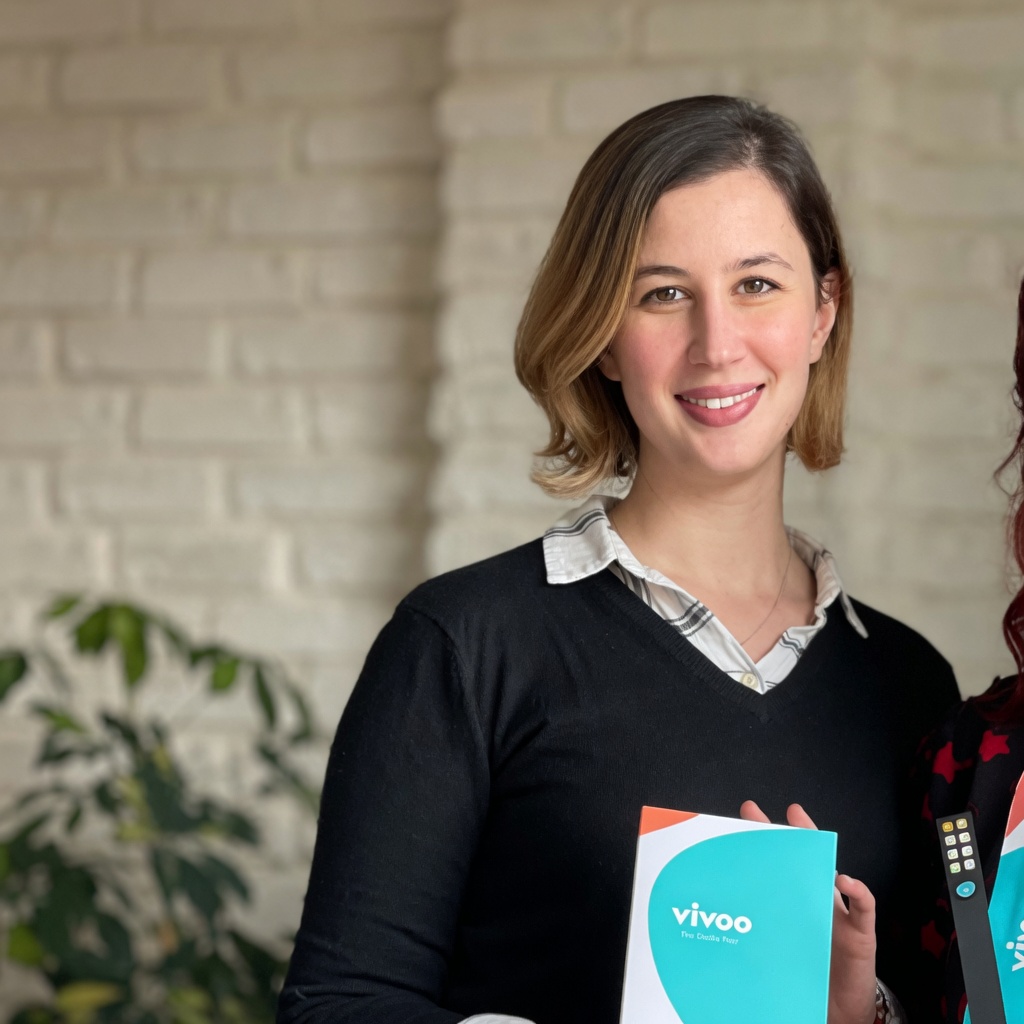
| Role | Co-Founder & CEO, Vivoo |
| Location | San Francisco, CA |
| Background | Bioengineering |
| Founded | 2017 |
| Stage | Series B |
| Category | Health Technology |
"For me, wellness is listening to your body's voice; listening to your mind's voice. Give it your full attention every day."
On wellness philosophy"We'd like to position Vivoo as a one-stop shop by covering a big area of wellness, nutrition, mindfulness, activity, and sleep."
On Vivoo's vision"By offering Vivoo Smart Toilet for just $99, we're democratizing this technology to make daily health insights accessible to everyone."
On the smart toilet launch"Our approach is to suggest evidence-based recommendations created by dieticians and reviewed by doctors. The research mainly uses higher-quality scientific research such as meta-analysis and systematic reviews."
On scientific rigor"We're a bunch of young, health conscious women, with various degrees in bio-science. We wanted to have access to personalized healthcare, but found out that the market was expensive and lacked accuracy and personalization."
On the founding team"We will continue to spend a fifth of our budget on R&D. More data will allow our technologies to provide better insights and recommendations."
On R&D investment2019. One of the most competitive recognition programs for women in business across the Asia-Pacific region.
2018. Awarded for building companies that contribute meaningfully to people's wellbeing.
Vivoo Smart Toilet selected from thousands of CES 2026 exhibitors for its breakthrough optical urine sensing technology at an accessible $99 price point.
Built Vivoo to 300,000+ users across 120+ countries and 150+ organizational partnerships with a team of 67 people - an organically 70% female workforce.
Vivoo's urine test strips are FDA-registered. Machine learning trained on 1M+ data points handles color analysis across devices and lighting conditions.
Draper Associates, Otsuka Pharmaceuticals, Revo Capital, 500 Startups, Global Ventures, and Halogen Ventures among investors backing the vision.
Tayfun used her own Vivoo product and discovered she needed more dietary salt to maintain her energy levels - a detail no wearable or blood panel had flagged in years of testing. The founder used her own product and it worked.
She quit coffee for a teeth-whitening treatment and tracked the fallout through Vivoo: measurable changes in pH levels, body composition, and energy. She came out of the experiment not anti-caffeine, but a committed, data-backed advocate for it.
Vivoo's team is organically 70% female - not by design, but by hiring for the right skills in a space where women were already building and buying. It mirrors the customer base: women are Vivoo's largest user segment.
She wears an Oura ring but doesn't obsess over the data. After red-eye flights skew her sleep metrics into the red, she keeps perspective. A founder who builds health tech and isn't neurotic about her own data - a rare combination.
Making a urine test strip read consistently across different phones and bathroom lighting is harder than it sounds. Vivoo solved it by training their ML model on over 1 million data points. That's the kind of unglamorous engineering that becomes a moat.
The smart toilet market trends expensive (hundreds to thousands of dollars). Vivoo launched at $99 with no consumables - just optical sensors, nanotechnology coating, 1,000+ measurements per charge, and 15-user household profiles. Democratization as a product strategy.
How to build a world-class wellness and health company - Vivoo founder Miray Tayfun
Tayfun describes Vivoo not as a competitor to wearables but as the biomarker foundation beneath them. Partnering with Apple, Calm, Oura, and Whoop, the goal is a unified wellness platform where urine biomarkers give context to everything else - sleep scores, activity rings, mindfulness minutes.
The smart toilet is the next hardware layer: no test strips, no manual dipping, no scheduling around bathroom time. Just a clip-on optical device on your existing toilet that generates daily biomarker data while you go about your morning routine. At $99 and a $5.99/month subscription, it's priced as a mass-market consumer product, not a medical device.
Vivoo has also moved into reproductive health - hormone tests for FSH, LH, and hCG for fertility and early pregnancy tracking, and ESR tests for inflammation monitoring. The company that started with hydration is now reading the full physiological story.
"We believe together we can change bad habits to goods more easily. More data will allow our technologies to provide better insights and recommendations."
- Miray Tayfun