A grocery bag is an argument between physics and optimism. The eggs would like some space. The ice cream has a deadline. The bananas bruise under pressure, the detergent should keep its distance from dinner, and somebody will notice if the birthday candles arrive smelling like gardenias. Online, this jumble presents itself as a clean row of thumbnails. Behind the screen, it becomes a low-margin obstacle course. Mir Aamir has spent much of his career moving closer to that hidden mess.
His route was not a straight march toward robotics. It began with a business education in Karachi, continued with an MBA at Chicago Booth, and ran through management consulting, a large grocery chain and a digital promotions company. Each stop added another view of the same transaction. The consultant saw the system. The Safeway executive saw the shopper. The technology CEO saw the offer on the screen. At Fulfil Solutions, where Aamir has been president and CEO since November 2021, he sees the moment all those promises must be placed into a bag without crushing the tomatoes.
This is the useful frame for understanding him. Aamir is not presented publicly as a roboticist tinkering alone at a bench. He is an operator shaped by retail arithmetic. His work circles a plain question: if customers increasingly expect quick delivery and easy pickup, who pays for the human labor required to walk the aisles, find each item and pack the order? Grocery margins do not leave much room for romantic answers.
Learning the basket before building the machine
Aamir graduated from the Institute of Business Administration at the University of Karachi with a BBA, then earned his Chicago Booth MBA with honors in 1997. He moved into consulting at Kearney, working in consumer and retail before joining Safeway in 2005. By the end of that run, he was president of customer loyalty and digital technologies at a grocer with more than $30 billion in annual sales.
The title is corporate, but the work was intimate. Safeway's Just for U platform used purchasing data to tailor offers to individual shoppers. By 2013, it had more than six million registered users. Long before every supermarket app learned to wave a digital coupon at you, Aamir was working on the bargain at the heart of personalization: a customer will share data when the value returned feels relevant.
“Relevance and value, we've seen, trumps everything in the consumer's mind.”Mir Aamir, Chicago Booth Marketing Summit
That sentence, delivered while he was leading Quotient Technology, sounds like marketing advice. It also contains the spine of his later work. Technology earns its place when the shopper gets something useful. A complicated automation stack is merely expensive furniture unless it produces a more accurate order, a reasonable fee or a faster pickup.
In 2013 Aamir left Safeway to become chief operating officer and chief financial officer of Coupons.com. He helped take the company public in 2014; it later became Quotient Technology, and he served as president and CEO from 2017 to 2019. Quotient sat between retailers, consumer brands and shoppers, turning promotions and media into a digital system. Aamir had moved from the grocery aisle to the connective tissue around it.
Board work widened the view again. He joined Bob's Discount Furniture in 2021 and also serves on the board of Teach the World Foundation, a nonprofit using technology and game-based learning to reach children outside school. Earlier directorships included FTD and Cloudways. One sells perishable gifts; the other sold cloud infrastructure before its 2022 acquisition by DigitalOcean. The collection looks miscellaneous until you notice the repeated concern with operating a service at scale.
The bag becomes the bottleneck
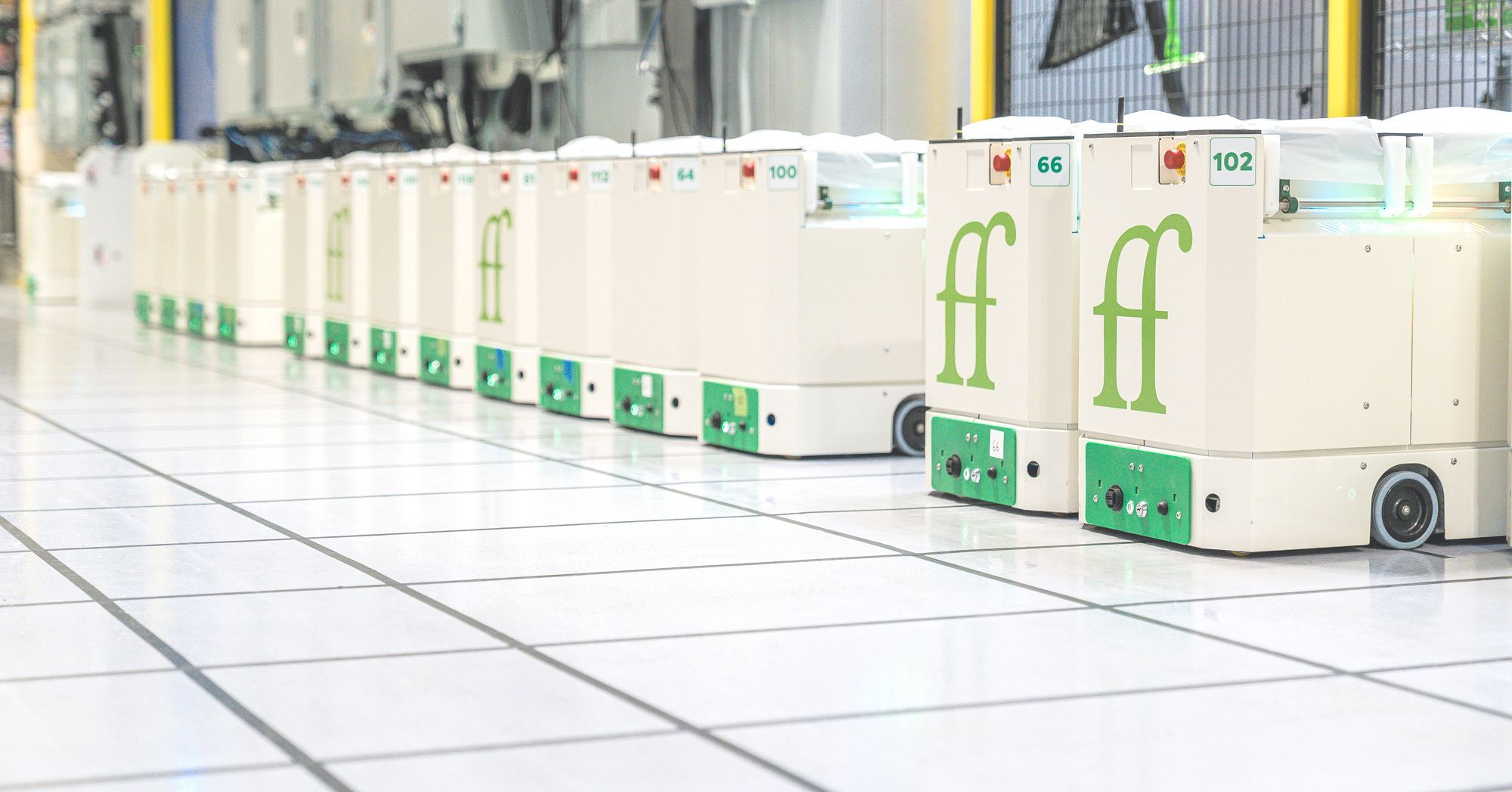
Fulfil brought Aamir back to grocery, except now the aisle was being rebuilt from scratch. The company stores inventory in dense trays stacked vertically. Fixed dispense stations retrieve products. Mobile ShopBots carry grocery bags around the system, gathering items in a sequence meant to reduce damage and packing time. They enter cold enclosures for refrigerated and frozen goods. Cameras, custom actuators and sensor-fusion software check each dispense. Pickup portals hand completed orders to customers or drivers.
How one digital basket becomes a physical order
The vocabulary is playful. The engineering constraints are not. A jar and a lettuce behave differently. Frozen food needs another climate. A bag must be packed in an intelligent order, because gravity is a critic with no patience for product demos. Fulfil tested its adjustable, cushioned bins with raw eggs; the reported test broke none. It is a charming detail because it reduces an industrial thesis to breakfast.
The first public proof appeared in Mountain View. A former Lucky supermarket became a roughly 6,500-square-foot automated dark store, powering same-day delivery and pickup through Lucky Now in partnership with The Save Mart Companies and DoorDash. It opened in late 2022, before Fulfil emerged from stealth in February 2023 with a $60 million Series B led by Eclipse, with participation from Khosla Ventures and DCVC.
Aamir's public pitch kept returning to the economics. Manual picking can make an online grocery order unprofitable before the delivery car moves. Substitutions irritate the customer. Scheduled pickup windows turn convenience into an appointment. Fulfil's proposed answer was full automation across categories and temperature states, close enough to shoppers for on-demand pickup and same-day delivery.
“This is something that touches every household.”Mir Aamir on grocery automation
Every tomato gets a memory
The most consequential part of Fulfil may be the least photogenic. Its database tracks the origin, location and expiration profile of individual items. A grocer can see not merely that it owns tomatoes, but which tomato should leave next. Inventory models can use that visibility to identify perishables approaching expiration and adjust prices to move them sooner.
Aamir connects this capability to food waste and affordability. His published estimate starts with roughly 16 billion pounds of food discarded by US retail stores each year. If Fulfil eventually automated five percent of US grocery shopping, he argues, its system could influence about 800 million pounds of that flow. The number is a company projection, contingent on adoption and performance. Its logic is still revealing: the robot is being sold as a sensor network for shelf life as much as a substitute for footsteps.
Precise markdowns could help a grocer sell food while it is still good and make fresh products available at lower prices. That is why Aamir talks about automation and food deserts in the same conversation. The aspiration reaches beyond a tidy warehouse: lower the cost of handling groceries, reduce waste, and widen convenient access to produce, dairy and meat. It is an ambitious chain of cause and effect, and it begins with knowing the biography of a tomato.
From a dark store to the room behind Whole Foods
In 2024, Aamir introduced MARS, Fulfil's next-generation pick-and-pack system, with a claim that it could handle grocery and non-food goods in smaller footprints. The announcement thanked engineers, technicians and operators before discussing density and throughput. The order matters. Industrial automation is a team sport played by software, sheet metal, control systems and people willing to discover which cable is six inches too short.
The next public installation moved the idea from a converted supermarket into an operating one. At Whole Foods Market in Plymouth Meeting, Pennsylvania, Amazon built a 10,000-square-foot automated micro-fulfillment center behind the store. It holds more than 12,000 distinct items across temperature zones. A shopper can scan a QR code in the aisle, add familiar national brands or household supplies through Amazon, and collect the robot-picked additions at a counter, often in less than ten minutes.
The setup is a retail diplomatic mission. Whole Foods keeps its natural and organic assortment in front. Amazon adds products that do not fit those shelves. Fulfil's ShopBots reconcile the two lists out of sight. For Aamir, the deployment is a larger stage for an argument he has refined since Safeway: respect what the customer values, then redesign the machinery underneath.
Chicago Booth MBA, followed by consumer and retail consulting at Kearney.
Joins Safeway and later leads customer loyalty and digital technologies.
Moves to Coupons.com, later Quotient Technology, as COO and CFO.
Becomes president and CEO of Fulfil Solutions.
Fulfil's ShopBots operate inside Whole Foods Market in Pennsylvania.
Follow the inconvenience all the way down
Aamir's career offers a useful lesson without requiring anyone else to build a robot. Durable problems have layers. Retail strategy, loyalty data, digital promotions, inventory and fulfillment may live in separate departments, yet the customer experiences one trip. A failure in any layer becomes a single verdict: too expensive, too slow, wrong item, bruised fruit.
The temptation in technology is to improve the visible interface. Aamir kept moving in the opposite direction, from the screen toward the floor. The closer he came to the physical order, the more stubborn the details became. That is where his current company has chosen to live: among cold rooms, vertical trays, item databases and bags waiting to be filled.
There is wit in the result. We taught a computer to remember every tomato because humans kept forgetting when tomatoes would spoil. We built small robots to roam a private grocery grid because roaming public aisles was expensive. We hid the machinery behind Whole Foods so a shopper could ask for Goldfish crackers without rearranging the store's identity.
Aamir's wager is that all this mechanical choreography can make convenience ordinary: an accurate order, ready quickly, at a price the customer and grocer can both accept. The machine disappears into the experience. The egg arrives intact. In retail, that quiet ending is the whole production.