An empty space on a supermarket shelf is a surprisingly ambiguous thing. The product might be in the stockroom. It might have wandered into the next aisle. The store’s inventory system might insist it is available. The shopper, who came for that particular box, is unlikely to appreciate the philosophical distinction.
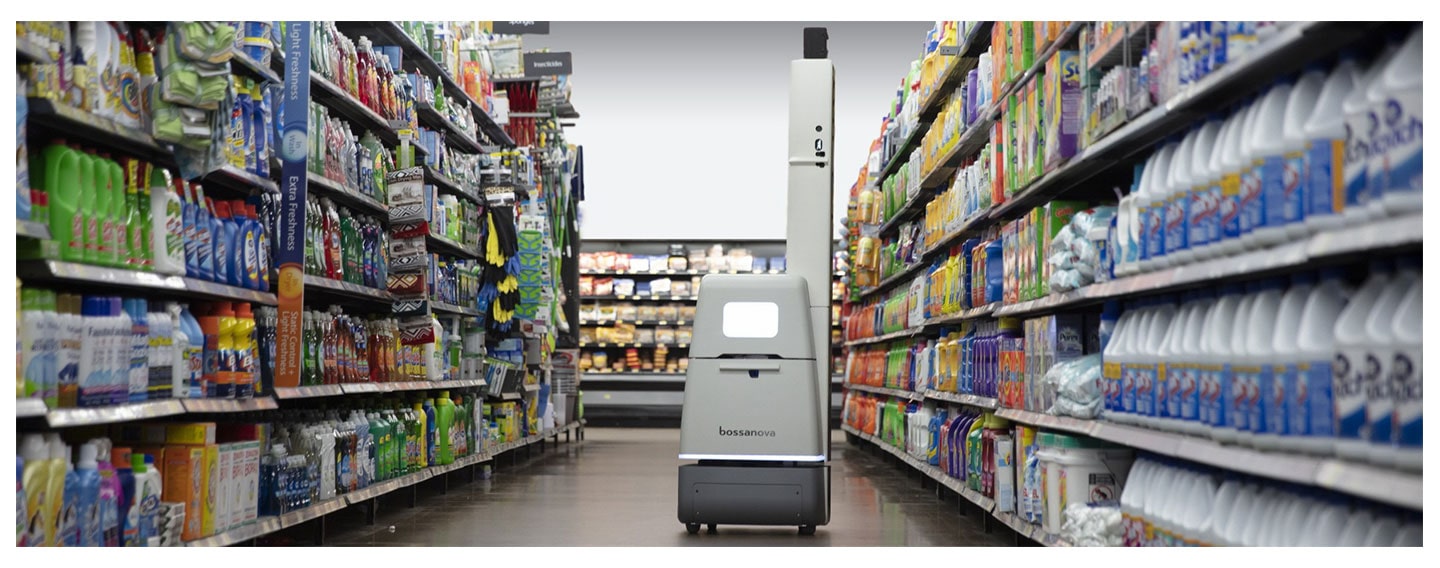
Bossa Nova built a business around making that space visible to software. Its autonomous robots travelled through store aisles, photographing merchandise and turning shelf conditions into data. Walmart became its defining customer. For a time, the partnership seemed to offer a straightforward account of progress: build a useful machine, put it in more stores, repeat.
Then Walmart changed course. The interesting part of Bossa Nova’s story is how little the robot alone can explain.
- The job: find stock gaps, misplaced products and pricing problems so store employees know where to act.
- The scale: a 50-store trial grew into hundreds of deployments; a proposed 1,000-store rollout was a target.
- The turn: Walmart ended the relationship in November 2020.
- The afterlife: Bossa Nova veterans now publish operating lessons and startup resources.
A supermarket needs eyes
Retail software can record what arrives and what sells. That does not settle what a customer can find at 4 p.m. An inventory record describes an accounting state. A shelf describes an immediate opportunity to buy. Bossa Nova worked in the awkward distance between them.
The customer was the retailer; the immediate users were store teams. A scanning system could help direct an associate to the aisle with missing goods or incorrect labels. The shopper benefited when the correction happened. Online order picking added another reason to care: a product offered on a website is considerably less useful when the person fulfilling the order cannot locate it.
In the 2017 pilot announcement, Bossa Nova described images becoming information about product location, price and stockouts. By then it reported more than 80 million product images captured in earlier deployments. The robot was a means of gathering evidence at shelf height.
“Access to data is the foundation of a truly seamless omnichannel retail business.”
Martin Hitch / Chief business officer / 2017
The ape before the aisle
Bossa Nova began in Pittsburgh in 2005, with roots in Carnegie Mellon’s robotics community. Sarjoun Skaff and Martin Hitch are identified as co-founders. Before retail inventory came consumer toys: Prime-8, a robotic ape, and Penbo, a penguin accompanied by a baby.
The toys are more than an entertaining footnote. A 2009 account described the effort to turn research robotics into consumer products whose mechanics were simple enough to afford. Prime-8 travelled on its large forearms; Penbo responded to nurturing play. The company was learning to package sophisticated movement in something ordinary people would encounter.
The retail scanner faced a different purchase decision. A supermarket did not need to be charmed by a penguin. It needed an observation repeated reliably, across aisles, shifts and stores. The task was less glamorous and easier to connect to an operating budget. Getting it right required robotics, perception, cloud software and the decidedly unromantic ability to maintain equipment in the field.
Four businesses inside one robot
Bossa Nova’s expertise crossed boundaries that software companies can usually avoid. It had to build the machine, get it safely around a busy store, interpret the pictures and support deployments after installation. A robot that navigated beautifully but delivered unusable product data would leave the retailer with a very expensive pedestrian.
The 2018 funding announcement paired a $29 million investment with a manufacturing agreement with Flex. Cota Capital led the round; LG Electronics and China Walden Ventures joined as new investors. Production capacity mattered alongside research.
That July, Bossa Nova acquired HawXeye, a Carnegie Mellon AI spinoff. Professor Marios Savvides joined as chief AI scientist. The stated purpose included better recognition of products and more accurate detection of missing or misplaced stock. Manufacturing and recognition were separate problems. Both had to be solved before the retailer could trust the resulting task list.
The sale is recovered only if the final step happens.
This was an enterprise data-service proposition supported by hardware and field operations. Calling it robotics-as-a-service describes the structure, but it does not make the physical work disappear. Customer economics must include installation, support, data integration and the effort required to act on alerts. Investment raised by the supplier is a different number entirely.
The cardboard problem
The Bossa Nova 2020 generation, introduced in late 2019, had a smaller footprint and additional cameras. Downward-looking imaging expanded coverage to displays such as produce and freezers; RFID extended the potential scope to tagged apparel. Narrower hardware could get closer to shelves and through tighter spaces. In a store, inches can decide which data exists.
There was also a problem no elegant mast could simply wish away. In a January 2020 interview, Skaff discussed shelf-ready packaging: the cardboard case whose top is removed so the remaining tray can become a display. Its front can obstruct the view deeper into the shelf. The packaging that makes restocking convenient can make inventory counting inconvenient.
That detail is useful because it changes what “AI accuracy” means. An algorithm cannot identify what its camera cannot see. A credible pilot therefore has to include actual fixtures, promotional displays and packaging. The same logic applies to crowded aisles: coverage is a practical achievement before it becomes a statistic.
1,000 was a plan
By the start of 2020, the Walmart deployment had expanded from 50 stores to 350, according to the company interview. January brought a plan for another 650. It was an impressive vote of confidence, and it was still a plan.
About 500 stores were reported at termination. Bossa Nova later described 600 Supercenters across the program. The counts refer to different moments; the target is not an installed fleet.
In November, Walmart confirmed that its relationship with Bossa Nova had ended. The retailer said it was trying other ideas and continuing to test inventory technologies. Reporting on the decision described an alternative that became more attractive as online orders grew: employees already walking the aisles to pick purchases could also observe inventory.
That explanation should be treated as reporting about Walmart’s decision, rather than a universal verdict on robots. It points to a subtle kind of competition. Bossa Nova competed with other scanning systems, but also with information gathered during work the retailer already needed to do.
If a person must walk past the shelf anyway, the cost of an additional observation may fall. The robot can still be technically capable while its incremental value changes. This is the commercial interpretation of the reversal, not a claim that its cameras or autonomy were the first things to fail.
The documents left on the table

Bossa Nova’s current website has an unusual purpose for a venture-backed company’s domain. Veterans of the business use it to share what they learned. Its founder retrospective reports $120 million of venture capital and more than $90 million of revenue over a seven-year effort. Those are self-reported historical totals, not annual sales, a valuation or the price Walmart paid.
The resources go beyond cheerful advice. There are strategy frameworks, financial forecasts, manufacturing agreements and field-operation topics. The fundraising section even offers a Series A pitch described as successful and another described as unsuccessful. Few business websites make failure so easy to browse.
For founders, the copyable part is the discipline: test customer workflows, price the service burden and examine what happens after data reaches an employee. For retailers, measure the time from detection to correction alongside scan accuracy. For anyone buying automation, compare the proposed system with the customer’s evolving way of working.
There are conditions in which the approach loses its appeal: obstructed views, poor aisle coverage, alerts that nobody has time to resolve, or an existing process that produces adequate observations cheaply. Simbe’s Tally remains a direct example of the shelf-scanning alternative. Fixed cameras and handheld capture offer other ways to collect images. Bossa Nova’s distinctive achievement was operating the whole chain at Walmart scale; its history also shows how many links that chain contains.
The empty space is still there, waiting to be filled. A machine can give it an address. The business depends on who uses that address next.
Back to the aisle
Explore Bossa Nova’s startup resources, its LinkedIn profile, X account and Facebook page.
Read the 2020 interview on scaling and packaging and the report on Walmart’s reversal.