The oddest thing about walking out of a shop without paying is that you did pay. There is simply no ceremony. No barcode chirps. No hunt for a loyalty card. No tiny referendum on whether you would like a receipt. You enter, take a bottle from a shelf, perhaps return it in favor of another, and leave. A few seconds later the transaction arrives on your phone. The store has watched the products move, maintained your virtual basket, and closed the sale before the doors settle behind you.
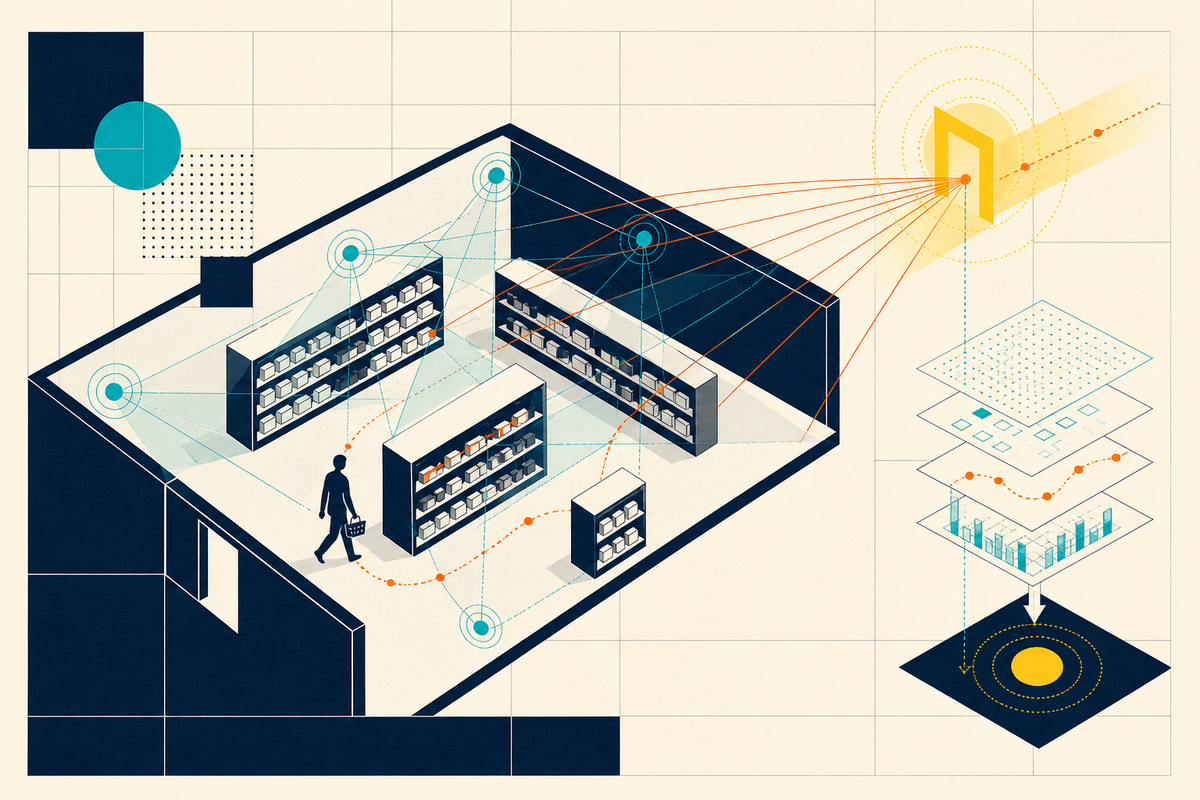
That vanishing act is Cloudpick's business. The company builds cashierless stores from a carefully coordinated stack of cameras, depth sensing, shelf signals, edge computing, payment connections, and cloud software. Its algorithms distinguish a pickup from a put-back, connect an item to the right shopper, and give the operator a remote view of sales and stock. To a customer, the result should feel pleasantly uneventful. To a retailer, the same visit becomes a stream of operational data.
Cloudpick calls the underlying model a digital twin of the physical store. The phrase can sound grandiose until you picture its most useful job: keeping an accurate second version of the room in software. In that version, each shelf has a state, each item movement becomes an event, and each shopper carries a provisional cart. The difficult work is making that model survive actual humans, who browse in groups, block cameras, inspect two nearly identical packages, and put the granola bar back beside the toothpaste.
01 / The mechanismA store with a memory
A conventional checkout resolves uncertainty at one fixed point. The customer presents every item to a scanner, and the scanner converts the basket into a bill. Cloudpick moves that accounting process across the whole room. Shoppers authenticate at the entrance with a QR code, payment card, employee credential, or a retailer's own app. Cameras and other sensors then follow interactions with merchandise. When a person leaves, the system settles the basket through an integrated payment method.
One visit, five coordinated systems
The multi-sensor approach is important. Pure image recognition has to deal with hands, bags, crowded aisles, and changing packaging. Shelf data can confirm that the physical weight or position changed. Edge processing lets the store respond without sending every raw moment on a long trip to the cloud. The separate signals are less interesting than their agreement. A reliable transaction emerges when the software knows who acted, where the action happened, and which product moved.
Founder and CEO Jeff Feng came to this problem from research in computer vision, pattern recognition, machine learning, and human-computer interaction. In a 2023 McKinsey interview, he described the opportunity in plain terms: repetitive checkout work can be handled by algorithms, while computer vision can also show how shoppers interact with products. That second half matters. A completed sale tells a retailer what won. A pickup followed by a put-back records what almost won.
“Computer vision can also understand shopping behavior - how consumers interact with products in the store.”Jeff Feng, in conversation with McKinsey, 2023
02 / The customerThe economics of a very small shop
Cloudpick's natural customers are operators with a location that has demand but awkward staffing math. Consider a campus between lectures, an office lobby after dinner, an airport satellite hall before dawn, or a fuel station late at night. A small shop may not generate enough sales to justify a cashier on every shift, yet closing it leaves useful demand untouched. Self-checkout reduces some work but still asks each customer to stop, scan, troubleshoot, and pay.
A cashierless format changes that calculation. It can keep longer hours, move people through a compact footprint, and let staff concentrate on replenishment, merchandising, and exceptions. Cloudpick has supplied formats to established retailers and technology partners including Auchan, Schwarz Group, FairPrice, NEC, CAINZ, Coca-Cola HBC, Etisalat, NTT DATA, and Don Quijote. Its case studies span convenience food, branded beverage shops, pharmacies, universities, airports, and modular stores placed outdoors.
The numbers need a timestamp. Cloudpick's public pages currently carry different totals, including 700-plus, 1,000-plus, and 2,000-plus stores, while the 2023 McKinsey profile reported more than 800 across 20 countries. The clean conclusion is not a precise live counter. It is that the company moved beyond a single-market pilot and into repeat deployments with recognizable operators. Cloudpick now says it serves more than 100 partners and customers across 30 countries.
The product family reflects those different sites. The full AI-Powered Unmanned Store serves open-shelf shops. Moby Mart packages the idea into a movable, container-like unit for campuses, communities, events, and parks. The Computer Vision Coolbinet shrinks it toward a cabinet that can sit near the last few meters of demand. Behind all three, the Store Digital Management System handles stock alerts, prices, promotions, reports, and remote oversight.
03 / The differenceNo tag on every chocolate bar
Retail automation offers several compromises. A vending machine controls inventory tightly but limits browsing and assortment. Self-checkout preserves the store but transfers scanning labor to the customer. RFID can identify merchandise automatically, but each item needs a tag and the operation inherits the cost of attaching and maintaining it. Smart carts add computation to the trolley, which makes sense in a large supermarket but less so in a twelve-square-meter lobby shop.
Familiar shortcuts
- Self-checkout keeps scanning
- RFID adds an item-level tag
- Vending limits browsing
- Smart carts need a cart
Cloudpick's wager
- Recognize the interaction
- Fuse vision with shelf signals
- Keep merchandise on open shelves
- Use one system across small formats
Cloudpick's distinction is not that it invented the grab-and-go idea. Amazon Just Walk Out, AiFi, Trigo, and Zippin all occupy the same broad market. Cloudpick's pitch is an integrated, tag-free stack that can be deployed quickly, connected to local payment and identity systems, and reused across several store shapes. The company also sells the less cinematic layer: remote operations, inventory visibility, shopper-path analysis, sales forecasts, digital signage, and promotion tools.
That package makes it a business-to-business infrastructure company rather than a retailer. Revenue comes from combinations of hardware, software, installation, support, and analytics. Cloudpick Japan has publicly referenced subscription plans, while the broader product materials describe SaaS merchant platforms. Each serious deployment is still physical and local: cameras need positions, shelves need calibration, entry and exit need design, and payments must work in the market where the door stands.
04 / The expansionWhen the shopper is an engineer
The most revealing extension of Cloudpick's technology has no shoppers at all. Its AI Smart Warehouse applies the same event-recording logic to a hospital supply room, factory tool crib, laboratory store, or office cupboard. An authorized worker enters, takes gloves, a medical consumable, a spare part, or a drill, and leaves. The system associates the movement with that person or department and updates inventory without requiring an RFID tag on every object.
This changes the problem from checkout convenience to accountability. Manual ledgers are easy to skip. Periodic stock counts discover a shortage after it matters. Cheap, frequently used supplies are individually unremarkable but collectively expensive. A live record can show what was taken, where it went, when a threshold is approaching, and which site needs replenishment. Cloudpick says its warehouse system can learn a new item in roughly 20 seconds and allow several people to use the room simultaneously.
The move also widens the company's market. Retail technology budgets rise and fall with store expansion, but materials management appears in healthcare, manufacturing, construction, research, and logistics. The core expertise remains recognizable: spatial computation, object recognition, behavior recognition, sensor fusion, and the creation of a usable digital record from an untidy physical place.
05 / The riskTrust is part of the interface
Removing the checkout does not remove retail's obligations. It relocates them into software. A wrong charge is no longer corrected by a cashier who can see the cereal in front of them. Privacy expectations differ by country. Payment failures, identity systems, age-restricted goods, returns, and crowded scenes all demand an exception path. For a merchant, the labor does not become zero; it shifts toward replenishment, customer support, maintenance, and remote supervision.
This is why partnerships matter. Epson invested in Cloudpick in 2022 and described co-creation around advanced retail operations. NEC combined Cloudpick's store technology with its own identity and retail systems. In Japan, NTT DATA's Catch&Go service provides the operating relationship around deployments using Cloudpick AI. These arrangements let a specialized perception engine sit inside payments, retail software, and service networks that customers already know.
The company's mission is to free people from mechanical, repetitive work so they can do more creative, higher-value work. The claim is appealing, but the test is operational rather than philosophical. Does the receipt arrive accurately? Can a confused shopper get help? Does the operator know what to restock? Can the system pay for itself in a small, low-margin location? Invisible technology earns trust by being boring on the busiest day of the week.
06 / The marketFrom spectacle to plumbing
Cloudpick was founded in 2017, when staffless shops were often presented as science fiction made retail. The market has matured into a more grounded set of choices. Some stores need faster self-checkout. Some need smart carts. Some need a cabinet in an office. A narrower group can justify full autonomous checkout. Cloudpick's advantage is the ability to move along that spectrum while keeping a common perception and management layer.
Recent deployments illustrate the practical turn. Don Quijote opened its first unmanned small-format campus shop in Japan in 2025 with roughly 450 food, stationery, and daily-use items. CAINZ has used the technology in mobile and 24-hour formats. Chateraise opened an unmanned shop at Nanyang Technological University in Singapore. These are not attempts to replace every supermarket. They target constrained places where queues, limited hours, or shift coverage create a specific cost.
The future Cloudpick is selling may therefore look surprisingly ordinary: a room with shelves, fluorescent light, and a door. Its novelty lives in the record underneath. The shelf knows something moved. The virtual basket knows who moved it. The inventory system knows one fewer remains. The operator knows before arriving. And the customer, ideally, knows almost nothing happened at all.