Tarun Kumar Roy had booked the meeting room. He was new at Quantanite, with a US client to speak to, and arrived to find somebody already settled inside with a laptop. Roy explained that he needed the space. The occupant apologised and left. Only then did the encounter acquire its punchline: the obliging stranger was Mikko Tamminen, the company’s founder and chairman.
There are more theatrical ways to introduce a business leader. This one has the advantage of involving an actual booking. The company was Tamminen’s creation; the room, for the allotted time, belonged to Roy. A modest distinction, easily overlooked by someone accustomed to getting his way.
It is also a useful opening to a career spent arranging for other people to get things done. Tamminen founded Taskeater in 2014, building delivery operations in Bangladesh. The business became Quantanite, spread internationally and added customer operations and technology to its offer. His own role changed too. The founder who once ran the daily operation became the chairman supporting somebody else at the controls.
A company with an appetite for other people’s tasks
Taskeater was a pleasingly unambiguous name. You could put it in front of a busy manager without first supplying a glossary. Companies accumulated work; Taskeater offered people to handle it. Research, verification and prospect lists might lack the romance of launching a product, but the product’s sales team still needed the list.
Tamminen’s interest in business had an earlier printed expression. In 2000, he published Pörssikauppa: osakemarkkinoiden perusteita koululaisille, a Finnish guide to stock market basics for schoolchildren. It ran to 28 pages. Some people’s introductions to finance require a shelf; this one could be finished before lunch. The title sits oddly, and rather nicely, beside the later chairman’s biography: an early attempt to explain a complicated commercial system in manageable pieces.
He went on to study management at Warwick and spent time at Wharton. His professional background included private equity and startups across emerging Asian markets, Europe and the United States. By 2014, the commercial problem he chose to tackle was the recurring operational work that growing companies needed somebody to own.
His 2018 explanation of lead generation gives the idea some texture. Taskeater researched prospects against a customer’s criteria, built and checked lists, and conducted the first email outreach. The service extended through the tedious middle between deciding whom to approach and receiving an interested response. Tamminen described an operation in Dhaka approaching 400 people.
“We eliminate the bottleneck. All our clients need to deal with are the positive replies.”
Mikko Tamminen · 2018
The appeal was time. A sales manager could spend an afternoon supervising research or spend it talking to a prospective buyer. Neither activity was optional. Tamminen’s proposition was to organise the first so the customer could concentrate on the second. The administrative work did not disappear when it crossed a border; it acquired a team responsible for delivering it.
- 01Define the prospects
- 02Research & verify
- 03Make first contact
- 04Hand over interest
The geography of a growing promise
The Bangladesh delivery centre opened in March 2014. The company entered the UK market in 2015 and the United States in 2017. Those dates describe two different kinds of expansion: finding customers and building the operation that could serve them. A company selling dependable work had to make the distance between the two feel uneventful.
Its own history records a group milestone of 1,000 employees in 2019, followed by 1,500 in June 2021 and 2,000 in April 2023. These are dated checkpoints, rather than a headcount to attach permanently to Tamminen’s name. They show the scale of the coordination problem changing. More people bring more capacity, and more occasions for a handover to go wrong.
South Africa joined the operating map in 2020; a Johannesburg customer experience centre followed in 2022. By its tenth anniversary in 2024, Quantanite was also discussing its Mumbai technology operation and an ambition to combine service delivery with AI. The business that began with a very literal name now had several kinds of expertise to fit under one roof.
That geographical spread makes the founder’s original choice look more consequential. Dhaka was the beginning of a continuing operation, with international sales and delivery relationships accumulating around it. The business had to keep earning the right to receive another client’s unfinished work. A new office could make a handsome announcement. The following morning, somebody still had to answer the customer.

Eighteen months before the handover
On 4 January 2022, Quantanite announced Atreya Chaganty as its new chief executive. Tamminen stayed actively involved as executive chairman. He had been CEO through December 2021; now he would work closely with his successor and the management team.
The telling detail is the period before the appointment. Tamminen said he and Chaganty had worked closely for 18 months and had spent considerable time discussing the company’s opportunities and challenges. His confidence rested on familiarity with how the incoming leader understood the business, including its culture.
For a founder, that is a different form of work from approving the next operational decision. It means deciding who can make those decisions, and building enough understanding that the appointment is more than an exchange of business cards. The succession announcement described continuity in a relationship already under way.
Tamminen’s chairman responsibilities centre on governance, strategy and supporting the executive team. Those words can sound ceremonial until a company has to make a difficult choice. Who sets direction? Who tests the assumptions? Who helps the people accountable for delivery? The change in title moved his attention toward the framework within which other people worked. That framework matters to a client as well as an employee: it determines who can settle a problem and who must take responsibility for it.
The founder returns to the classroom
His education continued after the handover. Stanford Graduate School of Business identifies Tamminen as a member of its MS class of 2024. His professional profile also lists him as a Sloan Fellow and Robert Joss Scholar. A founder with years of operating experience had put himself back in the position of being taught.
When Stanford celebrated its teaching award recipients in 2024, Tamminen spoke about Allison Kluger’s Reputation Management course. What impressed him included her ability to engage a class, her enthusiasm, and her attention to individual students. He singled out the care offered to each person willing to receive it.
It is an unusually personal detail in a record otherwise full of market entries and workforce milestones. At business school, he was discussing the experience of being noticed. The teacher remembered the individual in the room; the student remembered the teacher for doing so.
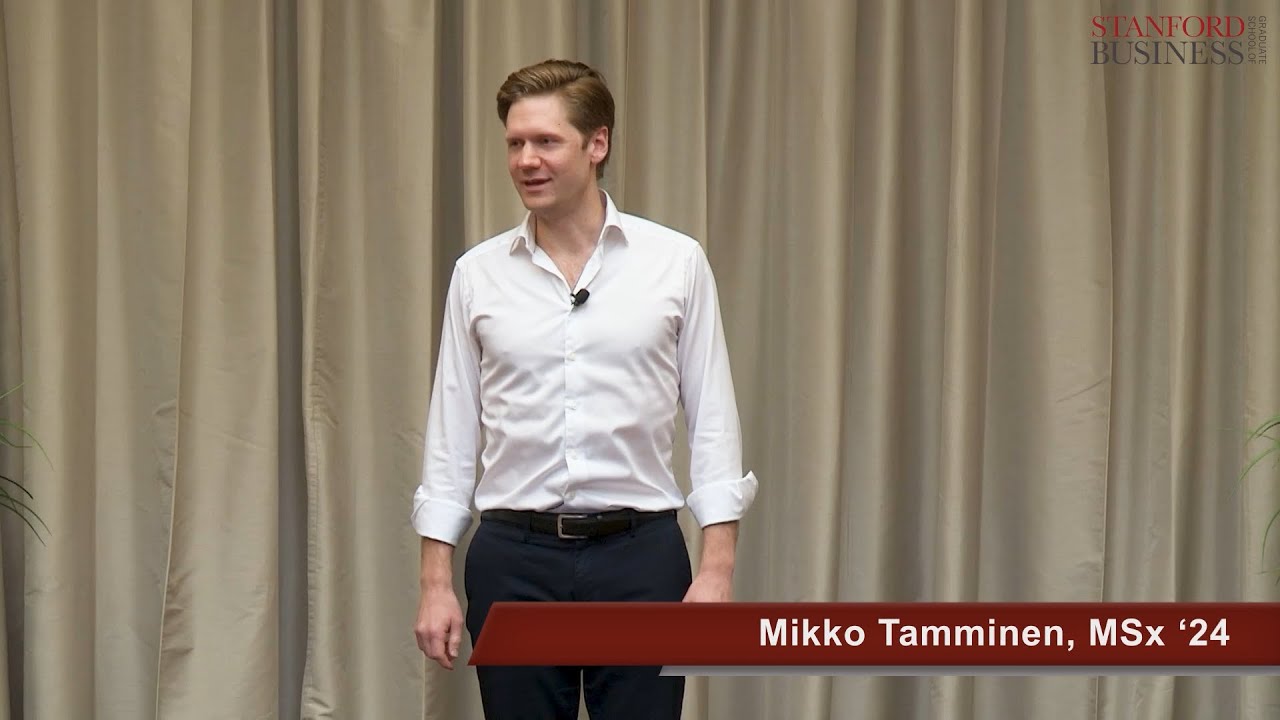 ▶ Watch the Stanford talk
In a LOWkeynotes presentation shared by Stanford in 2025, Tamminen discussed spirituality and the different paths people take toward belief. He described learning from more than one tradition, rather than assuming that a single path had to supply every answer. The talk gives a public glimpse of questions extending beyond the next commercial milestone.
It also changes the register of his story. Alongside an outsourcing founder explaining a sales process is a speaker considering what a person chooses to believe. The two appearances belong to the same career without requiring every private question to be converted into a management technique.
A shorter journey to school
Another chapter leads back to Bangladesh. OHARU lists Mikko and Sabreen Tamminen as co-founders of an education initiative for children from ethnic minority communities in rural areas. Its stated purpose concerns a practical barrier: a school may be available, yet reaching it from home may be too difficult.
OHARU describes an approach involving affordable accommodation near schools, supplies and collaboration with local communities. The accommodation question is particularly relevant where distance and family resources constrain a pupil’s options. The initiative’s aims are concrete enough to picture: somewhere to stay, the materials to learn, and a school day made possible.
The public description is a statement of purpose, and it deserves to stay in that tense. Its ambition is to remove obstacles to attendance. An education initiative earns its meaning through what pupils can actually do as a result. A place near school has value when it helps a child get to class.
When the task itself becomes the question
In April 2026, Quantanite published the launch announcement for QiQ, a decision intelligence platform. The company describes software that examines customer interactions, identifies recurring problems and helps organisations change the processes producing them. Its commercial ambition now includes preventing some of the demand that service teams would otherwise have to handle.
For Tamminen’s company, the progression is understandable. Years spent dealing with operational work create an interest in why the same difficulties keep returning. A queue can be staffed. Its causes can also be examined. QiQ is the company’s stated attempt to connect those activities; the launch describes the proposition, while results must be judged in use.
Tamminen’s own progression has involved a similar reassignment of attention: from running the operation to supporting its leadership, from experience back to study, and from a commercial organisation to an education initiative. Each chapter has a different measure of useful work.
The meeting room remains a good place to leave him. An employee had a call to make. The founder had somewhere else he could sit. For that moment, the useful decision was simply to leave the room and let the person who had booked it get on with his call.