In 1998, Kenneth M. Woolley had been in self-storage for twenty-one years. His portfolio held twelve properties. He knew how to develop buildings, find financing and sell what he had built. What came next required a change in habit: keeping more of the properties, bringing in a partner and giving one business more of his attention.
That year is a useful place to begin his story. The first building had opened long before, in Billings, Montana, in 1977. But a building and an enduring company are different undertakings. Woolley had spent two decades learning the former. Now he wanted to assemble the people and money for the latter. A corporate strategy teacher was about to give himself a fairly demanding homework assignment.
Twenty-one years between the first store and the partnership that reshaped Extra Space.
A stamp dealer takes the long route
Woolley’s commercial education began with things considerably smaller than buildings. At thirteen, he distributed collectible postage stamps. Later, he helped pay his way through college by importing and selling antique British cars. Before the storage doors came envelopes and engines: objects whose value depended on finding someone who wanted them.
His academic route was less predictable. He earned a bachelor’s degree in physics at Brigham Young University, followed by an MBA and a doctorate in business administration at Stanford. Physics supplied one kind of problem. Business offered another, with people, prices and financing making the variables less obedient.
As a Stanford graduate student, he became interested in storage through a research project. He later worked as a management consultant at Boston Consulting Group. The combination matters: Woolley encountered the business through study, then accumulated experience examining companies. Storage was a subject he could investigate before he committed to building it.
He grew up in Northern California’s Bay Area, where self-storage was already familiar. Moving to Boston brought a different view of the market. He noticed the relative scarcity of the product on the East Coast. An ordinary building type, seen in a different place, began to look like an opportunity.
Forty thousand square feet in Billings
The first store was called Secure-it Mini Storage. It opened in Billings in May 1977, with 40,000 square feet. The name had the practical directness of a padlock. There was no need to explain the product at length: customers needed somewhere to put their belongings, and the building provided it.
Extra Space Development Company was formally organized as a Wyoming limited partnership in 1979. An Orem, Utah, development followed that spring, near a university, in a populated location with visibility and access. San Jose and Los Angeles facilities were completed in 1980. Location was already part of the proposition.
During those years, Woolley also taught. His business administration teaching at BYU ran from 1979 to 1998, first as an associate professor and later as an adjunct associate professor. His subjects included corporate strategy and real estate. The classroom and the construction site occupied the same career.
The business did not advance in a smooth line. High interest rates slowed development in the early 1980s and again in the early 1990s. Borrowing costs could interrupt a promising plan regardless of how well the buildings worked. A developer could know the product thoroughly and still have to wait for the arithmetic to cooperate.
“You’re just trying to survive.”
Ken Woolley, recalling the early business
He developed and sold properties, recycling the proceeds into further projects. Between 1983 and 1989, he also worked as a preferred developer for Public Storage. A future competitor was part of his working education. The route toward a national storage company included doing business with a company already pursuing that market.
The partner who needed a site visit
Spencer Kirk brought a different background. He had co-founded Megahertz, the laptop modem business, and Woolley had served on its board. By the time Woolley approached him about storage in 1998, the two already had a working connection. Persuading Kirk still required more than familiarity.
Kirk’s first impression of self-storage was unflattering. Woolley took him to see facilities in Los Angeles and Boston. These were modern buildings in dense metropolitan markets, a different proposition from the rough industrial compounds Kirk associated with the category. The site visit changed his view. Sometimes the most useful sales presentation is an address.
They reorganized Extra Space Storage LLC in June 1998, with Woolley as CEO and Kirk as executive vice president. Prudential Real Estate Investors became a financial partner. The strategy shifted toward buying and holding a portfolio. The twelve-property business now had a structure intended to support something larger.
The corporate strategy class Woolley was teaching helped prompt the change. His own company presented a concrete question: how could the knowledge accumulated in individual transactions become an organization capable of growing beyond them? A partner, a team and a durable source of capital made an answer possible.
Making an unglamorous business presentable
Storage has a wonderfully literal relationship with its customers. It rents room. Yet the choice of that room involves practical judgments: whether the site is convenient, whether it looks cared for, whether booking it is easy. Woolley paid attention to those decisions. Clean buildings and a useful location could alter what customers expected from the category.
By 2003, Extra Space emphasized attractive construction, lighting and careful site selection. Its marketing included direct mail, coupons and online reservations. These details belong in Woolley’s story because they show the operating choices behind the later financial milestones. The buildings had to attract tenants before the portfolio could attract investors.
Technology became part of that approach. The business used pricing and promotions tailored to different customer needs and storage products. Woolley placed this alongside investment in employees and fairness in transactions. Those priorities connect the analytical side of his career with the practical work of running a service business.
A person renting a unit sees a nearby store and its staff. An investor sees a portfolio. Management has to make those two views agree often enough to produce a repeatable business. That is where the less photogenic work sits: hiring, training, answering questions and keeping a promise made at the front desk.
From twelve properties to the stock exchange
Extra Space began trading on the New York Stock Exchange on August 20, 2004. Its IPO raised $252.5 million gross. The following year, a joint venture with Prudential acquired Storage USA from General Electric for $2.3 billion. The transaction brought 458 facilities into the deal.
Those dates compress an enormous change in scale. Seven years after the partnership with Kirk, Woolley’s company was buying a large national portfolio. The business that had once sold developments to finance the next project could now participate in a transaction that reshaped its place in the industry.
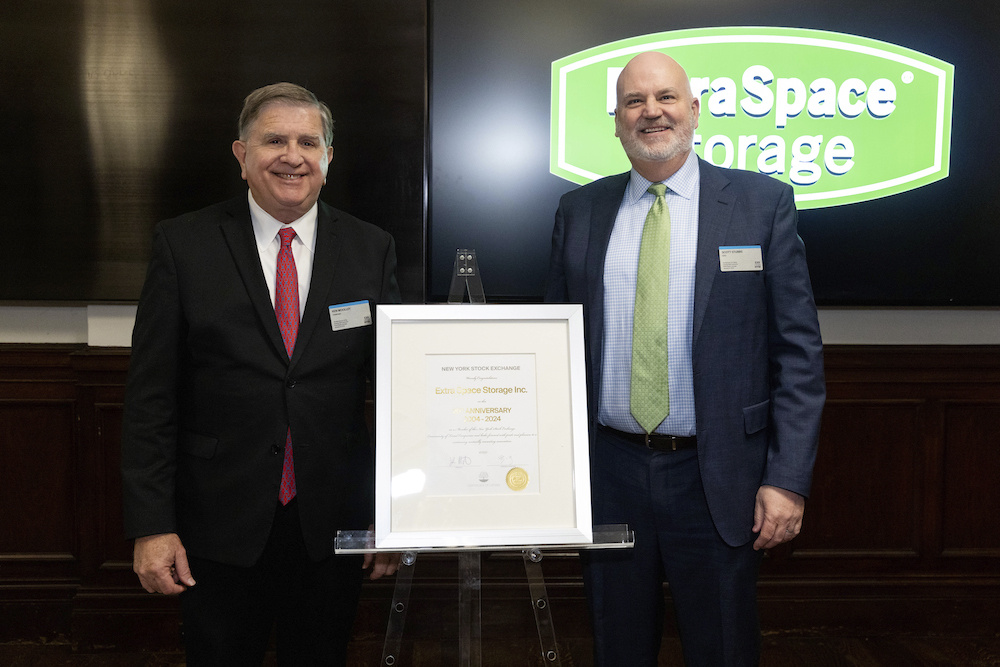
The achievement also attracted recognition from his peers. Woolley entered the Self Storage Hall of Fame in 2014. He had joined the Self Storage Association in 1977, the year of that first Billings property. His working life in storage and the industry’s organized history had developed alongside one another.
Knowing the manager’s name
Joe Margolis, who later became CEO, remembered a founder who knew store managers personally, including their spouses, children and interests outside work. That recollection gives Woolley’s employee philosophy a human scale. Before a company has thousands of locations, someone has to decide what kind of attention its people deserve.
Another thread runs through his public conversations: friendship and trust. In a 2023 interview with Whitney Johnson, the discussion of his career ranged across airlines, apartments and vintage cars, with relationships holding the account together. The variety is striking. Woolley’s résumé has enough different businesses to make a conventional job application rather crowded.
He also made room for a commitment outside business leadership. Effective April 1, 2009, he stepped down as chairman and CEO to undertake a three-year church mission, remaining a director. Kirk succeeded him. The transition placed the organization in the hands of the partner he had recruited eleven years earlier.
Woolley returned as executive chairman in July 2012 and served briefly as chief investment officer. He became non-executive chairman in May 2018. His relationship with Extra Space continued through changing responsibilities. Founding the business had become one part of a much longer association with it.
Room for the next person
In February 2026, Woolley was still discussing the economics of storage in a public interview. He described a difficult market shaped by supply and financing conditions, while maintaining confidence in longer-term demand. Nearly half a century after Billings, he remained engaged with the same questions of buildings, capital and customers.
Another succession was announced in August 2026. Noah Springer would become CEO on January 1, 2027, following Margolis’s retirement at year-end. Woolley, speaking as founder and chairman, endorsed the choice. At June 30, 2026, the company owned or operated 4,410 stores across 42 states and Washington, D.C.
The distance from twelve properties is easy to count. The more interesting change is the number of people who could carry the work forward. Kirk joined. Margolis followed. Springer was preparing to take responsibility. Woolley’s second beginning in 1998 had created room for those careers as well as for the buildings.
For someone whose earliest business involved stamps, it is an unusually large collection. Its defining feature is that other people now help decide where it goes.
Follow the conversation
More from Woolley and the people who worked with him.
Listen: Leading Voices with Matt Slepin ↗Listen: Disrupt Yourself with Whitney Johnson ↗Listen: Stories Behind the Door, February 2026 ↗Watch: Huntsman School entrepreneurship lecture ↗Read: The announced 2027 CEO succession ↗Read: Scott Stubbs on twenty years at the NYSE ↗Read: Woolley’s early entrepreneurial ventures ↗Kenneth Woolley on LinkedIn ↗Extra Space Storage website ↗