The photograph has flowers in it. Pankaj Dhanuka is standing on an office floor in Kolkata, holding a bouquet, surrounded by colleagues. The ceiling tiles are ordinary. So are the desks behind him. For someone whose working life involves buying companies across borders, it is a pleasantly modest setting: the business, briefly, at the scale of a conversation.
The occasion was a Fusion CX town hall in August 2025. More than 300 employees attended. Dhanuka and other senior leaders visited teams in their workspaces, where employees put questions to them directly. The scene offers a useful starting point for understanding the company’s co-founder, chairman, managing director and CEO. An international business can be described through its acquisitions. It also has to be understood through the people expected to make those acquisitions work.
The accountant leaves the ledger
Dhanuka’s formal preparation was in finance. He holds a bachelor’s degree in commerce from the University of Calcutta, with qualifications in chartered accountancy and company secretarial work. Unit Trust of India appears among his earlier employers. These are credentials suited to reading a business closely: how it is financed, how it is governed, and where its obligations sit.
His present responsibilities cover Fusion CX’s vision, strategy, growth and innovation. There is a considerable distance between understanding an organisation’s accounts and being responsible for the organisation itself. In customer experience, that responsibility reaches all the way to the interaction a client’s customer has with an agent. An unhappy caller is unlikely to be impressed by the elegance of the ownership structure.
He and Kishore Saraogi founded the business in 2004. Dhanuka recalls pooling ₹85 lakh and sketching a plan in a café. Earlier experience setting up a call centre helped shape the choice of industry. The partnership has endured: Saraogi serves as managing director and chief operating officer, responsible for operations and executing growth initiatives. Their roles give the story two recurring characters, with strategy and daily delivery continually meeting in the middle.
Pankaj Dhanuka and Kishore Saraogi found the business that becomes Fusion CX.
Canada sends the bill
The company’s history places its acquisition of HelpDeskNow in 2007, bringing centres in Newfoundland, Canada. Buying abroad enlarged what a business founded in India could offer. It also placed part of its operation inside another country’s employment practices and administrative requirements. A border is a small line on a presentation slide and a much larger presence in a payroll department.
Dhanuka recalls costly Canadian operating and payroll problems in early 2008, then a recovery supported by cash from India. The expansion continued. Fusion acquired O’Currance Teleservices in 2012 and opened a Utah delivery centre. Phocus Contact Solutions in Canada followed in 2013.
By the Phocus transaction, the founders were already describing growth in terms of the people who could carry it out. Dhanuka credited executives across India, the Philippines, Canada and the United States. Saraogi emphasised integrating management teams from different backgrounds and distant locations. The machinery behind an international company was becoming part of their explanation of its success.
That transaction also involved financial support from Exim Bank of India. It is a useful detail in a founder’s story: ambition requires institutions, colleagues and financing arrangements that rarely fit into a neat portrait. The acquisition announcement belongs to the person at the top. The resulting organisation belongs to a much longer chain of decisions.
- 2004The founding partnership
- 2007HelpDeskNow · Canada
- 2012O’Currance · Utah
- 2019Ameridial · United States
- 2026VA Platinum · Australia
A selection of acquisitions and milestones, rather than a complete transaction history.
A deal needs people who can run it
Ameridial joined Fusion in January 2019 as a wholly owned subsidiary. Founded in 1987, it brought more than 800 employees and an established American contact-centre operation. Acquiring a business with its own history means taking responsibility for relationships formed long before the buyer arrived. A new parent company inherits expectations along with capacity.
Boomsourcing added another dimension in 2022. The Utah business combined outsourcing operations with soundboard technology and resources in the United States, Mexico and the Philippines. Dhanuka’s expansion was accumulating methods and tools as well as addresses. Each addition changed the range of work the combined organisation could undertake.
The S4 Communications acquisition, announced in January 2025, brought more than 900 employees in Houston and the Philippines. Its telecom and utilities expertise fitted with Fusion’s voice bots, chatbots, analytics, accent harmonisation and quality-management technology. S4 had recorded $23.5 million in revenue during 2024. These were existing operations with customers to serve while their ownership changed.
Two months later, Fusion announced the acquisition of Sequential Technology International. The planned investment in buying and integrating the business was approximately $12 million. That wording deserves attention: integration was part of the investment. Andrew Wilmott, Fusion’s president, took on oversight of the acquired business. The company named the person who would have to make the transition function.
Planned investment in acquisition and integration.
The work after signing is part of the bill.
The leadership structure was changing too. In February 2025, Fusion announced four board appointments drawing on accountancy, finance, human resources and investment banking. Ritesh Chakraborty and Bradley Call also joined the board alongside the founders. The expertise being assembled was broader than a single founder’s original training.
Dhanuka linked the appointments to international expansion and to services combining people and technology. A growing organisation needs colleagues who can challenge assumptions from different directions. Finance can ask whether an acquisition is affordable. Operations must ask whether it can be absorbed. Human resources has to consider the employees whose working lives appear beneath both questions.
A bouquet on the office floor
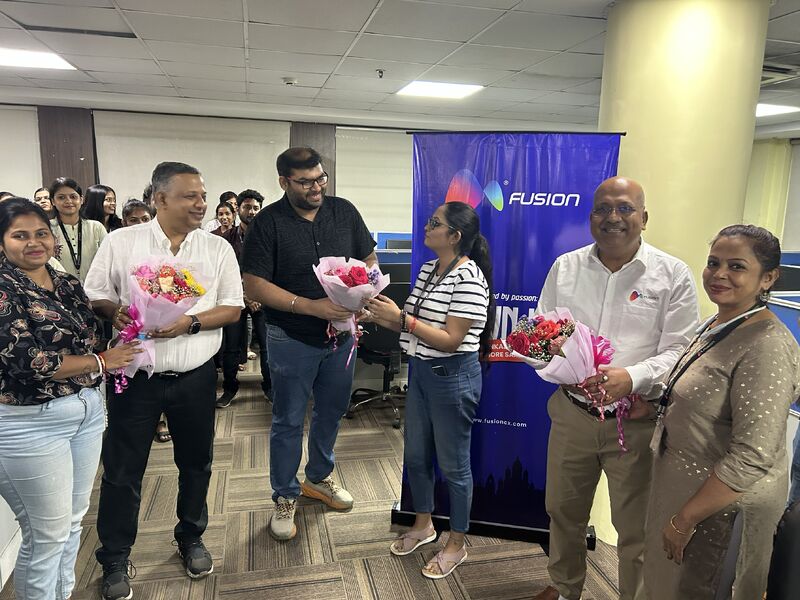
The Kolkata gathering makes those organisational questions visible at a smaller scale. Saraogi was there alongside Dhanuka. So were the chief financial officer, company secretary and senior colleagues responsible for human resources and learning. Employees asked questions and offered ideas. The people responsible for different parts of the business were sharing the same floor.
A town hall is one occasion, with all the limitations of an occasion. Its value here is in the arrangement: leaders moved through the workplace, and staff could address them directly. An employee’s question has a different journey when its intended recipient is standing nearby. For a company spread across countries, opportunities to shorten that journey matter.
In December 2025, Dhanuka received the Silver Feather Awards’ CEO of the Year recognition, while Fusion CX received Outsourcing Organization of the Year. His response began, “This recognition belongs to our teams”. The accompanying emphasis was on consistent execution and customer outcomes. It was a suitable vocabulary for a business whose work is delivered through thousands of individual exchanges.
The cost of being understood
The company he runs now describes its work across voice, email, chat, social media and messaging. The customer can change channels; the company handling the interaction still has to preserve enough context to be useful. Fusion’s move from the BPO name to Fusion CX places customer experience directly in the identity of the business.
Dhanuka’s public argument about AI begins with a criticism of his own industry’s habits. Too much attention, he says, has gone toward making service cheaper. He argues that customers want greater understanding. His proposed division of work gives repetitive tasks to AI and leaves people responsible for complexity and emotionally demanding moments.
“But customers weren’t asking for cheaper service. They were asking to be understood.”
Pankaj Dhanuka
That position makes customer understanding a design requirement. The difficulty lies in translating it into staffing, training and tools. An automated response can be quick and still leave someone needing help. A human agent needs the information and authority to finish the job. Dhanuka’s proposition depends on the two parts working together in the actual conversation.
He took the leadership question to IIM Calcutta’s Being a CEO series on 31 January 2026. His session concerned decisions, doubts and direction in a world shaped by AI. The setting brought an experienced founder into a conversation with MBAEx participants about a technology changing his own business. His accounting background makes that continuing education an interesting part of the picture.
Australia, then another public test
The expansion has kept moving. Fusion announced the acquisition of El Salvador-based Skycom in January 2026, adding approximately $25 million in annualised revenue and strengthening its Latin American delivery operations. Dhanuka described nearshore delivery as a priority for enterprises seeking operations closer to their markets, including culturally aligned service. The geography still matters, even as more of the work becomes digital.
September brought VA Platinum and entry into Australia. That business supplies dedicated offshore professionals for finance and accounting, mortgage broking, financial planning, legal work, real estate and other specialist functions. Dhanuka highlighted its knowledge of the Australian market. After years of buying customer-service operations, he was adding another kind of expertise: people assigned to specialised business work.
By 15 October 2026, he and Saraogi were discussing Fusion CX’s launched ₹702 crore initial public offering. It comprised a ₹500 crore fresh issue and a ₹202 crore offer for sale, with some proceeds intended for debt repayment and AI-tool upgrades at subsidiaries. Their business had reached a stage where its growth plans were being presented to a wider investing public.
The setting changes again: an office floor, a boardroom, a classroom, an interview about an IPO. Through each runs the same practical responsibility. Dhanuka has built by bringing more businesses and more people into the organisation. Each addition gives him and his colleagues another promise to keep when the next customer gets in touch.