Before there was a billion-dollar transaction, there was a tuition bill. Shegun Otulana was studying at the University of Alabama at Birmingham, far from the Lagos where he had grown up. Some semesters, the arithmetic refused to cooperate. He delivered pizzas. He used credit cards. One semester, a friend paid the bill that would otherwise have stopped his education.
The amount, he later recalled, was $5,000. In a startup biography, that might qualify as an opening anecdote before the money gets interesting. In Otulana’s story, it deserves to stay in view. Years later, after he had built and exited a software company, he and his wife Mary gave $1 million to establish a scholarship at the same university. The original kindness had acquired a much longer reach.
Between those two sums sits a career with more false starts than the tidy version suggests. There was an early business that failed to work out, a return to employment, another attempt with family savings and debt, and eventually a $1.25 billion exit. There was also a choice about where to spend the next chapter. Otulana stayed in Birmingham. He had people there, and work he wanted to do.
as described by Otulana
with Mary, announced 2022
Lagos had already supplied the business education
Otulana arrived in Birmingham in 1998, aged 18, following an older brother to UAB. His parents were business owners in Lagos. Neither had a college education or the political and business connections that might have smoothed their path. They built gradually, through ventures including property rentals and gas stations. Their son saw entrepreneurship before he encountered its professional vocabulary.
He has described the family as middle class at his birth and upper-middle class by the time he left Nigeria. That distinction matters. A family can have resources at home and still struggle to pay American tuition when an economy weakens and its currency loses value. At different points, his parents were supporting three international students at UAB. Their ambition for their children was expensive in dollars.
Birmingham offered a new set of relationships. At Smolian International House, Otulana met fellow Nigerian students Bolaji Kukoyi and Stephen Odaibo. He would later describe it as “a place of refuge.” All three went on to build businesses and support scholarships. The institution that gave them somewhere to gather also became somewhere they could give back.
He graduated in 2003 with a degree in management information systems. He also met Mary at UAB. The university was becoming a rather efficient introduction service: education, friends, a future spouse and a city in which to build a life.
The first company did not provide the happy ending
After college, Otulana worked as a network administrator at U.S. Infrastructure. In 2004, he started Zertis, a software and IT consultancy, with a classmate. They disagreed about its direction. Otulana ended up with the company and its debts. An early attempt at independence had left him with obligations, rather than a flattering case study.
He continued his salaried career, joining BioHorizons as a senior systems administrator in 2007. In 2011, he returned to Zertis full time. Mary encouraged him to try again. They committed savings and took on debt. This detail puts another person inside a story usually told through one founder’s name: the household was taking the risk together.
Zertis became a place to test product ideas while taking on software projects. Otulana had criteria for the business he wanted to find. It should be capable of supporting a substantial team. It should be something he could imagine working on for ten years. And it should be a web-based subscription software product. That is a demanding brief for an idea still waiting to introduce itself.
TheraNest arrived in 2013. Therapy Brands followed as a holding company in 2017. Otulana stepped down as chief executive in 2020 while remaining on the board. KKR announced its agreement to acquire a majority interest in 2021; the transaction became the exit around which much of his public biography now turns. Otulana describes the exit at $1.25 billion. By then, his company had passed well beyond the days of a single programmer testing ideas.
- 2004Zertis begins
- 2011Back to building full time
- 2013TheraNest launches
- 2021The Therapy Brands exit
A lime seltzer and a theory of time
For a clue to how Otulana thinks, consider a conference room at Innovation Depot in 2023. Over a lime seltzer, he was explaining a concept he called density. University compresses learning, social discovery and career exploration into a few years. A founder, he argued, can apply a similar principle to experimentation. The useful question is how much learning fits into the time available.
“Make all the mistakes. See what works.” His prescription was to concentrate the early cycle of trial and correction, then let the knowledge compound. There is something disarming about an experienced founder offering permission to make mistakes. The permission, however, comes with a deadline. Three months of concentrated learning is preferable to allowing the same uncertainty to occupy ten years.
His own education continued among neighboring founders at Innovation Depot. Tony Summerville of Fleetio, Nate Schmidt and Jonathan Robinson were part of the circle he later credited with helping him avoid expensive mistakes. They compared approaches to hiring and growth. Advice had practical value because somebody nearby had already paid for the lesson.
His reading list extends that habit beyond the office. It includes Michael Dell’s Play Nice But Win, Claude Hopkins’s Scientific Advertising, Bob Fifer’s Double Your Profits and Harvey Firestone’s Men and Rubber. Software moves quickly; a business book with rubber in the title can apparently still earn its place on the desk.
Make all the mistakes.
See what works.Shegun Otulana, on concentrating the learning
Building a place where another attempt is possible
Harmony Venture Labs gives that approach an organizational home. Otulana is its founder and CEO. The Birmingham venture studio works with founders and established businesses to test opportunities, build products and commit capital alongside partners. The sequence begins with a problem and evidence of demand. An idea that survives the tests can become a company; an idea that fails them can be shelved.
There is discipline behind that arrangement. Speaking to Birmingham’s Rotary Club, Otulana described a combination of venture ambition and private-equity attention to profitability. Birmingham does not have unlimited startup capital. The model he outlined tries to make businesses substantial enough to matter while keeping an eye on whether they can sustain themselves.
HVL’s current experiments include PackPay, aimed at accounts-receivable work, and DealTree, focused on deal sourcing. Its portfolio includes ListedKit, RaveCapture and Copysmith. Otulana also serves as CEO of Copysmith AI, whose products include Frase and Describely. These businesses take him into real estate workflows, customer feedback and content software. The common interest is work somebody already needs to get done.
The studio also has a physical expression. Venture Yards brings founders and business teams together on Birmingham’s Morris Avenue. AppThink teaches participants to move from identifying a problem to building a prototype. Offices, education and company formation sit close together in this version of the ecosystem. A useful conversation ought to have somewhere to happen.
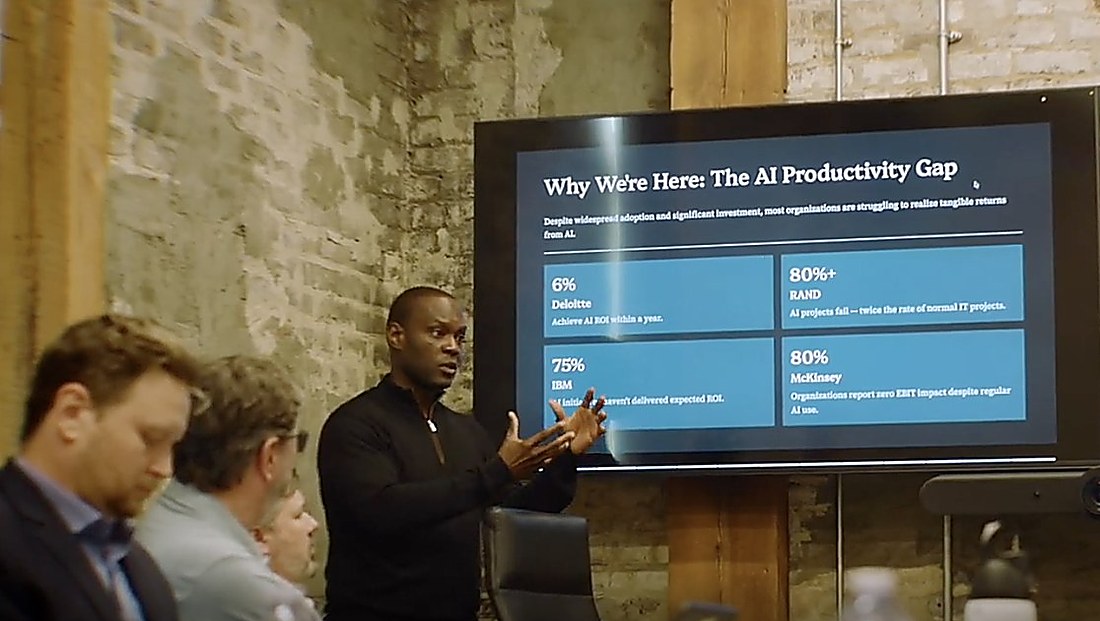
The faster tools still need people who agree
His recent writing shows the operator still at work. In March 2026, he published an essay about letting AI agents operate software serving 50,000 users. He described automated boundaries around their actions, separating operations that must always be blocked from those that need permission in a particular context. The agents, in his account, cannot rewrite the rules that constrain them.
The following month, he turned to human coordination. When individual output accelerates, people can produce incompatible work before anyone notices the disagreement. His proposed response centers on explicit ownership, precise scope and shared objectives. A faster team needs to know where one person’s responsibility ends and another’s begins. Otherwise, enthusiasm merely delivers the confusion sooner.
That concern connects with his earlier writing about company culture. As TheraNest expanded, he found that shared values needed routines and systems to remain present across the organization. A founder’s intentions do not automatically travel to every new employee. The practical work is arranging the business so that its people can keep acting on the same understanding.
The scholarship brings the story back to campus
The Shegun and Mary Otulana Endowed Scholarship makes another part of his thinking concrete. Announced in 2022, it supports international and underrepresented students, with preferences that include students from Nigeria or West Africa and students facing particular barriers to college. Its design reflects a problem the donors had encountered themselves: capable people can arrive at a university and still be unable to afford to finish.
The gift is shared work. Mary is an accountant and entrepreneur, and the couple have four children. Their decision to invest in students also sets an example at home. Education had expanded their own possibilities. They wanted the next family’s financial difficulty to have a better chance of being temporary.
Otulana’s attachment to Birmingham follows the same reasoning. Relationships accumulated here. Opportunities became available here. He has spoken about an obligation to improve the people and places around him, rather than treating success as a reason to leave. His venture studio and scholarship are two distinct ways of acting on that responsibility.
A billion-dollar exit is easy to turn into a finishing line. Otulana’s subsequent choices give the story a different shape. He is back among product ideas, founders, students and the untidy work of helping something begin. The tuition bill was paid long ago. He is still finding people for whom a second chance could make a difference.
Keep the conversation going
Read Otulana’s essays and Let’s Build newsletter, explore Harmony Venture Labs, or visit his personal website.