In 2011, Dennis Kogan and Björn von Siemens set themselves a peculiar limit: one company. They were forming an investment partnership, K v S Beteiligung, with the intention of finding a business they could join, own, and develop over time. There would be capital, contacts, and advice. There would also be their full working days. In an occupation fond of the word portfolio, they were volunteering to become rather attached.
That proposal makes a useful starting point for Kogan. Today, his name is associated with Caresyntax, the company he co-founded in 2013, and with a financing commitment announced at $180 million in 2024. Those numbers can make the earlier years disappear. Yet the small, deliberate premise of the partnership reveals something that a funding announcement cannot: he was already interested in the patient work of operating a business before there was a conspicuous business to celebrate.
By July 2025, the company had reached another decision. Matt Krueger would become CEO. Kogan would remain a director and continue contributing in an executive capacity to capital markets and corporate development. The job had changed. The original question - how to keep building - remained.
A partnership with a one-company limit
Kogan studied management information systems and finance at Carnegie Mellon, then earned an MBA at Harvard Business School. The combination put technical systems and commercial decisions within the same education. Before Caresyntax, his work included Analysis Group and independent assignments in international business development, technology transfer, marketing, and market entry. He had spent time with the awkward middle of a business idea: finding out who might buy it, at what price, and in which market.
There is a useful connection between those early assignments and the choices that followed. Technology transfer and market entry both concern movement: taking something developed in one setting and finding a workable place for it in another. Consulting adds the discipline of asking whether demand and price support the proposition. These are ordinary commercial questions, but they become especially important when a founder intends to work across several markets. A good idea still needs a buyer, a partner, and a way to pay for the next stage.
At Harvard, he met von Siemens. Their early collaboration included international marketing of products in environmental technology and IT. They subsequently established K v S in autumn 2011. In a 2012 interview, they described looking for a profitable company with annual revenue between €10 million and €40 million, and room to grow internationally. Trust with the existing owner and management mattered. They expected those people to remain partners in the work.
The details are revealing. They allowed roughly two years for the search. They wanted a strong base from which to grow. Their proposed contribution included time inside the company. This was an ambition with a calendar and an attendance requirement. Whatever else the future might hold, somebody would have to come to work on Monday.
The business came with a history
Caresyntax’s corporate history has a detail worth lingering over. An investor group around Kogan and von Siemens bought S-CAPE in 2013. That German company had been established in Reichenbach, Saxony, in April 1990. Its headquarters later moved to Berlin in 2015, and it was renamed Caresyntax GmbH in the third quarter of 2018. The 2013 founding date and the older business history describe different stages of the same undertaking.
For a founder, an acquisition changes the starting conditions. There are people to work with, relationships to understand, and existing commitments. The first page already has writing on it. Kogan has described combining entrepreneurship through acquisition with organic company building. The corporate record gives that description a concrete foundation: the team was developing something new with assets and experience that had accumulated before its arrival.
His professional biography also records that he had co-founded and run two companies before Caresyntax. The founder label can flatten this kind of preparation. It bundles earlier attempts, consulting assignments, and market-entry work into a single line beneath a photograph. Kogan’s route was more cumulative. The company people now recognize came after practice in both analysis and execution.
A map is an expensive sales plan
International expansion is one of the recurring subjects in Kogan’s public writing. He has built business-to-business operations across Europe, the Middle East, Asia, and the United States. His advice to other founders has the vocabulary of someone who has had to pay for the exercise. Local relationships take time. Sales infrastructure costs money. A new market can consume both before producing much of anything.
His argument starts with partners who already have customer relationships. A young company cannot casually reproduce an entire local sales organization. He also warns that a small market can bring many of the same complications as a larger one. The size of the opportunity deserves scrutiny before the effort begins. A pin on a map is pleasingly inexpensive; what happens after the pin is considerably less so.
He allows an exception when a local partner offers strategic value or capital as well as sales. That qualification makes the advice useful. It acknowledges that founders make decisions with the resources actually available to them. International ambition still needs a return on the investment. Kogan’s enthusiasm for working across borders comes with a warning about the money that can disappear while a company chases distant possibilities.
“you can burn a lot of cash chasing shadows in distant corners of the world”
Dennis Kogan, on international expansion
The partner approach also appears in the company’s record. In April 2019, Barco announced an agreement with Caresyntax that combined a commercial collaboration with investment and a board seat. Kogan emphasized the reach that Barco’s established position could give the company’s software. It was the practical counterpart of his later advice: work with someone who has already spent years getting through the doors you would like to enter.
The arithmetic beneath $180 million
The August 2024 financing announcement gave Kogan’s company a large headline number. Its composition deserves equal attention. The $180 million commitment consisted of $80 million in equity and up to $100 million in a growth debt facility. The distinction matters when describing his achievement. Equity and borrowing are different forms of capital, and a facility described as “up to” a sum should keep those two words attached.
The announcement also brought together investors including Symbiotic Capital, MTIP, Pictet Alternative Advisors, and BlackRock Innovation Capital. For a company with acquisition plans and international operations, that mix of financial relationships belongs in the story alongside the product.
The announced uses included expanding customer adoption, developing AI and edge-to-cloud applications, and pursuing acquisitions. Caresyntax said it had acquired several US data and technology assets in 2023 and was looking at further transactions. Here, the early interest in buying and building businesses reappears within a larger organization. Acquisitions remained part of the plan, alongside product development and sales.
Those are three separate demands on a founder’s attention. Product work asks what to build. Distribution asks who will use it and how to reach them. Corporate development asks whether an existing business or asset can help. Kogan’s career has repeatedly crossed those boundaries. The financing gave the company resources for each, while making the allocation between them a more consequential decision.
$80MEquity
Up to $100MGrowth debt facility
The name on the office door changes
On July 16, 2025, Caresyntax announced Krueger’s appointment as chief executive. He had been the company’s president and, before that, chief customer officer. Kogan and von Siemens jointly credited his contribution over the preceding decade, including expansion and partnerships. This was a handover to someone with a substantial history inside the organization.
The announcement assigned the founders continuing board roles and executive work supporting capital markets and corporate development. For Kogan, those responsibilities connected directly with earlier parts of his career: assembling capital, evaluating opportunities, and building partnerships. The title changed while several of the underlying tasks continued. A founder’s relationship with a company can outlast a particular job description.
A book with very little varnish
For a less formal glimpse of Kogan, consider his reading. In 2024, he said he was rereading Ben Horowitz’s The Hard Thing About Hard Things. He liked its account of the persistence needed to build a business, calling it a “no BS” description. A repeat reading is a modest but telling detail. The book had evidently remained useful after the introductory excitement of entrepreneurship had worn off.
In another reflection, prompted by old photographs of his early company years, he advised younger entrepreneurs to find a purpose that could sustain them through uncertainty. He also told them to enjoy the process. That last instruction gives the advice some warmth. Years of operating a company are a considerable stretch of one’s life to reserve entirely for the result.
His stated leadership preferences include collaboration, resilience, and experimentation. His product advice begins with end users and includes trust. He has said he would have liked to meet Steve Jobs, particularly for a conversation about product development and the user’s experience. Across these interests, the practical test keeps returning: does an idea work for the people expected to use it?
The early K v S proposal offered capital and knowledge, but also the founders’ working time. It is still a useful way to understand Dennis Kogan. The international partnerships, acquisitions, financing, and eventual handover all belong to a career spent working on what happens after an idea acquires a company. That stage has fewer clean beginnings. It has colleagues, customers, and another Monday.
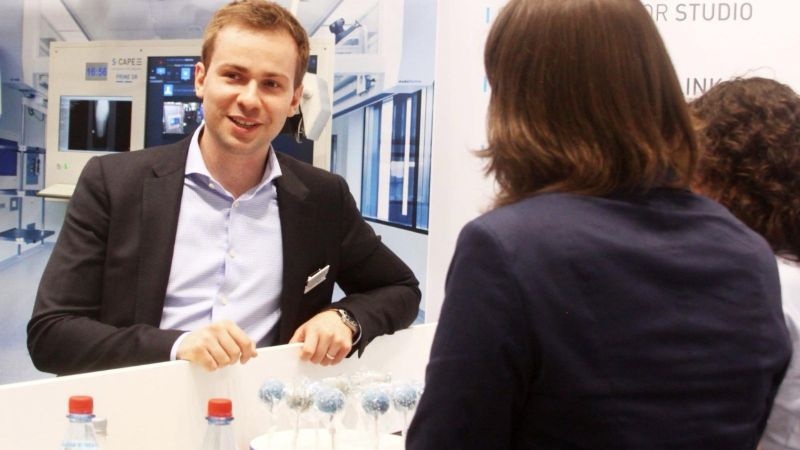
Photograph: Dennis Kogan / LinkedIn. Shared in his 2024 reflection on entrepreneurship.