Vladimir Lupenko arrived in Barcelona in early 2019 with a business to build and some previous businesses to remember. He had already lived through the peculiar education of entrepreneurship: companies that grew and one that went bankrupt. A fresh address could give the next venture a beginning. It could hardly erase the chapters before it.
The new company was Impress. His partners were Diliara Lupenko, his wife, and Khaled Kasem. Seven years later, the venture would have an international footprint and a reported €103 million in annual revenue. Between those two points sits a more interesting story than the usual straight line drawn from an idea to a large number.
There is an accountant at the beginning of this one. There are marketplaces, a relocation, a factory, financing agreements and an acquisition of a competitor. There is also a recurring practical question: how much of a business should its founders take responsibility for themselves? It is a question with a talent for getting more expensive.
The arithmetic before the adventure
Lupenko’s working life began in finance. He joined KPMG Russia as a consultant in 2005, studied corporate finance in Vienna that year, and left KPMG two years later. His education also includes a master’s in economics from Plekhanov Russian University of Economics. These are fairly sober credentials for someone whose subsequent career would involve repeated acts of starting something.
In 2007 he co-founded FCG, a corporate finance and mergers-and-acquisitions advisory firm. CarPrice followed in 2013, with Lupenko in a non-executive co-founder role. In 2015 came AKTIVO, a technology-backed real estate platform. CarFix added another automotive venture to the sequence. The list crosses industries, but keeps returning to the mechanics of a transaction: organising a market, connecting participants and building a company around the exchange.
A résumé makes that sequence look orderly. Company names are neat, portable objects. Running the companies is less obliging. Lupenko’s earlier record included two consumer internet businesses that reached more than $300 million in revenue, and a third that went bankrupt. Those outcomes belong together. Separating them would produce a tidier biography and a less useful one.
The bankruptcy matters without needing to become a fable. A large business and a failed business both force decisions about capital, costs and dependence on other people. Neither supplies a permanent certificate of competence. The next venture still has to work. Experience can furnish comparisons; it cannot furnish next month’s revenue.
By 2021, Lupenko was describing lessons from earlier ventures in terms of reducing dependence on external capital and trusting partners. That sits comfortably beside his financial background. It also introduces a tension that would run through Impress’s expansion: building a business capable of sustaining itself while raising money to make it larger.
BEFORE THE BARCELONA CHAPTER
- 2005KPMG Russia
Consulting and corporate finance study - 2007FCG
Corporate finance and M&A advisory - 2013CarPrice
Non-executive co-founder - 2015AKTIVO
Real estate technology - 2019Impress
A new company in Barcelona
A new address, a shared bet
One early step toward Impress came at a YPO conference in New York in 2018. A market trend caught Lupenko’s attention. Research followed, and Spain became the place to begin. By early 2019, he and Diliara had moved to Barcelona. This was a commercial decision with a household attached to it.
That last detail changes the scale of the opening scene. A founder can describe market selection in a presentation. Moving with a partner turns it into a shared change of daily life. Barcelona became both the base for the venture and the place from which the couple would build it. Geography had acquired a personal cost as well as a business rationale.
Diliara brought her own operating history. She had held finance and operations leadership roles at Aquaton and founded StyleMeUp, a marketplace for designers’ jewellery and accessories. The partnership joined two people who had already spent time inside businesses rather than merely admiring them from the pavement. Kasem completed the founding team.
It is tempting to give a company a single protagonist. A name is easier to remember than a division of responsibilities. Impress resists that convenience. The three co-founders appear together in the early photographs, and the partnership is part of Lupenko’s story from the start. The company had more than one kind of experience available to it.
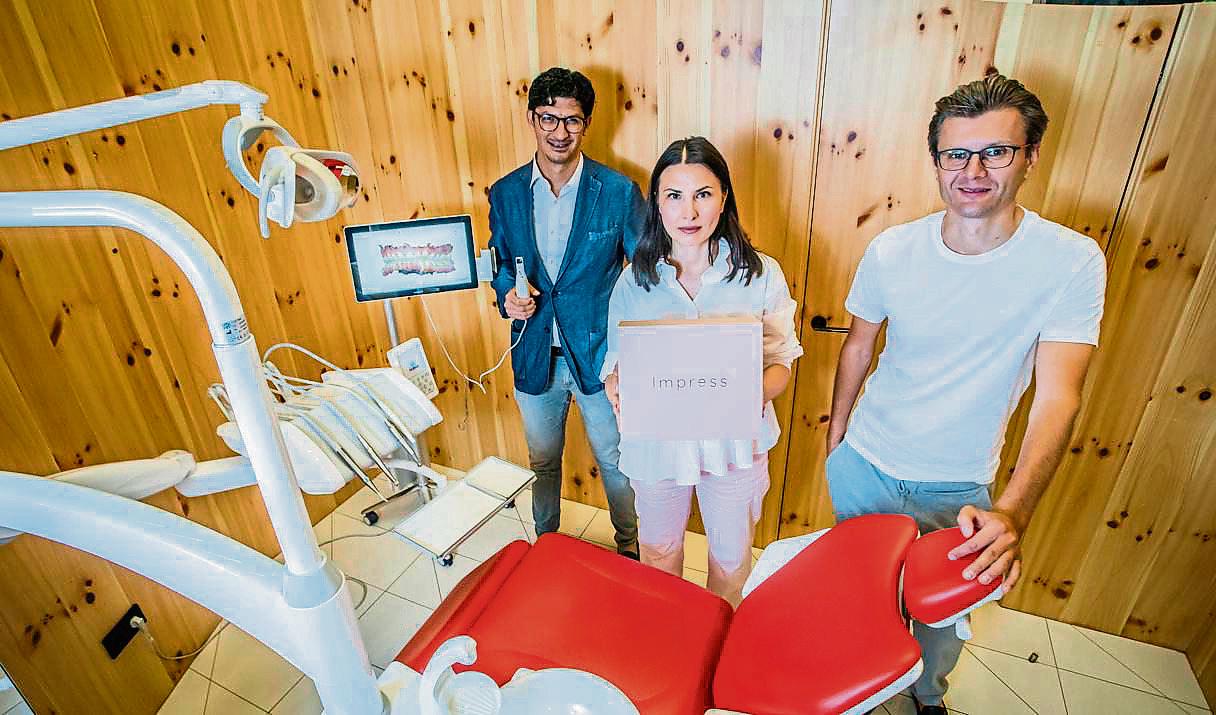
The early operating priorities were equally practical: earn revenue and adjust the business model to what actual customers and partners did. The distinction between research and experience is familiar to anyone who has opened a business. A spreadsheet offers assumptions in obedient rows. Real people tend to arrive with edits.
There is no need to invent a dramatic meeting to make that consequential. A company that changes its model after contact with customers has accepted that its opening theory needs work. Lupenko’s account of those first months gives the business that room. The first version was a starting position, with decisions still ahead.
Owning more of the work
In 2021, Impress announced an investment of at least €10 million in a Barcelona factory in the Zona Franca. Lupenko described the reason in supply-chain terms: the growing business needed more control over production. The plan included 130 jobs in the short term. Barcelona was becoming a place where the company made things as well as managed them.
A factory is a wonderfully unsubtle answer to an operational question. It occupies space. It requires equipment and people. It makes a commitment visible in a way a strategy document seldom manages. For Lupenko, the decision added another layer to the company: production alongside its existing operations and software.
The money supporting expansion came in substantial rounds. In 2022, Impress announced €123 million in financing, with territorial growth, acquisitions and technology among the intended uses. The company was giving itself several routes to become larger. Each route carried a different sort of work, from establishing a new location to bringing an existing business into the group.
In November 2024 came another round, announced at $117 million. Trinity Capital’s commitment was $40 million in debt financing within that total. That detail deserves to survive the headline. Financing is a collection of obligations and arrangements, even when the announcement presents it as one impressively round sum.
NOVEMBER 2024 · FINANCING
$117mAnnounced round total
$40m Trinity Capital debt commitment within the round.
The remaining $77m: balance of the announced round.
Lupenko’s financial background makes this part of the story particularly worth watching. He had worked in advisory before taking responsibility for his own expanding businesses. By this point, Impress’s growth involved investors, lenders and advisers, as well as the founding team. The decisions had acquired more participants.
“the investors who truly matter”
Vladimir Lupenko
His public testimonial for the adviser Jouanne is revealing in its emphasis on connections. The quote concerns getting the right participants around the business. Company building has an institutional side as well as an entrepreneurial one: introductions, negotiations and people whose work never appears in the founding photograph.
The deal and the days after
In August 2024, Straumann announced an agreement to sell DrSmile to Impress. The transaction completed in September. Straumann received a 20% minority holding in the combined business on a fully diluted basis. A competitor was joining the group, and its former owner was becoming a shareholder.
The agreement enlarged Impress’s geographical footprint, including Germany, France, the Netherlands and Sweden. That is a compact sentence with a large operational consequence. Four country names can fit comfortably on a line. A company working across those markets has a much longer list of things to organise.
An acquisition gives the timeline a precise event. Integration gives the founder a less tidy calendar. There are decisions about which arrangements to retain and which to change. The public transaction describes ownership. The company that follows it must turn the arrangement into everyday work. Signing and operating use different verbs for a reason.
By October 2025, Lupenko was discussing another acquisition, the Swedish business Smajla and its three locations. This time the expansion was concentrated within a market Impress had already entered through DrSmile. The sequence shows two scales of the same work: first widening the map, then adding depth inside one of its countries.
In February 2026, Impress reported €103 million in revenue for 2025, a 30% annual increase. The result followed the DrSmile integration. It is a company number, rather than a measure of its founder’s personal fortune. It gives the Barcelona chapter a useful marker: the business now had enough scale for its operating results to become a story in their own right.
Another beginning, with a larger calendar
Along the way, Lupenko and Diliara became Endeavor Entrepreneurs in 2022. At 4YFN in 2025, Vladimir joined a discussion with leaders from Creditas and Job&Talent, moderated by Verónica Pascual. The subjects included earlier scale-up experience and working abroad. They were topics with fairly direct connections to his own route.
By June 2026, he was discussing further European openings and preparing Impress for a possible stock-market listing in 2029. Both belong in the future tense. An opening plan is a programme of work; readiness for a listing is an ambition with a date attached. The distinction is small on the page and considerable in a boardroom.
The young consultant of 2005 and the Barcelona CEO of 2026 occupy different positions in the same working history. Finance came first. Several ventures followed. Impress brought relocation, a founding partnership and responsibility for an international operation. Starting again had become a habit with increasingly large consequences.
Barcelona remains the address that gives this chapter its shape. The early company has expanded, bought businesses and raised capital, yet its founding photograph still contains three people standing together. The numbers have grown much larger than the frame. The next decisions still have to be made by people.