The team flew to Sydney with a project to build and very little ceremony. Jack Abraham had gathered five colleagues from eBay, booked six flights, and taken them across the Pacific to work on a new version of the company's homepage. The trip compressed a corporate problem into a small room, a short deadline, and a handful of people who could actually make something. A calendar full of meetings would have been considerably easier to explain.
Abraham had arrived at eBay through the sale of Milo, his shopping search company. He was young, accustomed to moving quickly, and now working inside an organization whose coordination requirements were rather larger than his old team's. Sydney offered distance from the usual interruptions. The group returned with a prototype. Whatever else the episode says about him, it shows a founder with a practical instinct: change the conditions around the work, and the work might change too.
His later career would give that instinct an institutional home. In 2012, he founded Atomic, a venture studio that starts businesses inside the firm and recruits people to build them together. The company at the center of his working life makes other companies. Its raw materials include ideas, capital, code, and the unusually difficult task of getting the right people interested in the same problem.
A small-team experiment inside eBay, before Atomic gave company building a home.
A whiteboard within stumbling distance
Long before the fund announcements, there was a bedroom whiteboard. In 2011, Abraham kept one close enough to capture ideas when he got out of bed. The detail is more revealing than a polished founder biography. An idea can be inconveniently punctual. A whiteboard is a modest concession to that fact.
That year, Fast Company included him in its list of 100 Most Creative People in Business, at number 38. Milo was the reason. Its premise connected something people increasingly did online with something they still did in person: research a product, then buy it from a nearby store. Finding reviews was easy. Finding a particular item on a particular shelf was a different matter.
The company had a mascot, also called Milo. In a photograph from that period, Abraham holds the little dog in an orange bandana. There is a useful corrective here to the monumental language that tends to collect around acquisitions. A business can be valued in tens of millions of dollars and still have someone responsible for a dog.
The shelf was there. The information was elsewhere.
Abraham grew up around entrepreneurship. His father, Magid Abraham, co-founded Comscore, the internet measurement business. Jack worked there while young, encountering the possibilities of data before founding his own companies. At Wharton, he studied technological entrepreneurship; Atomic's biography describes him as a Joseph Wharton Scholar who designed his own major. He left before completing his degree.
His earlier experiments included tutoring and custom computers. Both taught him about the difficulty of scaling. Milo, which he pursued full-time in 2008, addressed a more widely shared irritation: discovering whether a nearby shop actually had the thing a shopper wanted. The business joined the inventory in physical stores to the search habits of internet users.
The significance of that connection became clearer after the acquisition. eBay integrated Milo's local shopping capabilities with RedLaser, its barcode-scanning mobile application. A phone could help a customer compare products while standing in the physical world. Local inventory also became part of eBay's broader shopping experience. The shop floor and the search result were beginning to share an address.
For retailers, this was a distribution question as much as a technology question. Their customers were making decisions online; the stores needed to appear where those decisions happened. Abraham worked with retailers to bring inventory onto the internet. The product's appeal lay in making an ordinary errand less uncertain. A shopper did not need a theory of commerce to appreciate avoiding a wasted journey.
The $75 million exit had a next chapter
eBay bought Milo in December 2010 for a reported $75 million. Abraham was 24. The amount makes a convenient milestone, but the purchase also changed his job. He became director of local at eBay, moving from a small company into a much bigger organization, with more resources and more people to coordinate.
One part of his earlier financing had been especially deliberate. Alongside investment, he negotiated regular time with Keith Rabois, Jawed Karim, and Kevin Hartz. The young founder wanted access to their judgment. Those relationships provided help with product, strategy, recruiting, and the practical questions that arrive after a promising idea has become an employer.
The connection to Rabois lasted. Years later they co-founded OpenStore, the Miami company focused on e-commerce businesses. Abraham's investments also included Pinterest, Uber, and Postmates. His network developed through specific products and working relationships, rather than existing merely as a decorative list of recognizable names.
The Sydney episode offers another connection that persisted. Benjamin Gleitzman, who worked on eBay's personalized feed, later co-founded Replicant with Abraham and Gadi Shamia. Replicant develops conversational AI for customer service. The relationship carried an engineer and an operator from one difficult problem to another. An offsite can leave behind more than a presentation.
A company with companies on the workbench
Atomic's model puts a founding team and operating support around a new business early. Design, engineering, finance, legal work, recruiting, and growth expertise sit within the studio. A co-founder can draw on those capabilities while developing the product and hiring the company's own team. That arrangement changes the resources available at the stage when an ordinary startup is often a few people doing every job.
The studio's portfolio spans different kinds of work. Homebound builds homes. OpenStore operates in commerce. Replicant works on customer conversations. Bungalow works in housing. These businesses have distinct customers and operational demands, which is why a shared starting point cannot substitute for learning an individual market.
Abraham's recurring question is whether a problem can support a business large enough to justify the effort. Atomic describes a process of research, testing, prototyping, and validation before committing more resources. An idea is allowed to encounter evidence. The machinery includes a way to stop, which is an easily overlooked feature of an organization dedicated to starting things.
By May 2023, the firm described two parts of its operation: people working on the earliest stages of company creation, and specialists helping businesses grow. That division recognizes a fairly common experience. Getting something to work once and getting it to work repeatedly are different assignments. The founder's early enthusiasm has to survive contact with contracts, accounts, and the next customer.
- 01 / ResearchIdentify a customer problem
- 02 / TestPrototype and validate
- 03 / BuildPair people, capital, and support
Ideas can be stopped during testing. Progress depends on evidence.
An enthusiast who tells people to say no
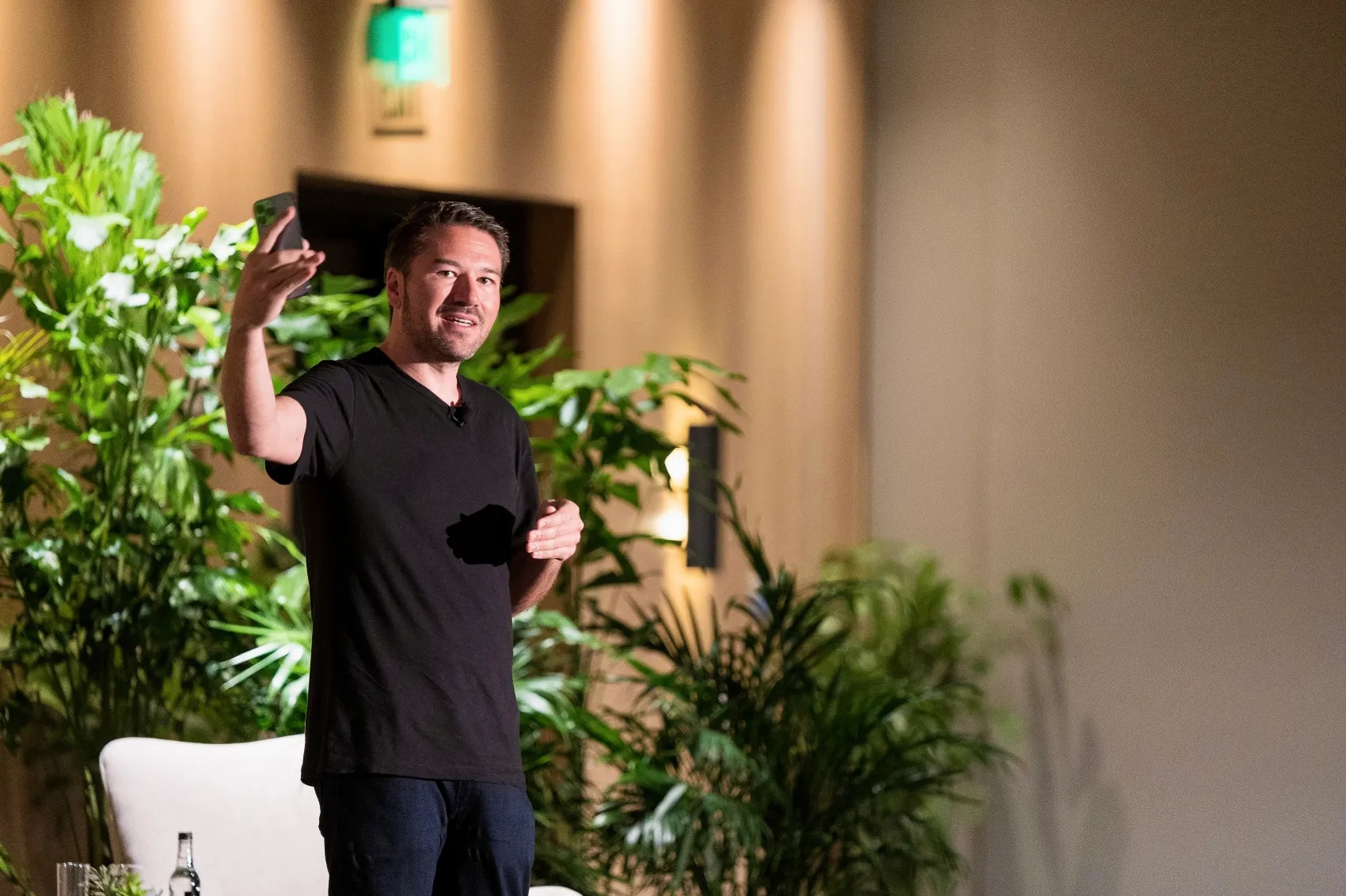
At Atomic's Future Founder Summit in 2022, Abraham urged entrepreneurs to reject weak ideas before they consumed years. His sharpest instruction was brief: “Kill bad ideas quickly.” For someone whose firm depends on new businesses, he spends a noticeable amount of time discussing which ones should never become businesses at all.
He also talked about allocating time deliberately. A single hour, he argued, can matter more than long stretches of routine effort. That view helps explain the appeal of gathering builders together: the useful encounter, the right question, or a decisive piece of feedback may arrive during a conversation that was never guaranteed to be productive.
The summit brought together 85 founders and builders. Alongside Abraham, participants heard from Andreessen Horowitz partner Chris Lyons and people involved in Miami's technology community. A gathering like that combines two habits that can pull against each other: enthusiasm about possibility, and discipline about choosing where to spend the next year. Abraham's advice gives the second habit considerable weight.
“Kill bad ideas quickly.”Jack Abraham, Future Founder Summit, 2022
Miami becomes a place to make things
Abraham moved to Miami in July 2020. Atomic opened its Wynwood office in April 2021, and other leaders followed him to the city, including Chester Ng and Healey Cypher. The move became part of a wider conversation about where technology companies could be built, but it also had a concrete form: office space, colleagues, and new ventures.
In June 2021, Atomic announced Future Founders Miami, presenting company creation as something to do within the local entrepreneurial community. The invitation mattered because a technology scene needs more than visiting investors. It needs people willing to begin the daily work of products, recruitment, and sales there.
Wynwood gave Atomic an identifiable base. OpenStore was also part of the Miami story, with Abraham and Rabois linking an established working relationship to a new business in a new location. Geography became another condition he could change around the work. The question remained familiar: who could build together, and what could they build?
A downturn, an idea list, and $320 million
In May 2023, Atomic announced its fourth fund, a $320 million vehicle. The firm said it had more than $750 million in assets under management. Those are figures about investment capital, with a job to do: finance the creation and growth of businesses.
At the time, Abraham described a list of more than 800 possible company ideas. The team would put a smaller amount of money into examining an idea, then invest more if the evidence justified building. The list was a queue of possibilities, rather than 800 promises. Even a company that manufactures beginnings has to choose.
Atomic's case for expanding during a difficult market centered on talent availability, less competition, and the habits imposed by limited capital. The firm said it had started 16 companies over the preceding year and grown to more than 75 builders. These were dated snapshots of an operation expanding its capacity to experiment.
There is a personal echo in the argument. Milo had been built during the financial crisis. Abraham had already experienced the uncomfortable distance between wanting to start a company and finding a receptive funding market. In 2023, he was approaching that distance from the other side of the table, with a fund intended to help companies begin.
December 2010
May 2023
Different measures, different moments: an acquisition price and a venture fund’s capital.
The next bottleneck has a power bill
Exowatt takes Abraham's company-building work into physical infrastructure. Co-founded in 2023 with Hannan Happi, it develops modular solar technology that stores energy as heat and converts it into electricity. Its intended customers include data centers. The underlying question is tangible: where will electricity come from when computing demand keeps growing?
The company announced a $70 million Series A in 2025, following its $20 million seed round. In November 2025, it announced another $50 million. These financing milestones describe backing for a business still pursuing manufacturing and deployment; the ambition has to be translated into equipment that performs in the field.
In January 2026, Exowatt launched ExoRise, a business arm combining land development and energy infrastructure for data centers. It identified locations across the American Southwest, including New Mexico, West Texas, Arizona, and Nevada. The proposal extends beyond making an energy module to assembling more of the conditions a customer needs to use it.
Other parts of Atomic's portfolio have reached different stages. In September 2026, Navan announced its acquisition of BoomPop, the events platform listed among Atomic's companies. The studio's work consequently contains several clocks at once: a company finding its first usable design, another building an operating organization, another becoming part of an established business.
Abraham's career keeps circling back to the point before a company looks inevitable. A store's inventory needs connecting to a shopper. A small team needs room to build a prototype. A promising idea needs someone who can test it, and a weak one needs an early goodbye. The bedroom whiteboard and the venture fund differ enormously in scale. Both make room for the next beginning.