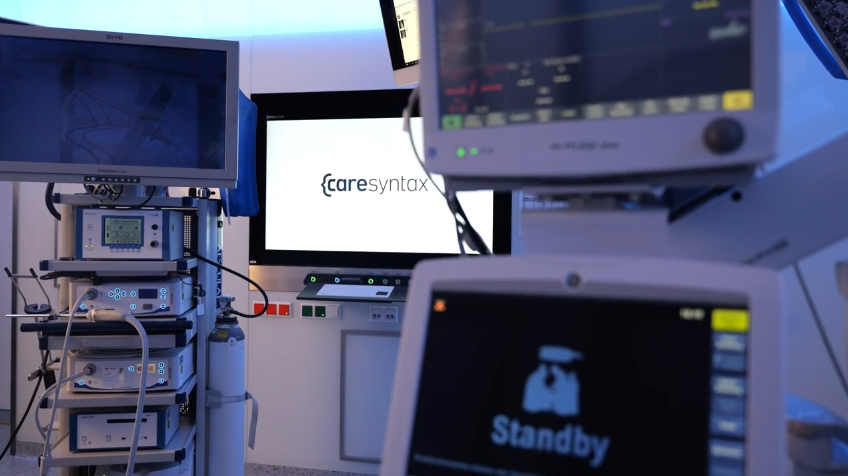
Right now, in a hospital you have probably never visited, a knee replacement is underway. The surgeon does not know it, but cameras above her are feeding video to a model trained on millions of prior cases. The instruments she picks up are being timed. The room itself is keeping notes. That is Caresyntax - quietly running, mostly unseen, slowly becoming the most informed observer in modern surgery.
The quiet operating system for the OR.
Most healthcare AI companies are eager to be seen. Caresyntax is the opposite. Its software does not introduce itself, does not greet the surgeon, does not flash a startup-blue dashboard. It just records, parses, and remembers. Then, after the case, it produces something hospitals have always lacked: a structured account of what actually happened.
Today the company operates in more than 4,000 operating rooms across North America, Europe, and Asia, supporting upward of two million procedures every year. Headquartered in both San Francisco and Berlin - a setup that makes scheduling meetings only mildly painful - it has become, in a category that did not really exist a decade ago, the default name for surgical intelligence.
A black box, on wheels.
Hospitals have spent the last twenty years digitizing nearly everything. They digitized scheduling. They digitized billing. They especially digitized billing. But the operating room - the place where the most dangerous and lucrative work happens - stayed weirdly analog. Devices did not talk to each other. Video, when it existed, was wiped after the case. Outcomes were filed under "the surgeon was tired" or "the patient was complicated."
This was not for lack of trying. Vendors had pitched integrated ORs for years, but each pitch required the hospital to surrender to a single manufacturer's ecosystem - the surgical equivalent of buying every appliance in your kitchen from the same brand because the toaster refuses to acknowledge the fridge. The result was predictable. Most hospitals declined.
So the OR remained a black box on wheels. Surgery happened, money changed hands, patients went home (mostly), and almost no one could say with confidence why one case went smoothly and the next did not.
Two outsiders, one obstinate idea.
Dennis Kogan grew up watching surgery the way other kids watched cartoons - his father is a third-generation surgeon. Bjoern von Siemens comes from the family that built half of modern industrial Germany; the kind of family that takes engineering personally. They met at Harvard Business School, decided that the surgical OR deserved better than its current information diet, and started building.
Their bet was peculiar in healthcare circles: refuse to pick a side. While device makers wanted to lock customers into proprietary stacks, Caresyntax committed to vendor-neutrality. Any robot. Any imaging system. Any anesthesia cart. Plug them all in, capture everything, normalize the data, hand the insight back to the clinician. Some industry observers - the polite ones - called this ambitious. The less polite ones called it crazy.
It turned out to be neither. It turned out to be the only approach that hospitals could actually buy.
Twelve years, give or take a pandemic.
A short tour of how Caresyntax got from a Berlin whiteboard to 4,000 ORs.
Founded in Berlin. The category "surgical intelligence" still needs explaining at parties.
qvident launches: real-time event reconstruction for surgical risk and quality.
Surgical.AI commits $20M, pushing first-round financing past $30M.
Series C closes during a year in which elective surgery was, briefly, illegal.
$30M Series C extension with Optum Ventures and the Relyens Group.
$180M round - $80M equity, up to $100M growth debt - led by PFM Health Sciences.
Platform powers 4,000+ ORs and over 2M procedures a year, with M&A on the radar.
What it actually does.
Strip away the marketing and the Caresyntax platform does three boring, valuable things. First, it captures - every video feed, device output, anesthesia reading, and EMR field associated with a surgical case. Second, it normalizes - converting that chaos into a structured record any downstream system can query. Third, it learns - applying AI to flag risk, score skill, benchmark teams, and predict the cases most likely to go sideways.
The Platform
Vendor-neutral data backbone for the OR. Connects devices, video, and the EMR into one auditable record per case.
qvident
The risk and quality module. Reconstructs a surgery from real-time data so teams can review, train, and improve.
PRIME365
OR integration for chiefs of surgery and managers. Less "command center" theatre, more workflow plumbing.
AI Video Analytics
Machine learning that reads intraoperative video for skill, technique, and risk signals.
Risk Management Services
An advisory layer pairing analytics with insurers and quality teams to actually reduce complications and cost.
Numbers that survived a procurement committee.
The most convincing argument for surgical analytics is not a TED talk. It is a quarterly report. Saint Thomas Hospital in Tennessee, an early Caresyntax customer, ran a year-long pilot and produced the kind of figures hospital CFOs frame above their desks.
What one hospital recorded after deploying Caresyntax
Saint Thomas Hospital, Tennessee - 12-month internal review
The customer roster has spread beyond academic centers. Saint Thomas in the United States. The University Hospital of Strasbourg in France, where the platform documents orthopedic training. Insurers like the Relyens Group and ProAssurance, who now use surgical telemetry to inform underwriting - a quietly radical shift in how medical liability is priced.
Make surgery smarter and safer for every patient. Everywhere.
Caresyntax states this plainly and resists the urge to dress it up. The point is not to replace the surgeon - a popular fantasy among people who have never met a surgeon. The point is to give the surgeon, the hospital, and the system around them the ability to learn from each case as it happens, and from every other case that ever has.
That ambition is starting to show up in unusual places. Insurers are pricing surgical risk with platform data. Device makers, finally, are agreeing to standardize outputs because Caresyntax can ingest them. Centers of excellence, those much-marketed hospital units, are quietly using qvident to actually measure what makes them excellent.
Things you probably did not know about Caresyntax.
- One co-founder's father is a third-generation surgeon. The other is a von Siemens.
- The platform has watched more surgeries than most surgeons will perform in 50 careers.
- It runs HQs in Berlin and San Francisco - a setup that gives the standup roughly nine hours of grace.
- It is one of the few healthcare AI companies whose data customers include medical liability insurers.
What happens when the OR finally has a memory.
Most of modern medicine has been built on an awkward truth: doctors learn from a small number of their own cases, and the system around them learns from almost nothing. Caresyntax flips that equation. Every procedure on the platform contributes back. Every surgeon, in theory, benefits from every other surgeon they will never meet.
If that sounds grandiose, it is partly because the implications are. Hospital networks could standardize technique across geographies. Insurers could price coverage on actual technical performance rather than malpractice history. Surgical training - currently a craft passed down through gritty apprenticeship - could become a measurable, comparable discipline. None of this is guaranteed. All of it is now within reach of a few hospitals running the same software stack.
Back in that anonymous operating room, the knee replacement is finishing. The cameras have logged 92 minutes of footage. The instrument tray has logged 411 separate movements. The anesthesia record matches the heart-rate trace to the second. Years ago, all of that would have evaporated the moment the door closed behind the patient. Tonight, Caresyntax will keep it. The hospital will review it. And the next case, in some small but real way, will go better. The black box, finally, is keeping notes.