An old door is an excellent desk if you have more ambition than furniture. In a Copenhagen apartment, Mikkel Svane and his friends Alexander Aghassipour and Morten Primdahl used one to work on the software that became Zendesk. A door normally divides rooms. This one gave three people somewhere to put their computers while they tried to make customer service less of an ordeal.
The detail survives because it is useful. It makes the beginning look like a beginning: people with an idea, an improvised work surface, and bills that continued to arrive. The later listing on the New York Stock Exchange lends the door a certain dignity. At the time, it was doing an honest piece of furniture’s work.
Svane’s career has since acquired plenty of numbers. Fifteen years as Zendesk’s CEO. A company acquired in a transaction valued at approximately $10.2 billion. A family foundation with a $5 million program for downtown San Francisco culture. Yet the door gives a better entry into the story than a valuation does. It suggests an appetite for taking something already available and making it useful in a different way.
A door, three friends, and an unfashionable problem
Zendesk’s founders picked customer service software, a subject unlikely to improve anyone’s standing at a glamorous dinner. They wanted businesses to have a simpler way to deal with questions and complaints. The product lived on the web, reducing the obstacles between deciding to try it and actually using it. Design belonged in that experience, even if the task itself seemed mundane.
There was a market behind the dull description. A customer waiting for an answer has little interest in the elegance of a company’s internal structure. The person giving the answer needs the relevant information somewhere accessible. A product that helps both parties has a practical reason to exist. Zendesk launched in 2007, with the founders supporting themselves through consulting work while building it.
That arrangement contains its own trap. The work that pays today can absorb the hours intended for the business that might pay tomorrow. The founders had families and responsibilities; they were not playing at entrepreneurship during a long school holiday. Svane was in his mid-thirties. Experience had given him reasons to see an opportunity and reasons to understand what could go wrong.
America came with moving boxes
He had already tried other forms of making things. Early ventures included stereograms, those images that conceal a three-dimensional picture, and an online community portal. He founded Caput, which supplied software for online communities and media websites. The dot-com collapse ended that company. A job at the consulting group Materna followed, then a return to freelance work.
The sequence matters because it complicates the tidy founder biography. Zendesk arrived after a failed business and a spell working inside another organization. Svane had encountered software as something to build, something to sell and something other people had to live with. A successful second act can make the first appear like preparation. While it is happening, failure has no obligation to feel educational.
San Francisco had been on his mind since a visit in 1995. In 2009, the Zendesk team moved to the United States, first to Boston and then to California. Investors and customers helped pull the business across the Atlantic. The move also pulled families out of familiar surroundings. A company can relocate in a sentence. A household needs boxes, arrangements and someone who knows where the keys are.
One episode in Startupland, the book Svane wrote with Carlye Adler, makes that second journey visible. His young daughter locked a bathroom door in their new home, and he spent hours trying to open it while an important meeting needed preparation. The scene punctures the fantasy of a founder moving serenely between strategic decisions. A door had once helped him work. Another was now keeping him from it.
The customers were allowed to be angry
A customer service company eventually gets the chance to test its own principles. In 2010, Zendesk changed its pricing and upset existing customers. One customer described a plan moving from the equivalent of $27 per agent to $59. The initial offer to preserve old pricing temporarily did little to make that feel fair.
The company reversed the change for existing customers and apologized. The episode is worth keeping in the story because it introduces a bill that growth cannot settle automatically: trust. A customer may accept that a business needs revenue and still dislike being presented with a new arrangement that feels imposed. Selling software for managing complaints does not exempt its seller from receiving them.
Svane’s broader account of the company returns to relationships. Early customer attention helped a product spread through recommendations. Twitter was among the startups that used Zendesk. With a young business, a conversation can do several jobs at once: reveal where the product fails, show that someone is listening and give a satisfied customer a reason to tell a friend.
In a conversation with HubSpot co-founder Brian Halligan, Svane discussed giving employees consolidated customer information and the freedom to use their judgment. The theme is practical. A company cannot expect warm, personal service from staff who must search through scattered records or request permission for every sensible decision. The software is only part of the arrangement; the people still have to answer.
Wall Street required a different voice
Zendesk went public in May 2014. The photograph from that day shows Svane outside the exchange beneath an enormous green banner and the company’s cheerful old mascot. Wall Street had found room for a cartoon in a headset. A business built around other people’s frustrations was allowed a day of celebration.
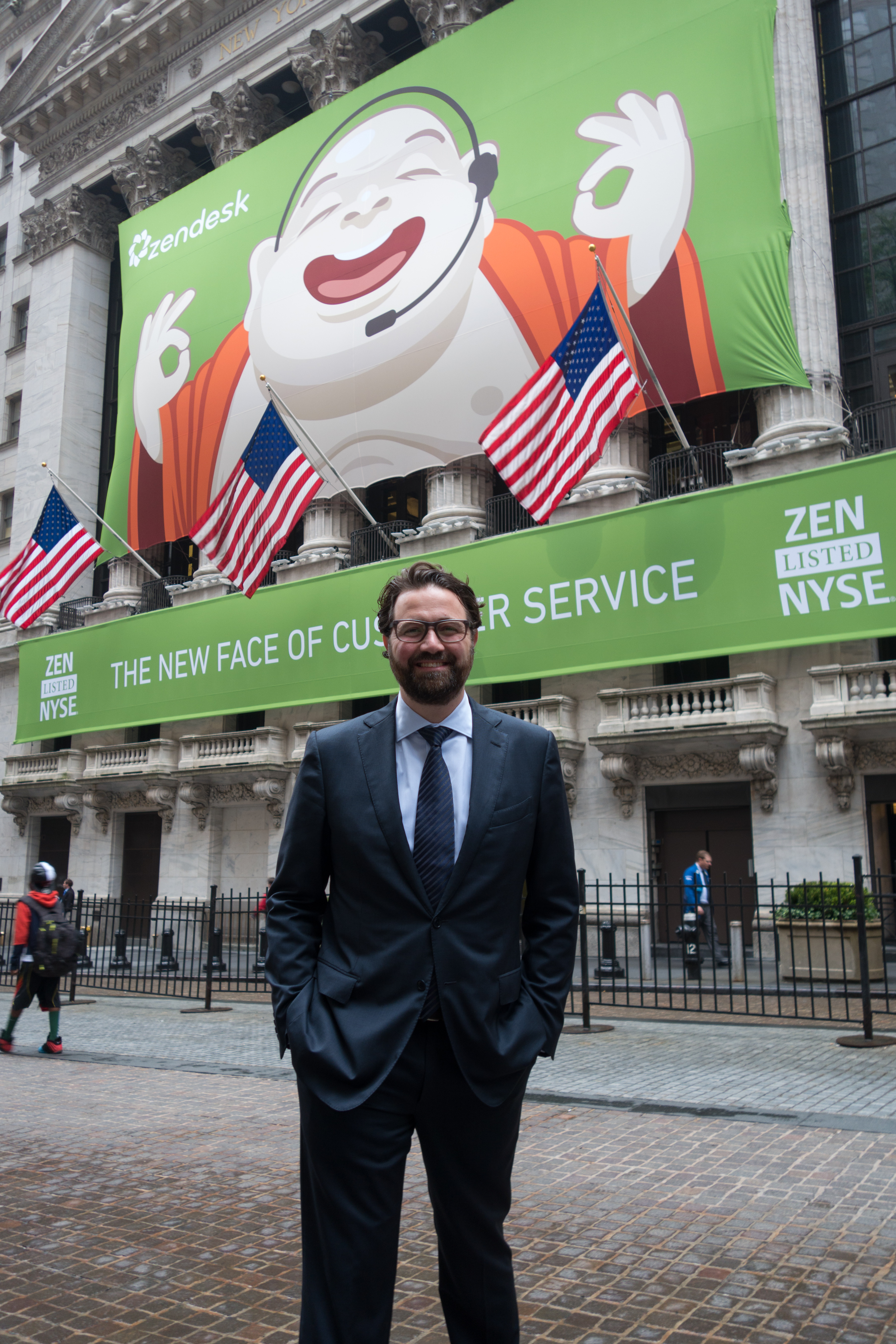
Going public changed the job. Svane later described learning to take more care with what he said, comparing the responsibility to fatherhood. A remark from the person in charge of a public company travels differently from one made across a makeshift desk. Growth expands the audience, including people who were never in the room and cannot ask what he meant.
He also pushed against the notion that the company could stand apart from its surroundings. Zendesk operated in San Francisco’s Mid-Market area, close to the Tenderloin. He talked about spending money at neighborhood businesses and helping local organizations. Success inside the office left questions waiting outside it.
“We cannot build our software in an ivory tower.”
Mikkel Svane, 2017
The CEO chapter ended in November 2022. An investor group led by Hellman & Friedman and Permira completed its acquisition of Zendesk on November 22. Six days later, Svane stepped down. Zendesk now identifies him as Founder Emeritus. The company’s account of his fifteen years at the helm includes its expansion to more than 169,000 organizations around the world.
The wall space eventually ran out
Art gave him another way to engage with the city. His early collecting included works by Charles Blackwell through Hospitality House’s Community Arts Program in the Tenderloin. The appeal included the immediacy of the relationship: buying a work could benefit the person who made it. That is a different experience from treating art chiefly as an item on a balance sheet.
By 2021, he was talking about ceramics because there was only so much wall space. He singled out Joe Turek’s White Collar as a favorite painting that had not been particularly expensive. Time spent living with it had made the difference. A collector’s home can become a rather expensive argument with the available square footage; his point was that price and attachment do not move together.
The Svane Family Foundation, established in 2019, turned that interest into programs. Ark invested $1 million in 100 Bay Area artists, commissioning new work at $10,000 apiece. The resulting auction benefited ArtSpan and raised $330,100. The structure supported production first, then sent the proceeds onward to an organization serving the local art community.
Each square represents one artist. The later auction raised a separate $330,100 for ArtSpan.
Other programs worked through institutions. A $1 million art fund helped the Fine Arts Museums of San Francisco acquire 42 works by 30 Bay Area artists and collectives. Another $1 million supported the launch of the Bay Area Fellowship at Headlands Center for the Arts, where artists helped design experiences suited to their own needs. The approaches differed, giving artists commissions, museum representation or a fellowship.
A city is more than its office buildings
Culture Forward brought the foundation’s attention to downtown public life. Announced in 2024, the $5 million program supports arts and culture projects in San Francisco. Its 2026 grant lists include a public radio space, artist fairs, performances and a community history archive presented as a coffee-and-doughnut cart. The currency for that last project is storytelling, a refreshing complication for anyone arriving with exact change.
In January 2026, Svane published an essay connecting the city’s counterculture to the environment that attracted entrepreneurs like him. He reported that Culture Forward had invested roughly $2 million in about 40 projects during its first year. His argument treats cultural activity as part of what makes a place attractive to people who want to try something unfamiliar.
The essay also refuses an easy victory lap. Svane argues that downtown renewal must include the Tenderloin and that cultural businesses need fewer obstacles to operating. His fondness for cocktails makes a cameo in a complaint about liquor licensing. Even civic impatience, it appears, can have a drinks order.
There is a continuity here, though software and arts funding have different jobs. Svane keeps returning to the conditions that let people do something: answer a customer, make a work, put on an event, meet in public. The Copenhagen door supplied a place to begin. San Francisco supplied a setting for the company to grow. Now he is spending money on some of the people who give that setting a life beyond the working day.