The sensible way to seek a job in the Netherlands is to wait until somebody invites you. Melody Roberts chose a more cinematic route. Fresh from graduate design school, she wanted to work for Philips Design, so she found an opening, told the company she would be in Amsterdam, and asked for a meeting. Then she made the claim true: one plane ticket, one night in what she later called a flea-infested youth hostel, and a train to Eindhoven.
The interview went well. Everyone liked one another. Everyone remained confused about why a designer had applied for what turned out to be a marketing job. Roberts flew home without an offer, carrying a story that makes much more sense in the context of the career that followed. She has a habit of making the future concrete enough to inspect. Sometimes it becomes a job. Sometimes it becomes a lesson. Either way, the prototype has done useful work.
That habit would take her from Smart Design in New York to IDEO in Palo Alto, into the operating machinery of McDonald's and Panera, and eventually to Liv Labs, the consumer wellness company she co-founded and now leads. The nouns kept changing: researcher, strategist, corporate executive, founder. The verb stayed put. Roberts designs.
Chapter 01The misfits define the job
When Roberts earned her Master of Design from Illinois Tech's Institute of Design in 1998, the profession had not yet manufactured a tidy shelf of roles for people like her. Design research was barely a recognized job. User experience was not yet the catch-all it would become. Design strategy sounded, even to designers, like a phrase waiting for a definition.
Smart Design hired her as a senior design researcher. Her first assignment was wonderfully circular: define “design research.” Five years later, Roberts was leading a major client account, and the department had grown to include project management and design strategy on both coasts. The chief executive still called them “the misfits.” It was accurate in the affectionate way that new disciplines often are. They did not fit because the old box had been drawn before their work existed.
Her product work there included the OXO Good Grips Smooth Edge Can Opener, named in a 2003 GOOD DESIGN award. Yet the object is less revealing than the approach around it: look closely at ordinary behavior, locate needless friction, and make the improved experience feel obvious after the fact. Good convenience has no interest in showing off. It quietly returns a few seconds, a little dignity, or one less irritating motion to the day.
Roberts moved next to IDEO's young Innovation by Design practice in Palo Alto. There, she “got religion” around prototyping. The firm's phrase was “build to think.” A prototype could be a product, but it could also be a service, a meeting agenda, a workshop, or a job description. The point was not polish. The point was to place an idea in the world, where a group could stop arguing about abstractions and begin reacting to the same thing.
The Roberts loop / a working model
Chapter 02A prototype meets 34,000 restaurants
The closer Roberts worked with clients, the more she wanted to become one. McDonald's had been a client at both Smart Design and IDEO. She joined the company around 2006 and entered a scale of operations that could make a clever idea look very small indeed.
Its innovation center in Romeoville, Illinois, was a 250,000-square-foot building with three kitchens, 135 dedicated employees, and no windows. The nickname was “Switzerland,” because partners from across the global system could test concepts on neutral ground. Restaurant interiors, service formats, and digital ideas were made full-size enough to bump into operational reality. A napkin sketch could meet a queue. A screen flow could meet a lunch rush.
Roberts organized innovation programs into 100-day bursts, leaving room between them for analysis and rest. The cadence, she said, fit natural human and social rhythms. It is a strikingly humane observation to carry into a company obsessed, by necessity, with speed and repeatability. A sprint without recovery eventually becomes an undignified crawl.
“I was only able to use my technical skills and make a meaningful contribution once I had made friends and proven my devotion to the cause.”Melody Roberts, reflecting on McDonald's
Her durable lesson from that decade was not a technique. It was a condition for techniques to matter. Colleagues had to believe that she cared about restaurant workers, customers, and the business. Only then did her design expertise become useful rather than ornamental. Trust was not the soft prelude to serious work. It was part of the operating system.
This is the difference between installing a design team and spreading a design practice. Roberts argued that design thinking across an organization requires understanding what the whole organization needs to build and grow. The center of gravity shifts from the designer's authority to the institution's shared problem. The designer gives up a little theater and gains a chance at consequence.
Chapter 03The old friend and the sharp turn
After twelve years in food-service research and development, including a role as vice president of customer experience innovation at Panera, Roberts wanted something completely different. The future obliged with a phone call. An old friend, industrial designer Carly Price, had an invention and asked Roberts to join her startup.
Roberts' first reaction was frank: the category did not sound appealing. The invention did. Her decision came down to a compact question: if not me, then who? In 2017, she co-founded Liv Labs and became its chief executive. A career spent helping established organizations make room for experimentation had arrived at the inverse challenge. Now the organization itself was the experiment.
Founding compressed several unfamiliar disciplines into one job. Roberts had to learn business formation, regulated development, grant writing, fundraising, and marketing. She calls the combined work “business design,” a phrase broad enough to contain a cap table, a customer conversation, a research plan, and the emotional weather of a tiny team.
The early years rewarded stubborn participation. Roberts attended the 2017 South Side Pitch in Chicago and heard an invitation to pursue a dream. The next year, she entered. Liv Labs won first prize: $5,000 and a year at the Polsky Exchange, the University of Chicago's startup hub. The company later joined the Polsky Incubator and Y Combinator's Summer 2021 batch.
What Roberts valued about the Exchange was not merely a desk. It was reciprocity. She could find help and offer it. A student intern, law students, mentors, and neighbors made the venture less solitary. Someone remembered the company during a corporate conversation and pulled her into the room. The network behaved like a good prototype: every interaction created information and another possible connection.
Chapter 04Optimism with a workbench
Roberts describes herself as generally optimistic. The evidence suggests a specific kind of optimism, less sunbeam than shop tool. It does not insist that everything will work. It insists that reality will become more negotiable after someone makes the first version.
Her 2024 return to the Institute of Design made the philosophy personal. Twenty-six years had passed since her MDes. In the old studios, her generation worked with paint, X-acto knives, rubylith, and film cameras. Early assignments entertained radical questions such as what an airline might put on a website, or where a person might print a photograph taken with a phone. The quaintness is useful. Today's obvious interface was yesterday's peculiar prompt.
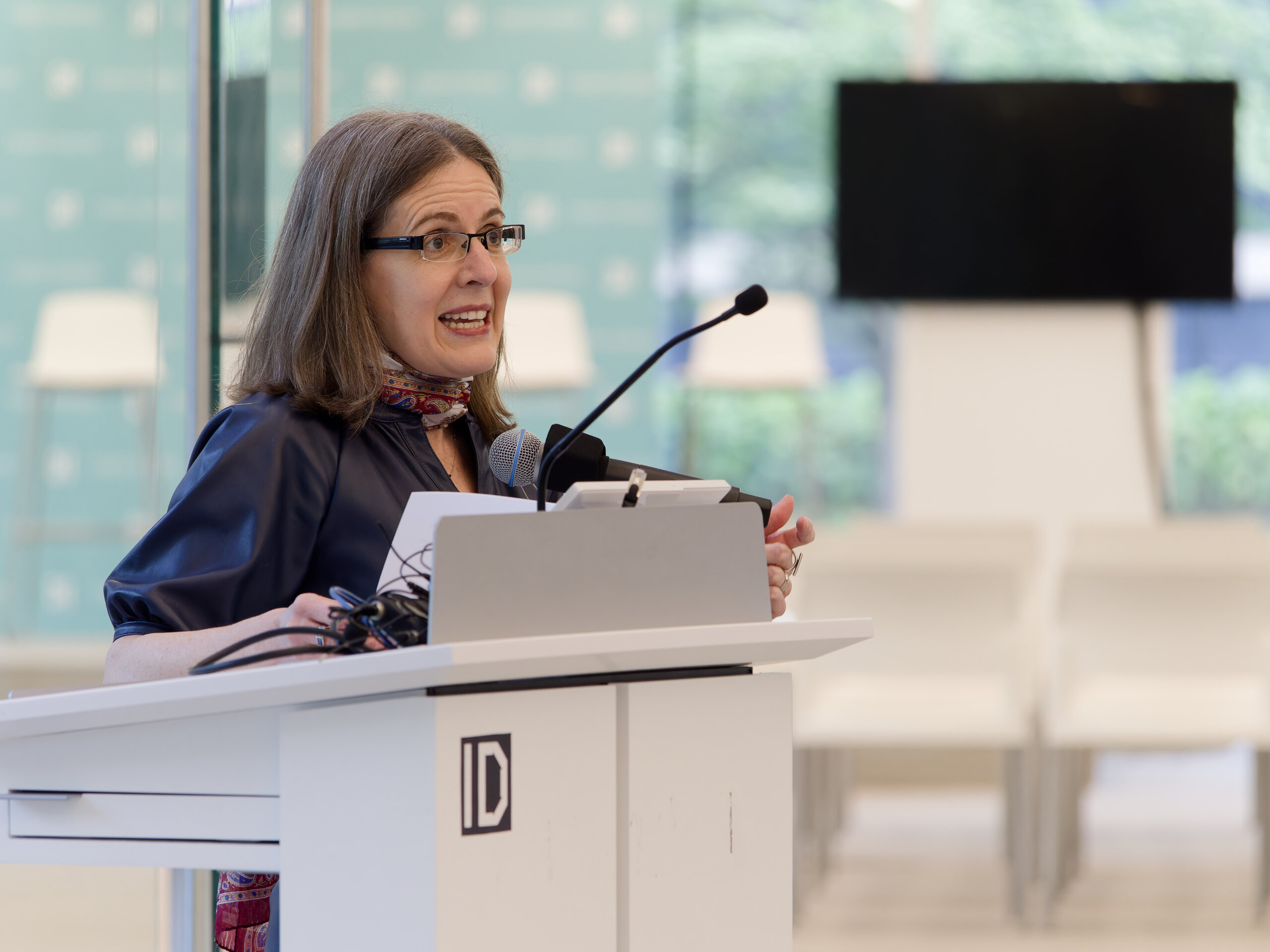
At the lectern, Roberts admitted that the strangest developments in her life would have sounded absurd even seven years earlier. She had made a home in the American South. She had performed stand-up comedy with scientist friends. She was leading work she could not have predicted from the drafting table. “But that,” she told the graduates, “is how the future works.”
“Change-making is fun. It's necessary. It's a team sport.”Melody Roberts, 2024
The speech refused to turn her path into a prescription. Some classmates built agencies. Some taught. Some ran design groups. Others cared for families and communities, or used their training part-time. There was no correct ladder and no obligation to keep the same title forever. Call yourself whatever works, she advised. The useful question is whether the work improves a life, a system, or a decision.
Four things worth stealing from Roberts' career
- Turn an ambition into a test. The plane ticket may teach more than another month of speculation.
- Prototype the invisible things too: meetings, roles, services, and the rhythm of the work.
- Earn trust in the system you hope to change. Care is practical infrastructure.
- Keep the identity loose. A designer can become an operator, founder, or something the old job board forgot to name.
Chapter 05The next useful version
In 2025, Liv Labs moved from long development into a public pilot, fulfilled a crowdfunding campaign, and opened ecommerce channels. The company's work received Fast Company Innovation by Design recognition. Roberts thanked engineers, scientists, researchers, investors, backers, advisers, and early customers. The list mattered. Her startup story, like her corporate one, was written in plural.
There is a pleasing loop in the arc. The young graduate who could not find an obvious role helped define one. The consultant who learned to make ideas tangible joined a client. The corporate innovator who learned that scale runs on trust took those lessons into a small company, where every relationship is visible and no department is far enough away to blame.
Roberts ended her 2024 address with a baton pass. Her generation would rely on the next one to envision, invent, act, lead, and, above all, care. It sounded less like a farewell than a design brief. The future would remain unreliable, titles would continue to wobble, and valuable jobs would arrive before their names.
Her own response has been consistent: make something. Invite other people to it. Learn what the world does next. The first version can be awkward. It can resemble a confusing interview in Eindhoven, a department of misfits, a mock restaurant inside a windowless bunker, or a young company with more unknowns than employees. The future rarely appears finished. Roberts has built a career by meeting it at the prototype.