Seven seconds is an awkward amount of time to wait for somebody to finish a thought. In the livestream-dubbing software Bing Wu’s team first built, that was the delay between speech in one language and its arrival in English. The intended customers were creators trying to reach an English-speaking audience. The translation came through. The traction did not.
“That product had seven seconds of latency,” Wu recalled. The sentence has the useful bluntness of a product verdict. A technical accomplishment can still be an uncomfortable experience. Seven seconds gives a viewer plenty of time to wonder whether something has gone wrong, and a founder plenty of reason to reconsider what he is building.
The team received requests that pointed toward a different possibility: generate the conversation with AI. That change of direction eventually led to Retell AI, where Wu is co-founder and CEO. The business moved toward phone agents, but the difficult question remained close to the original one. How do you make a machine participate in a conversation without making everybody wait for the machinery?
The delay Wu described in the team’s original livestream-dubbing product. A small number, until you are the person listening.
From product manager to the phone line
Wu arrived with experience on both sides of the startup divide. While in college, he founded two investor-backed businesses that generated six-figure revenues. He subsequently spent about three years in product management at ByteDance and TikTok, working on business and consumer products. His undergraduate education was at the University of Southern California, where he earned a bachelor of science degree.
That background helps explain the questions he asks publicly. His discussion of voice AI repeatedly returns to whether a customer can use it, whether a workflow completes, and whether a business can keep operating it. The voice matters. So does everything the voice is expected to get done. A pleasant greeting is a modest achievement if the caller still leaves with the original problem.
Retell was a five-founder effort. Alongside Wu were Todd Li, Zexia Zhang, Weijia Yu and Evie Wang. Their experience included Google engineering, speech technology, Meta product work and ByteDance design. The company dates its acceptance into Y Combinator to November 2023, followed by the Winter 2024 batch and a public launch in February 2024. Wu’s new job put him among people who could approach the same conversation from several different directions.
The trouble begins between sentences
In an ordinary conversation, a pause can mean several things. A person may have finished, be searching for a word, or be about to correct something. A voice agent has to decide whether to respond. It also has to cope when the person starts speaking again. Conversation contains a surprising amount of traffic management for an activity that rarely comes with road markings.
Retell developed a turn-taking model to address that problem. In Wu’s account, it uses meaning and audio cues to help determine when a thought has ended. The purpose is to reduce the gaps and collisions that make an automated exchange feel laborious. His attention to the interval between speakers gives the company’s origin a certain continuity: the delay that frustrated one product became a central concern of the next.
The early API let developers give their language models a voice. Wu’s ambition widened toward the practical work of contact centers: transferring a caller to a person, connecting to customer records, and understanding what happened during an interaction. These are the details that turn a conversation into a business process. The agent must fit into an operation that already has its own rules, systems and customers.
By May 2026, his conversation with CX Foundation’s Katherine Stone covered testing, quality assurance, guardrails and human handoffs. It also made room for human agents handling complex interactions. The scope was revealing. Getting software to speak had opened a much larger set of questions about who takes responsibility when the conversation becomes difficult.
“production first, demos second”
Bing Wu, on Retell’s approach to voice AI
The founder who kept the sales job
Wu’s account of building the business has a similarly practical center. When a new function became necessary, a founder ran it first. He says sales remained his responsibility until Retell reached $20 million in annual recurring revenue. That is a substantial stretch of customer conversations before handing the work over. A founder following this approach cannot remain entirely inside the product brief.
His explanation is that doing the job reveals its component parts. Some require people. Others can become software. The same method applied across operations, marketing, finance and customer implementation work. By the time someone was hired, the founders had a clearer understanding of the problem the new colleague would inherit. The job description had already met the job.
There is a useful connection here to the product itself. Retell’s customers need to understand what their phone agents are doing. Wu argues for founders understanding what their own functions involve. In both cases, responsibility begins with enough familiarity to recognize a failure and decide what should happen next. Delegation is easier to assess when the work has passed through your own hands.
Counting conversations that happened
In a public update announcing 20 million minutes of monthly use, Wu drew a distinction between contracted revenue and live revenue. He wanted attention on traffic already running through the platform. A signed agreement can describe an intention. Live use exposes the product to callers, exceptions and repeated demands. Those minutes also carry information about what customers actually need.
He described beginning with smaller and mid-market businesses, where the team could deploy, get feedback and improve quickly. Different customers solving similar problems helped show which workflows belonged in the product. His preference for live usage is also a preference for an environment in which a mistaken assumption gets an answer. The phone is unusually good at refusing to admire your roadmap.
The company’s reported financial milestones grew alongside that operating story. Retell records $40 million in annualized revenue and profitability in November 2025, with a team of 25. Its timeline puts the annualized figure at $80 million in September 2026. These are company-reported run rates, measuring the pace of business at those moments, rather than revenue collected over a completed calendar year.
By 2026, Wu was discussing Retell’s growth in a Nasdaq interview, and the company appeared in Wing VC’s Enterprise Tech 30 early-stage list. Recognition brought a wider audience to the same underlying question. What must a voice agent keep doing, call after call, for a customer to keep using it? A milestone attracts attention once. The operation has to earn its place repeatedly.
A small team with room to move
One of Wu’s more personal accounts of growth involved a returning visitor. He described an early meeting between the five founders and Michael Seibel. Sixteen months later, Seibel came back to a room filled with the expanded Retell team. It is a more tangible picture of company building than a rising revenue figure: the same visitor, the same enterprise, more people in the conversation.
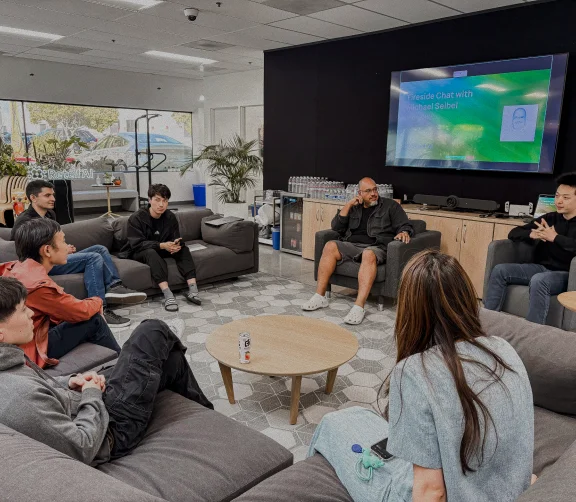
Wu has also argued for giving those people autonomy. Retell’s June 2026 workplace announcement described evaluating results rather than hours, flexible schedules and ownership from the beginning. The company announced first place in the 10-24 employee category of the San Francisco Business Times’ Bay Area workplace awards. That award category is a specific group, separate from the company’s overall staffing at other dates.
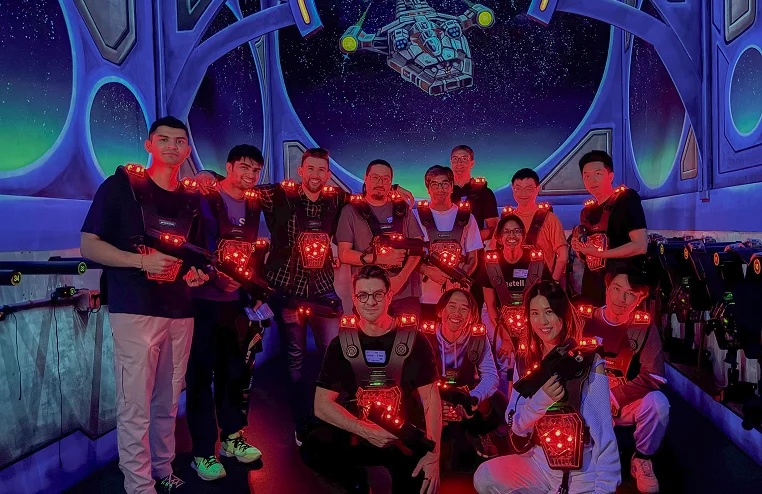
The argument for autonomy has a practical consequence. People need to own an outcome closely enough to make decisions about it. A smaller organization depends on that ability. It is an exacting promise to employees as well as an attractive one: freedom arrives with responsibility for the result, and a founder must make the problem clear enough for somebody else to take it on.
The day after the agent goes live
In the Nasdaq conversation, Wu also pointed to making the platform usable by everyday people. That concern adds another demand to the engineering work. If changing a call flow always requires a specialist, the people who hear the customer’s difficulty may have to wait for someone else to act. His interest in accessible tools places the person running the operation beside the person calling it. Both need the system to make sense, and both pay for unnecessary friction.
Retell’s June 2026 launch of Conductor made the next stage of Wu’s ambition concrete. The copilot can review failed calls, generate simulation tests and propose changes within the agent’s workflow. A person reviews those changes before they go live. The proposed fix appears where it would affect the operation, giving the reviewer something more useful than a general suggestion to make the agent better.
That arrangement brings the operator back into the center of the story. A business needs to see a problem, understand a proposed response and decide whether to accept it. Automating a conversation creates continuing work around the conversation. Wu’s broader goal of an AI contact-center platform includes that work: the monitoring, adjustment and judgment that follow the first successful call.
The seven-second dubbing problem now looks like an early encounter with a concern that kept expanding. First came the delay. Then the turn between speakers. Then the transfer, the customer record, the test and the next revision. Wu’s company has grown around those accumulating obligations. The familiar act of answering a phone contains enough unfinished business to keep a founder occupied for quite a while.
More from Wu’s corner of the conversation
- Bing Wu on LinkedInPosts and professional profile
- Retell AIThe company and its platform
- Watch: Building Enterprise Voice AIKatherine Stone interviews Bing Wu / May 2026
- Watch: Wu at Nasdaq MarketSiteA conversation about Retell’s growth / May 2026
- Listen: Can AI Replace BPOs?The Future of Voice AI / November 2024
- The dubbing experiment and the turn toward voiceRetell’s account of the early product
- The 2026 Enterprise Tech 30Wing VC’s list, including Retell AI