The detail Kyler Blue liked best about Wavedash’s launch was the invitation. A player could start a race, copy the link, and send it to a friend. The friend could use that same address to join the multiplayer lobby. A little piece of internet housekeeping had become part of the game.
It is an unusually useful detail for understanding Blue’s career. Before becoming Wavedash’s co-founder and CEO, he designed GIF Keyboard and became Head of Product at Tenor. His work put moving pictures within reach of people who wanted to say something to one another. Now he is working on the distance between wanting to play together and actually getting into a game.
A GIF and a PC game make strange companions. One might last three seconds; the other might swallow a weekend. But both have a social life. Someone sees something, likes it, and wants someone else to experience it. The link is where Blue’s two chapters meet. His current company asks how much of the ceremony around games can be removed before the playing begins.
A keyboard built for the conversation
Blue’s professional introduction is still a designer’s introduction. He calls himself a designer and builder. At Tenor, he was employee number one, designed GIF Keyboard, and helped build the API that allowed other applications to bring GIF search into their own products. The visible keyboard was one part of a business that also worked behind the scenes.
That distinction matters. A product can have a familiar name and still do much of its work inside somebody else’s application. For a designer, this means paying attention to a moment in another person’s day: the message being composed, the reaction being sought, the conversation already under way. The usefulness of the product depends on how comfortably it fits there.
Google acquired Tenor in March 2018. The acquisition announcement described an interest in helping people find images for communication and self-expression, alongside the familiar task of finding information. Tenor’s library and relationships with content partners would support GIF discovery in Google Images and other Google products.
Blue’s own Google byline supplies a particularly clear snapshot of that work. In June 2019, writing as Product Manager at Tenor, he introduced a Share GIFs section in Google Images. People could send a result directly into applications including Gmail and WhatsApp. The search result had somewhere to go.
The design problem was deliciously ordinary: someone wanted to say good morning, express surprise, or find a picture that captured a feeling. Search had to serve that small act of communication. Blue’s announcement explained that the section selected GIFs according to their likelihood of being shared. The next action helped determine what appeared in the first place.
Different media. A familiar design question: how easily can another person join in?
Before the browser, an island and a guitar
There is a more literal version of making things accessible in Blue’s early history. From October to December 2010, he volunteered with Conservation Volunteers New Zealand on Rotoroa Island in Auckland’s Hauraki Gulf. He describes helping shape the terrain into walking trails and paths, alongside other construction work.
A trail is a modest piece of design. It gives someone a route through a place they might otherwise find difficult to enter. There is no need to turn the volunteer assignment into a prophecy about a future startup. It is simply a concrete episode in a life that would later involve designing routes through software.
At Stanford, Blue studied product design. The university’s 2011–12 men’s crew roster also lists him, with Kirkland, Washington, as his hometown and Lake Washington as his previous school. The record puts rowing alongside the design studies, before the titles associated with Tenor and Wavedash.
He played music, too. In 2013, Blue performed an acoustic guitar duet with Zach Saraf at a Stanford Live student cabaret at Bing. The performance earned a place in the campus newspaper’s review of an evening that included classical music, rap, dance, and improvisation.
Blue’s present-day description of himself includes guitar and basketball. He rates himself as decent at both. It is a pleasantly restrained self-assessment on a personal website, a form of publishing where modesty sometimes struggles to find parking. The guitar appearance gives one of those interests a small, public history of its own.
The work hidden before a playtest
Wavedash was founded in 2024 and joined Y Combinator’s Spring 2025 batch. Blue’s account of the early work starts with the founders’ experience publishing games together. They had encountered cumbersome development workflows and wanted developers to spend less time getting builds out, arranging tests, and collecting feedback.
His initial pitch was specific about the customers he wanted to hear from: people building Unity3D games, using GitHub for version control, and looking for PC playtesters. That specificity gives the origin some texture. A founder can announce a mission to improve games; Blue was also asking who had a particular set of tools and a particular problem right now.
In his account, file uploads, tester coordination on Discord, and disorganized feedback consumed effort that could have gone into development. The complaint is recognizable even without having shipped a game. Getting people to try something can become its own production, complete with instructions, reminders, and the person who cannot find the correct file.
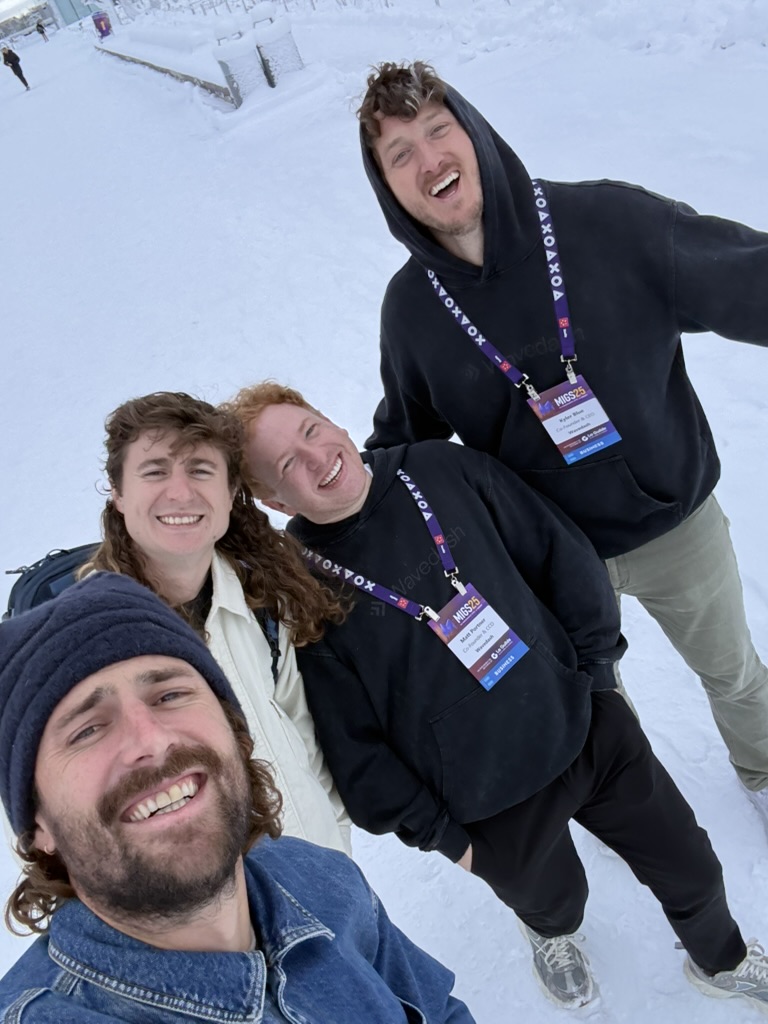
In May 2025, Blue and co-founder Matt Portner went to PAX East in Boston. Blue described meeting dozens of studios and hearing concerns about manual builds, managing playtesters, and missed opportunities to organize feedback. The conversations placed the early product in front of people doing the work it was intended to simplify.
There is a useful continuity between this developer-facing effort and the later public platform. A studio needs its game to reach a tester. A player needs a game to reach a friend. The people and circumstances differ, but each encounter begins with getting someone into the experience. Blue’s public work keeps returning to that first step.
Three people, one address
Blue founded Wavedash with Raymond (George) Kennedy and Matthew Portner. Kennedy is the company’s CTO; Portner is its chief creative officer. Their collaboration brings product design, engineering, and gaming production into the same project, with Blue responsible for leading the company.
Kennedy’s earlier work includes Rhythmm, a Y Combinator Winter 2018 company, and other software projects. Portner founded the gaming YouTube community DefendTheHouse and worked at Snap and BuzzFeed, with visual effects credits in television and film. These are distinct working histories, connected by the task of helping games find players.
The team’s offer to developers on its Y Combinator launch page was practical: Wavedash would help port their games to the web and undertake the engineering work required. A browser platform needs games, and a studio considering another platform needs a way to get there. Making the invitation credible requires work on both sides of the screen.
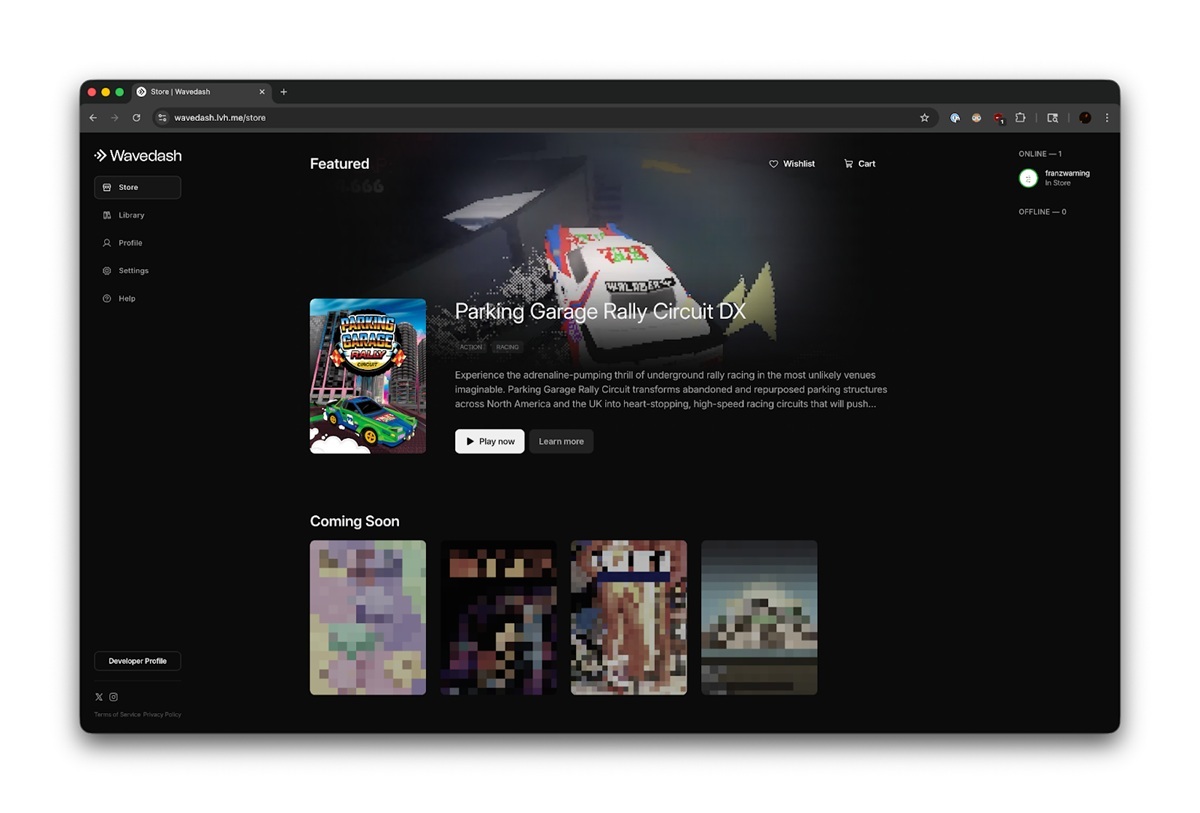
The public beta arrived in December 2025 with Parking Garage Rally Circuit DX, an arcade racing game from Walaber. Blue’s announcement emphasized the shared address that served as both a way into a race and a multiplayer invitation. Rather than sending friends through a list of setup instructions, the player could send the place where the game happened.
Wavedash announced $4.3 million in funding, led by Floodgate’s Mike Maples Jr. The backing included Y Combinator and other investors. The amount belongs to the company’s financing, while the personal story remains in the choices Blue and his co-founders are making about how a game reaches another person.
“The same link that starts a race is also your multiplayer lobby invite.”
Kyler Blue, on the public beta
Giving developers a route in
By 2026, Blue was also participating in the web game community beyond Wavedash’s own announcements. Gamedev.js listed him on the expert panel for its annual jam, alongside Kennedy and Portner. The event asked developers to make browser games and offered a Deploy to Wavedash challenge.
The team’s published feedback selected Not a Trolley Problem, BUILDOBAN, and Codepath() as its three challenge winners. The comments praised an ethical dilemma, a twist on Sokoban, and the appeal of a programming game. These are small pieces of evidence, but useful ones: a platform becomes more interesting when its founders pay attention to individual games.
In June 2026, Wavedash became a corporate partner of the Defold Foundation. An SDK integration was available at the announcement, with work planned on browser performance and further integrations. The partnership addressed part of the developer’s journey before a player ever clicks a link.
Blue’s explanation pointed to what he valued in the engine: its source availability, lightness, and attention to craft. He described the partnership as an investment in the engine, tools, and people who use them. His stated values became a relationship with an organization maintaining something developers build upon.
“These are values we believe in at Wavedash.”
Kyler Blue, on Defold’s approach to engineering
That is where the keyboard designer’s next chapter is taking shape. Getting a friend into a game sounds like a tiny ambition until the work required becomes visible: the developer tools, the platform, the game itself, the invitation. Blue has worked on sharing at several of those levels. Wavedash’s promise will be tested in the familiar moment when someone sends a friend something worth playing, and waits to see whether they join.