At 23, Larry Page woke with an idea that would have sounded excessive even before breakfast: download the web and keep its links. He reached for a pen. By morning, the thought had become a plan. When he told his Stanford adviser, Terry Winograd, that the job might take a couple of weeks, Winograd let the optimism stand. There is a particular generosity in allowing a graduate student to underestimate a problem.
Page was thinking about a map of connections. A search engine came later. The distinction helps explain a career in which the first question has often been more interesting to him than the accepted answer. Google would give him the resources to keep asking. It would also give him a large, successful institution with plenty of perfectly sensible reasons to stay occupied.
What happens to an inventor once the invention works? In Page’s case, the problem keeps changing size.
A printer made of Lego
Born in Lansing, Michigan, in 1973, Page grew up with computing close at hand. His father, Carl Victor Page, taught computer science at Michigan State University; his mother, Gloria, taught programming there. Computers and science magazines were part of the household scenery. For a child wondering how things worked, the reading material and the things themselves were conveniently scattered around.
His older brother helped him learn to take objects apart. Page remembered being an early adopter of word processing for schoolwork, an achievement with a modest audience and a useful consequence: the machine could do something for him. His account of childhood is full of mechanisms, electronics and possibilities. The attraction lay in getting his hands on the equipment.
At the University of Michigan, he built an inkjet printer using Lego. He wanted an inexpensive way to print large images. The project is an agreeable antidote to the solemn vocabulary that tends to gather around technology founders. Before the corporate vocabulary arrived, there were plastic bricks and a printing problem.
He graduated in computer engineering in 1995 and headed to Stanford. His preparation included the habit of looking at an existing arrangement and asking whether it had to remain that way. A printer was one arrangement. The internet offered considerably more moving parts.
The web had already cast its votes
At Stanford, Page met Sergey Brin, who had been assigned to show him around during his visit. Their collaboration became the foundation of Google. The partnership mattered as much as the initial idea: Page had a question about the web’s structure, and Brin brought an interest in extracting information from large collections of data.
The web was already full of judgments. Somebody making a link had chosen to point a reader somewhere. Academic work supplied a familiar analogy: a citation connects one piece of writing to another. Page and Brin investigated how those connections could help determine which pages deserved attention.
The useful complication was that links were unequal. A reference from an important page should carry more weight than a reference from an obscure one. Importance, in turn, depended on other references. PageRank made that circular relationship calculable. It took a messy collection of human choices and turned it into part of a ranking system.
A link can carry a judgment.
PageRank weighs the linking pages as well as the links. Search also needs to match the words in a query. This diagram illustrates the relationship; it does not represent measured scores.
The early project was called BackRub, a name that gave away its interest in backlinks and would have made an unfortunate verb. Google proved easier to say. Its name played on a googol, one followed by a hundred zeros, a numerical expression of the scale the founders had in mind.
Page and Brin’s early search paper described a prototype with a database of at least 24 million pages. There were crawling systems, storage decisions and text processing underneath the attractive idea. Good ranking needed an apparatus that could collect and handle the material. The question had acquired a workshop.
A company is another kind of machine
In August 1998, Sun Microsystems co-founder Andy Bechtolsheim wrote a $100,000 check. Google incorporated and moved into a Menlo Park garage belonging to Susan Wojcicki. The setting had blue carpet, desktop computers and a ping-pong table. Later, the garage would become part of the company’s origin story. At the time, it was space to work.
Page took leave from Stanford after earning his master’s degree. He became Google’s founding CEO. The decision replaced a familiar academic route with a business whose research had started attracting users. The algorithm could help answer a query; the company had to keep answering queries tomorrow.
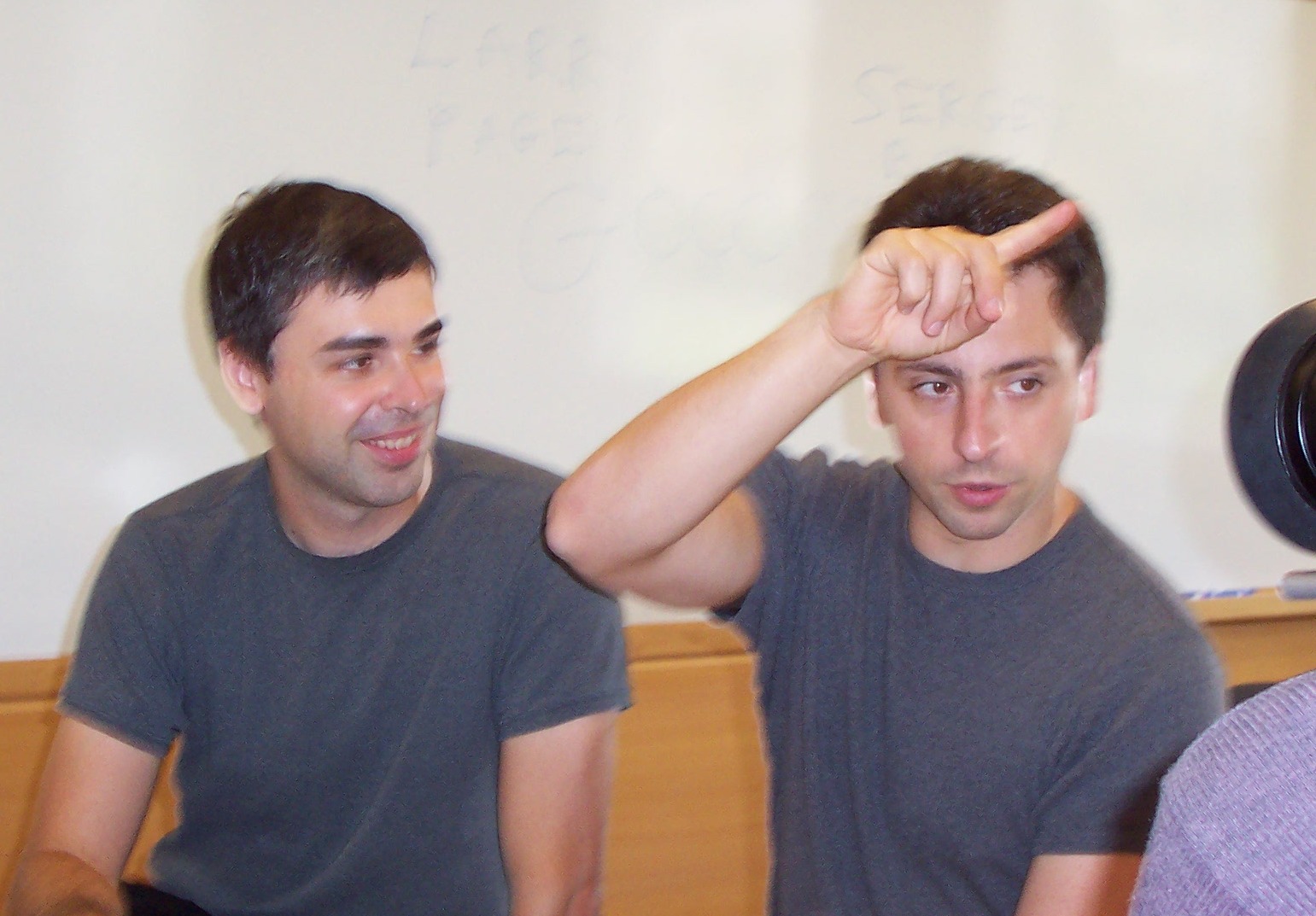

Google grew beyond 200 employees and became profitable during its early years. Eric Schmidt took over as CEO in 2001, while Page became president of products. For roughly a decade, the company’s leadership distributed responsibilities across Schmidt, Page and Brin. Founding a business had not obliged Page to hold the same position forever.
That arrangement also kept him close to products. The problem of building Google had expanded from discovering a useful method to deciding what useful things the company should make. A search engine brings users to information. Other products could bring information into more of the situations where people needed it.
The 2004 public offering introduced another audience: shareholders. Page and Brin addressed them with an opening that still reads like a polite notice attached to an unusual machine. They intended to keep their company unconventional.
“Google is not a conventional company. We do not intend to become one.”
Larry Page and Sergey Brin / 2004
The letter described a willingness to accept uncertain returns and pursue projects outside the established business. It also explained a voting structure that preserved influence for the founders. Patience was being written into the company’s expectations and its ownership. Investors were being asked to buy into a way of making decisions.
Making room for the next question
Page returned as Google CEO in April 2011. The position was familiar; the organization had changed. Keeping a growing company capable of trying unfamiliar things became a management problem of its own. The student who had wondered about links now had to think about the connections between teams.
Android offered one example of his willingness to look beyond the immediate business. Page had helped bring the mobile software company into Google in 2005. Years later, he admitted feeling guilty while working on something that seemed outside the company’s main activity. In retrospect, he regarded that guilt as misplaced. Phones were becoming a route to the information Google wanted to make accessible.
His preference for large improvements became associated with the idea of making something ten times better. As an aspiration, that changes the starting question. A team asked for a modest improvement can polish the existing design. A team asked for a much larger change may have to reconsider the design altogether. The demand is stimulating, though it supplies no guarantee that an answer exists.
A target for rethinking a product, rather than a measured result or a promise that every experiment will work.
In August 2015, Page announced Alphabet. Google would sit within a collection of businesses, with Sundar Pichai leading Google and Page becoming the parent company’s CEO when the restructuring took effect that October. The change gave the ventures outside Google a more distinct place in the organization.
It was an attempt to make independent leadership compatible with a shared pool of resources. Page’s argument concerned where responsibility belonged and how businesses could grow without every question travelling through the same company. An organization chart had become another design surface.
The road kept leading back to transport
His interest in transport preceded Google. At Michigan, Page had advocated a campus transit system to replace the bus journey between campuses. The proposal gave a familiar inconvenience the treatment he would later give other problems: examine the machinery instead of simply accepting the wait.
By his 2014 TED appearance, he was discussing automated cars and other ways of moving people. There was a continuity between the campus proposal and the later projects, even as the resources available to him changed. Getting somewhere seemed to invite the same questions as finding something online: why so much effort, and what could a different system do?
“Invention is not enough.”
Larry Page / TED2014
Page’s point was that technical creation needed a route into use. An invention could be ingenious and still remain inaccessible. Manufacturing, distribution and a company able to do the work were part of the problem. His interest in business had always sat close to his interest in making things.
The aircraft venture Kittyhawk tested that ambition in the physical world. Page backed the company, which pursued electric flight. In September 2022, Kittyhawk announced that it was winding down. The closure belongs in his story alongside Google’s success. A large goal can attract attention and resources while the project pursuing it still ends.
In March 2025, public reporting linked Page to Dynatomics, an AI manufacturing venture. Its reported existence points toward another attempt to connect designs with physical production. It remains a reported development rather than a demonstrated outcome.
A smaller title, a continuing stake
In December 2019, Page and Brin handed Alphabet’s daily executive leadership to Pichai. They described themselves as proud parents, ready to offer advice without daily nagging. After years of explaining a company in technical and financial terms, they chose a domestic analogy for leaving its management.
Page retained a board seat. Alphabet’s April 2026 disclosures list him as chair of its Executive Committee and give him 27.4 percent of total voting power. Leaving the CEO’s desk and surrendering influence are different events. The founding partnership still has a place in the company’s governance.
- 1998Google’s founding CEO
- 2001President, Products
- 2011Google CEO again
- 2015Alphabet CEO
- 2019Executive handover; board role continues
The role changes are a useful way to read Page. He has been a researcher, a product leader and an executive, sometimes simultaneously. Each position has put a different obstacle between an idea and its use. Some obstacles needed an algorithm. Others needed a colleague to take charge.
The night at Stanford supplies an attractive beginning because it contains both ambition and an underestimate. Page thought a vast job might take weeks. What followed required a partner, an institution, equipment, investors and years of work. The idea mattered. So did everything that made it possible to keep working on it after breakfast.