Soham Mazumdar thinks you should show a customer your product while it is still a little embarrassing. This is inconvenient advice for anyone who enjoys the splendid privacy of being right. A prototype on your own laptop can remain promising indefinitely. Put it in somebody else’s hands and the questions begin.
He has good reason to welcome them. Early customers helped change Rubrik, the data company he co-founded, from a business centered on the data center into a cloud company. At WisdomAI, where he is co-founder and CEO, he is again looking for the moment when a user’s experience changes the builder’s assumptions. The unfinished product has become a recurring character in his working life.
There is another version of this career that could be told entirely through prizes, acquisitions and funding rounds. Those events belong in the story. But they leave out its more interesting complication: a person trained to solve difficult problems keeps choosing situations in which the problem itself needs to be discovered.
A silver medal has a clear marking scheme
In 1998, Mazumdar represented India at the International Mathematical Olympiad and won a silver medal. His result was 26 points, with full marks on three of the six problems. An olympiad offers something business rarely does: a question carefully agreed in advance, a bounded interval in which to work, and an answer someone can mark.
That same year, he placed third nationally in the IIT entrance examination. He studied computer science at IIT Kanpur, graduating in 2002, then completed a master’s in computer science at the University of Illinois Urbana-Champaign in 2004. The sequence suggests a young person unusually comfortable with demanding intellectual work. It does not, by itself, explain why he would later spend time worrying about customer loyalty in neighborhood shops.
His graduate work supplies an intriguing detour. With Sariel Har-Peled, he wrote a paper on coresets for k-means and k-median clustering, published at the 2004 Symposium on Theory of Computing. In 2024, it received a twenty-year Test of Time Award. The academic chapter had kept working long after he had moved into industry.
A coreset is a smaller, weighted representation of a larger collection of points. The attraction is straightforward: do the clustering work on the smaller set while keeping a controlled approximation to the original result. The mathematics is precise about what can be preserved while reducing the work. It is an appealing idea for anyone confronted with more data than time.
The later analytics business is a separate undertaking, with its own engineering and commercial demands. Still, the juxtaposition is pleasing. Before Mazumdar was trying to make enterprise information easier to use, he was helping establish how a large mathematical problem could be represented more economically.
The shopkeeper interrupts the engineer
At Google, Mazumdar worked on search infrastructure, including Teragoogle, a rearchitecture intended to support a trillion documents. His work earned a Google Founder’s Award. Search at that scale makes reliability a practical concern: a system must organize enormous volumes of information and keep functioning when people actually ask it something.
The next problem arrived at a much smaller scale. Tagtile, which he founded with Abheek Anand, grew out of a conversation at Fatoush, a San Francisco restaurant. Its owner was frustrated that customers arriving through discount sites often failed to return. The founders saw a customer-loyalty problem and built a mobile service around it.
The company name had its own small joke. After winning a startup competition, they celebrated with Malbec wine. When their lawyer wanted a name for the entity behind Tagtile, Malbec Labs supplied one. A corporate identity can emerge from a branding workshop; this one had already been poured.
Facebook acquired Tagtile’s assets and brought its founders aboard in 2012. For Mazumdar, the move took him into Facebook engineering. It also put a completed transaction beside a much messier experience: building something for local merchants and discovering how hard it is to turn a technical idea into a business people adopt.
The difference between those settings matters. A search engineer can spend a day improving a system people already depend on. A new loyalty company must persuade a shopkeeper that another device or app deserves a place in an already crowded working day. The technical problem comes attached to a distribution problem, a habit problem and, quite possibly, a customer waiting at the counter.
Rubrik changes the question
In 2014, Mazumdar co-founded Rubrik with Bipul Sinha, Arvind Jain and Arvind Nithrakashyap. He became its chief architect. The business began with enterprise data protection and grew into a data security company. Rubrik went public on the New York Stock Exchange in April 2024, after Mazumdar had left to start his next company.
The four founders’ early statement of intent makes revealing reading. They emphasized simplicity, hiring for capability, an open workplace and design extending beyond the interface into packaging, sales and support. They described shared lunches as noisy family dinners. An infrastructure company was paying attention to the social machinery around its technical machinery.
That breadth helps explain why customer feedback became such an important part of Mazumdar’s account of the company. He credits early users with helping steer Rubrik toward the cloud. A customer asking for something inconvenient can force a company to reconsider its market, rather than merely add another item to the engineering backlog.
“Your first customers are worth their weight in gold.”
Soham Mazumdar
There is a practical generosity in this view of the customer. The early buyer contributes more than a purchase order. They show how the product behaves in an environment the founders do not control, expose missing assumptions, and may explain its usefulness to the next buyer in language the company would never have chosen.
For the founder, the uncomfortable part is timing. Feedback arrives with greatest force when something tangible exists, yet the temptation is to postpone exposure until it is polished. Mazumdar’s advice accepts that discomfort. Give the user something real enough to criticize. Their criticism may save you from perfecting the wrong thing.
The queue outside the data warehouse
Mazumdar founded WisdomAI in 2023 with Kapil Chhabra, Sharvanath Pathak and Guilherme Menezes, colleagues from Rubrik. Their new subject was the gap between possessing enterprise data and being able to use it. A company could have extensive infrastructure and still require a specialist to answer an ordinary business question.
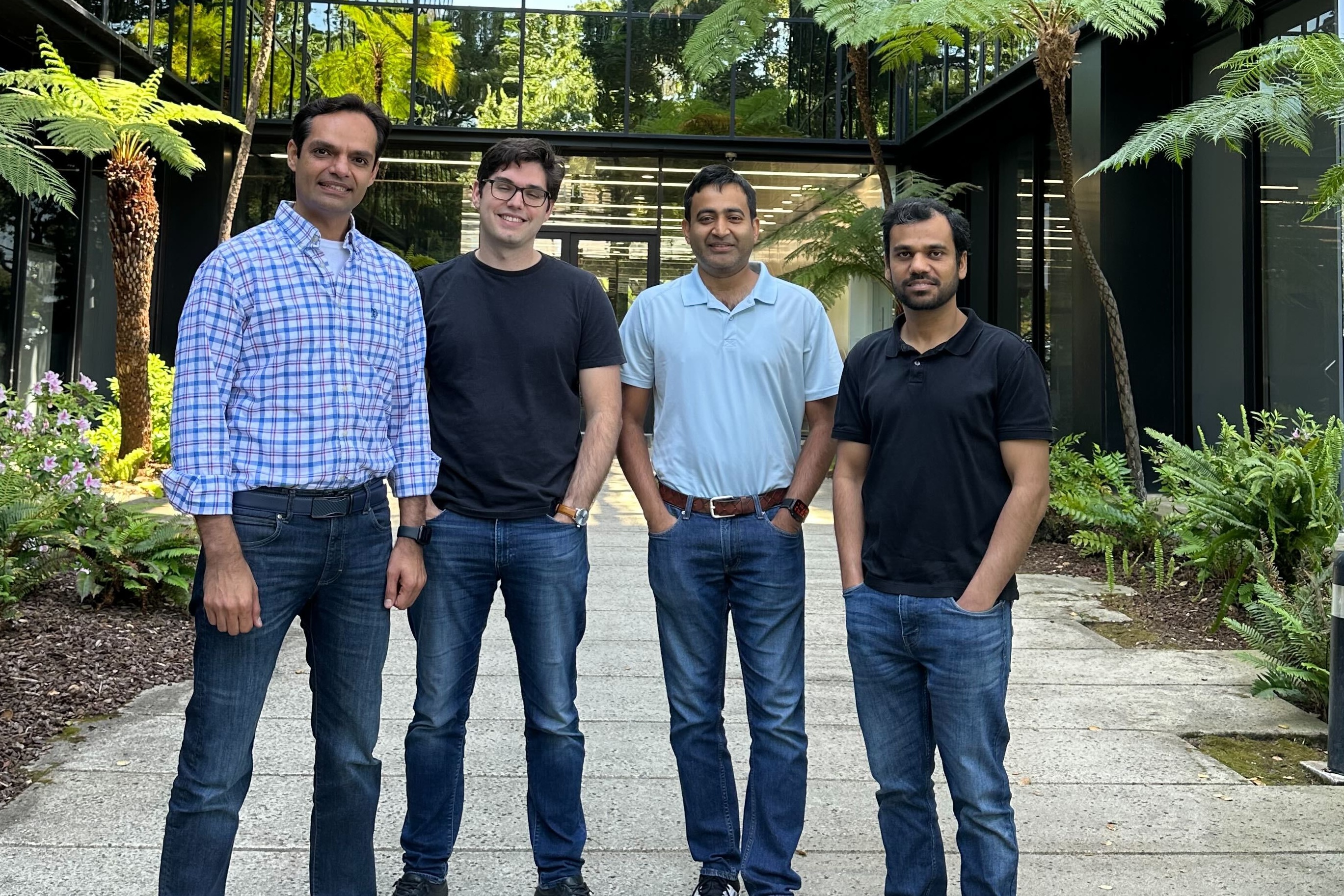
He describes himself as a builder. The choice of colleagues makes that description concrete: the founding group brought experience of enterprise data systems into a product meant for the people using those systems. The new company would have to translate between the engineer’s concern for dependable infrastructure and the manager’s concern for an answer before a meeting.
WisdomAI uses generative AI to formulate queries against data systems. Mazumdar’s stated design choice is to retrieve information through those queries rather than ask a language model to invent the underlying facts. Business vocabulary and permissions still matter. A fast answer becomes useful only when it refers to the right thing and reaches the right person.
- AskA question in everyday language
- InterpretBusiness definitions and permissions
- QueryRetrieve data from connected systems
- InspectAn answer with an explanation
The customer examples bring that abstraction down to earth. WisdomAI reports that an energy customer enabled more than 2,000 engineers across 14 countries to ask operational questions directly. The work combines drilling information with manuals. The useful unit here is a person who can investigate a question without first translating it into a request for a specialist.
In procurement, another company case study describes spend data in Snowflake and contractual detail scattered through PDFs and spreadsheets. It reports deployment to more than 200 users in under a month. These are company-reported results, but they identify the kind of fragmentation Mazumdar is trying to address: the number and the explanation live in different places.
The first customer does not wait for the polish
One of Mazumdar’s favorite WisdomAI memories is its first pilot. A startup co-founder tried a raw version of the product and sent an exuberant message comparing it to a tenfold improvement in the chief revenue officer’s abilities. There were rough edges. There was also somebody outside the company who wanted to use what it had made.
In June 2025, Mazumdar described a progression from that early pilot to a first Fortune 500 customer about six months later. The company emerged from stealth in May and appeared at Snowflake Summit in June. Those milestones tell a more useful story than a launch announcement alone: first an experiment, then a demanding buyer, then a wider audience.
In November 2025, WisdomAI announced a $50 million Series A led by Kleiner Perkins, with NVentures participating. Total funding reached $73 million. The stated uses included engineering, product development and commercial expansion. Money enlarged the team’s room to work; customers would still determine whether the work deserved a place in their routines.
Monday morning, with an audit trail
By September 2026, Mazumdar was describing one such routine of his own. Before the Monday leadership meeting, he opens a WisdomAI Live App called the CEO Weekly Brief. It has a newspaper design theme. Its job is to organize company information into a briefing he can question, rather than a fixed collection of charts.
His favorite detail is traceability: the ability to inspect the data, context and reasoning behind an insight. There is something fitting about an architect becoming a CEO and remaining interested in what sits beneath the presentation. A pleasing page helps. Being able to check the work helps him decide what to do next.
His recent writing also argues for treating business context as something organizations maintain deliberately, with versions, tests and approvals. Definitions change. Policies change. An AI system working from yesterday’s meaning can confidently answer today’s question incorrectly. That concern brings the conversation back to the patient engineering underneath the attractive interface.
The mathematician’s clear marking scheme has given way to a more troublesome test. People must find the product useful, keep using it, and trust it enough to bring it into a working day. Mazumdar keeps inviting them to mark the paper while he is still writing it. The unfinished answer is where the next question gets in.
Follow the questions
Conversations, earlier chapters and the work he is building now.