A year is a short time to discover that your business plan has become a historical document. Ankit Kumar Shah founded InterSources in 2007. In 2008, Circuit City, the young company’s largest client, filed for bankruptcy. A customer that had helped give the business its shape could no longer give it a future. Shah kept the company operating.
That is the hinge of his story. The founder, generally known publicly as Ankit Shah, has since built a technology consultancy whose work includes cloud, data, artificial intelligence and cybersecurity. Those words can make a career look like a sequence of fashionable destinations. The opening setback gives them a different meaning. Once a business has survived the disappearance of its largest account, dependability becomes a rather personal subject.
InterSources says it has grown without outside capital. The detail matters because it puts the first crisis in focus: there was no investor waiting to absorb the shock. The work had to justify the company’s continued existence. A founder could revise the presentation; clients still needed a reason to buy.
A warehouse is a demanding first teacher
Shah arrived in the United States as an international student. His education included an MBA at the University of Scranton, with a focus on information technology, international business and finance. It was a combination suited to the border between a technical system and the business that must pay for it. A useful piece of software has to make sense on both sides.
His early career included analyst and consulting work at Anchor Blue, supply-chain analysis at Mervyns, and client-services work at International Asset Systems. Retail and logistics offer a brisk introduction to the consequences of bad information. A report can look elegant while an order is still wrong. An inventory system has little use for eloquence when the stock cannot be located.
One of the first products in the InterSources story was a warehouse management system driven by data analytics. It is an unusually concrete starting point for a founder now associated with cybersecurity. The underlying task was to connect information to an operation: make the data useful to people doing something, moving something or deciding what should happen next.
That practical beginning makes the later changes easier to follow. Cloud services, AI and security involve different tools, but each places information inside a working organization. The question persists beneath the changing vocabulary: does the system help the work proceed, and can the organization rely on it?
The people who gave the plan a chance
Shah’s own reflection on the beginning gives people a prominent place. He remembers initially concentrating on products, services and strategy. Looking back at the first hundred days, he emphasizes trust and the early employees who helped turn an idea into a functioning business. The priorities of the founder had expanded to include the people carrying them out.
“They don’t just work on your idea - they bring it to life.”Ankit Shah, on early hires
There is something refreshingly ordinary about that observation. Early employees must interpret unfinished instructions. They discover which promises are easy to make and difficult to deliver. They influence the company before its habits have hardened. The founder supplies an intention; the team encounters the details.
The 2008 client loss made those details consequential. A business barely a year old had to continue finding work after its largest relationship broke down. Today, InterSources returns to that event when explaining its history. The episode remains useful because it is specific. A named client, a bankruptcy and a young company are more revealing than a polished declaration about perseverance.
Still, survival is a beginning rather than a management method. The business that remains open has to keep delivering. Shah’s later attention to systems, accountability and partnerships makes sense against that early experience. Keeping the doors open creates the next obligation: give people a company that works when they walk through them.
Four clocks on the wall
In a photograph from the InterSources office in Noida, Shah stands with the team among desks, computers and brightly colored partitions. Four clocks hang above the group. The office is dressed for a working day, with equipment still spread across the tables. It is a useful antidote to the abstraction of a global delivery network.
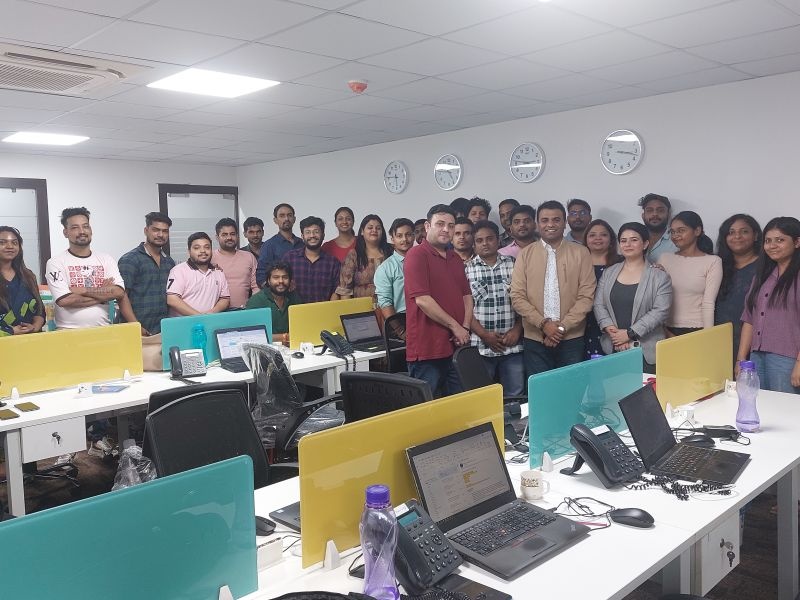
The company described the occasion as his first visit to its new office. Its delivery presence extends across the United States, India and Costa Rica. A footprint like that consists of people who must understand a request, carry out the work and pass it along without losing the important parts between time zones.
Shah’s public profile lists English, Hindi, Gujarati, Marathi and some Spanish. The list is a small personal detail in a career built around communication across organizations. Languages do not make an operation dependable by themselves, but they offer more ways to begin the conversation. And conversation, for a services business, precedes most things worth putting in a contract.
Buying expertise, keeping the expert
At the beginning of 2024, InterSources announced its acquisition of ComtechRIM. The deal added capabilities in cybersecurity, unified endpoint management and governance, risk and compliance. In plain terms, it widened the company’s ability to protect systems, manage devices and help organizations keep their controls in order.
A more personal detail sits inside the transaction: ComtechRIM’s founder and CEO, Puneet Bunet, joined the InterSources leadership team as chief information security officer. Expertise arrived with someone responsible for it. The relationship continued inside the acquiring company, rather than ending at the announcement.
Shah presented the deal as a way to combine the teams’ strengths. That is a familiar acquisition ambition, but the appointment gives it a concrete form. A founder who has built a specialist business brings experience that cannot be transferred by moving a logo onto a slide. He also brings a point of view about how the work should be done.
The current leadership includes Bunet as CISO and John Papazian as chief business officer, alongside Shah as CEO. The arrangement gives a visible shape to a business whose offerings span several disciplines. It also places people behind the language of combined solutions. Someone still has to answer when a client asks who owns the problem.
An editorial map of connected responsibilities.
A fast car, a careful system
Shah’s USPAACC biography describes him as a speed enthusiast whose passions include cars and software. It is an appealing pairing: two pursuits in which performance is exciting and the underlying engineering matters considerably. A computer and a car can both make a confident promise. The conditions under which they fulfill it deserve attention.
His business has pursued that relationship between performance and protection through partnerships. InterSources’ collaboration with Green Edge Computing concerns compact data centers for workloads such as AI and automation, bringing computing closer to where it is needed. Shah’s explanation joined the requirements in one sentence.
“Our clients demand both physical and cyber security alongside high-performance computing.”Ankit Shah, on the Green Edge Computing partnership
He has also backed a partnership with Seceon to bring its threat-management technology into InterSources’ security offerings. The emphasis is on combining detection, response and visibility across an organization’s environment. His stated position that “security cannot be an afterthought” is a practical demand on the design of the work.
Public appearances show the relationship-building side of that work. After attending the RSA Conference, Shah wrote appreciatively about conversations, creativity and partnerships in cloud and cybersecurity. He ended with a short invitation: “It’s time to build bridges!” For a founder whose company combines several kinds of expertise, the metaphor has a straightforward business application.
Trust has to work on a Tuesday
Shah’s current public writing brings the discussion back to accountability. In his LinkedIn activity, he raises questions about the business problem an AI project should solve, how success will be measured, which risks are acceptable and who owns the outcome after deployment. These are questions with a life beyond the launch announcement.
The attention to responsibility fits his recent promotion of an InterSources Safe-Spaces conversation with Al London, CEO of Generations Community Bank. The advertised discussion concerned leadership, risk, technology and the credibility needed to build a bank. Shah’s accompanying message put trust inside the operation, something that must be built into how the business functions.
His work outside InterSources also follows the connections between organizations. He held positions with ITServe California from 2018 through 2021 and served as president of ITServe Phoenix in 2021 and 2022. His USPAACC biography describes InterSources’ partnership with InspireEdu to help address gaps in digital literacy. The relationships extend the story beyond a single company’s client list.
There are other interests too. In his Phoenix Prosperity Podcast conversation, Shah discussed real estate and startups alongside technology and security. His path began with study and data analytics, then widened into company building and investment interests. The warehouse remains an instructive point of departure: information becomes valuable when it helps somebody make a useful decision.
The business Shah started in 2007 has acquired a much broader vocabulary. It has also acquired more people, relationships and responsibilities. The early bankruptcy is still the sharpest event in its founding story, but the later work gives the story its substance. A company gets through a crisis once. Dependability has to be practiced again on Tuesday.
Keep the conversation going
Explore Shah’s writing, the company’s work and his conversation about technology, security and entrepreneurship.