In 2008, Ankit Shah received the sort of business education no university advertises. Circuit City, the giant electronics retailer and his young company's largest client, filed for bankruptcy. InterSources was one year old. Its finances tightened. Some colleagues departed. The plan, so recently new, had already become obsolete.
A polished founder myth might place a thunderbolt here: one brilliant decision, taken at midnight, followed by a convenient sunrise. Shah's account is less cinematic and more useful. The people who remained strengthened the core of the business. They moved further into big data. They kept working. The crisis did not reveal a hidden map. It trained a reflex.
That reflex still explains InterSources better than its long menu of services. The company now works across cybersecurity, cloud, artificial intelligence, data engineering, software and managed services. The labels belong to different technology eras. The recurring move is the same: find the difficult operational problem, learn what it demands, then let the organization change shape around the answer.
Before the company, there was the workflow
Shah came to the United States as an international student. He earned an MBA at the University of Scranton, concentrating on information technology, international business and finance. His early work placed him close to the machinery of retail: analyst and consulting assignments at Anchor Blue, supply-chain analysis at Mervyns, and client-services work at International Asset Systems. Before he had a grand theory of transformation, he had purchase orders, warehouses, accounts and deadlines.
The first product associated with the InterSources story was a data-analytics-driven warehouse management system. It is a revealing beginning. A warehouse is philosophy made physical. Every vague assumption eventually becomes a pallet in the wrong place. Data matters because somebody must decide what moves, what waits and what happens next.
InterSources started with data analytics in 2007. Shah had spotted a useful seam between technical systems and business operations, and he built around it. Then the financial crisis arrived and removed the luxury of treating the original model as sacred. Big data was becoming commercially important. The company leaned in while the economy leaned back.
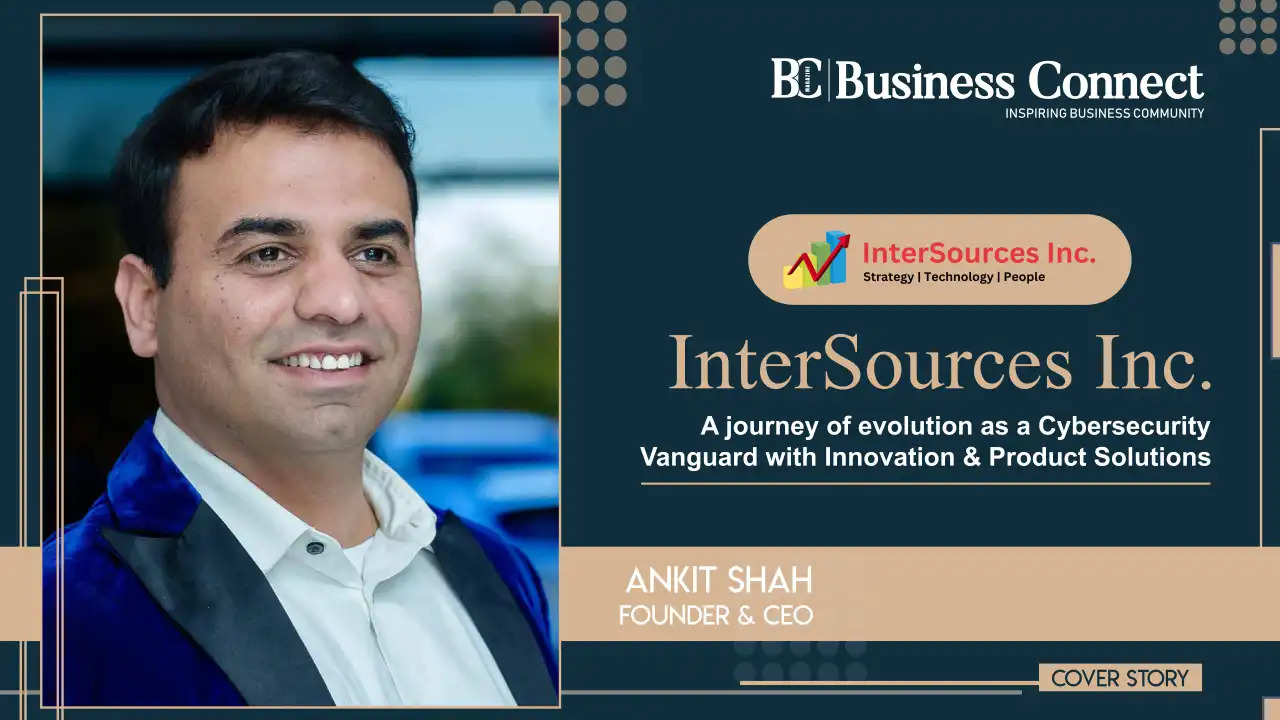
The resilience we exercised then was a defining moment. It was more than a setback; it jolted our entire operation.Ankit Shah
The team that stayed
The emotional center of Shah's crisis story is not the failed client. It is the remaining team. He remembers strained finances and colleagues leaving, but he gives the pivotal role to those who stayed. They helped fortify the business when confidence was a scarce resource.
That memory helps explain his later language about leadership. Early in his career, Shah associated leadership with initiative and aggressive execution. There is a season when this works. A small company, running short on time and cash, often needs someone willing to turn uncertainty into a list by breakfast.
But velocity is not a complete management system. As InterSources expanded, Shah began talking about a horizon five to ten years away. He also became more interested in human behavior: how clients decide, how teams react in critical moments, and how a leader travels through the highs and lows without converting every bump into a speech.
A founder can push a deadline. A durable company needs a way to make good decisions after the founder leaves the room.
His own summary is unusually direct: he became more patient, a better listener and more comfortable navigating alongside the team. Patience sounds decorative until a company operates across time zones and technical disciplines. Then it becomes infrastructure.
Shah kept a formal classroom in the mix as well. He completed Stanford programs in high-performance management in 2010 and in data-driven leadership in 2018. The timing makes a tidy pair of bookmarks. The first came after InterSources had survived its opening shock; the second arrived when data had moved from a specialist concern to a boardroom language. One course could not confer endurance, of course. But returning to study after becoming the boss suggests a useful refusal to treat the title as graduation.
Recognition followed in a characteristically industry-shaped form. His profile lists a Silicon Valley Award for Excellence in Technology Services, along with certificates from California legislators and a supplier-development credential. Awards are snapshots, not operating systems. Their value here is as evidence that the quiet rebuilding became visible outside the company, even while Shah continued to describe leadership as a continuous learning process.
Many hats, followed by hat discipline
InterSources grew lean. Employees wore multiple hats, which kept the company agile and exposed people to work outside a narrow job description. The arrangement also produced the predictable tax. Versatility drifted into overwork and stress. A strength had exceeded its useful dosage.
Shah's response was a recalibration. Teams developed clearer areas of focus while people who wanted cross-functional experience could still explore it. This is a subtle operating decision. Young firms need generalists to discover what the business can become. Larger firms need specialists to deliver the promise repeatedly. The trick is changing modes without sanding away curiosity.
The company's service history shows the same balancing act. Data analytics led to big-data engineering. Cloud applications introduced new security questions. Public-sector work brought regulation and scale. Artificial intelligence created opportunities for automation while making guardrails and governance more urgent. Each new capability arrived with its own nouns, but also with a familiar requirement: somebody must connect the technology to the work.
Security is what happens between the exciting parts
Cybersecurity can look thrilling in a demonstration. The ordinary practice is closer to housekeeping with consequences. Alerts must be triaged, identities managed, systems patched, controls documented and access removed when it no longer belongs. A managed-security business lives in the gap between the spectacular threat and the routine response.
InterSources' move into this field was gradual, then explicit. The company developed public-sector work, formed a strategic implementation partnership with secure-workspace company Kasm in 2023, and announced the acquisition of ComtechRIM in early 2024. The acquisition added endpoint management, cybersecurity and governance capabilities. Later partnerships extended the firm's work in AI-assisted threat detection and automated response.
Shah writes about AI guardrails, managed security partnerships and protected remote workspaces. The subjects meet at a single question: how does a business adopt a powerful tool without creating an equally powerful blind spot? His public answer favors combined systems, clear governance and partnerships. There is no romance in a well-configured control. Its charm appears on the day nothing goes wrong.
I learned that leadership is not just about business strategies or technical expertise. It's equally about understanding human behavior.Ankit Shah
A private company with a public horizon
InterSources says it has taken no outside capital. That fact changes the tempo of a business. Venture funding can compress years of hiring and product development into a few quarters. A self-funded services firm grows by persuading one client, delivering, collecting, and repeating. It must finance tomorrow with the credibility earned yesterday.
Shah's ambitions are not small, but they are framed through capabilities and geography rather than theatrical disruption. He has discussed deeper work in cloud applications, cybersecurity, machine learning and AI, along with expansion in Europe and Latin America. He has also spoken about real estate and startup investing, interests that place the operating company inside a wider view of wealth and enterprise.
His civic work follows another version of the network idea. Shah held several positions with ITServe California from 2018 through 2021, then served as president of the organization's Phoenix chapter in 2021 and 2022. InterSources has also partnered with InspireEdu on digital-literacy work. The pattern is partnership again: the belief that capability becomes more useful when it travels through other people.
Business meets technology
An MBA at the University of Scranton combines IT, international business and finance.
InterSources opens
A data-focused consultancy starts in the San Francisco Bay Area.
The largest client disappears
Circuit City's bankruptcy forces an early rebuild and a move toward big data.
A chapter beyond the company
Shah serves as president of the ITServe Phoenix chapter.
Cybersecurity gets wider
InterSources announces its acquisition of ComtechRIM.
The long game is mostly Tuesdays
Shah likes the language of big problems and grand scale. His stated company mission is to take technology to the world through clients and partnerships. Yet the persuasive parts of his story are stubbornly specific: a warehouse system, a lost account, the colleagues who remained, a management practice adjusted after people became overextended.
This is the operator's useful contradiction. A long horizon is assembled from short obligations. Five-to-ten-year thinking still has to survive the next client call. Global expansion still depends on a team handing work across time zones without losing the plot. AI strategy still ends at an access policy somebody remembered to enforce.
InterSources has changed its technical vocabulary many times since 2007. Shah has changed his leadership vocabulary too, trading some of aggressive execution's clang for patience and listening. Neither change is a retreat. Both recognize that survival rewards motion, while endurance requires judgment about direction.
The crisis came early, before the company had accumulated enough history to feel entitled to a future. Its gift, if a financial crisis may be accused of generosity, was to settle one question. InterSources could outlive its first version. Everything since has been a variation on that discovery.