Megan Imbres wanted Paris. What she got was Aix-en-Provence, one French class behind her and a required year abroad ahead. The distinction mattered to a student who had drawn a tidy line from an international-business degree to corporate finance. Paris was the picture. Aix was the detour. As detours go, it has had an excellent return on investment.
A year of language and cultural immersion pushed her beyond the competent version of herself. Then came an internship in marketing, a profession she had filed under “mumbo jumbo” and “not real life.” The surprise was how real it felt. Marketing, she discovered, was less about decorating a product than understanding people, relationships and connection. “It’s something that I eat up,” she later said. “It is the core of who I am.” Finance lost a recruit. Marketing gained someone who would spend the next two decades helping new habits look inevitable.
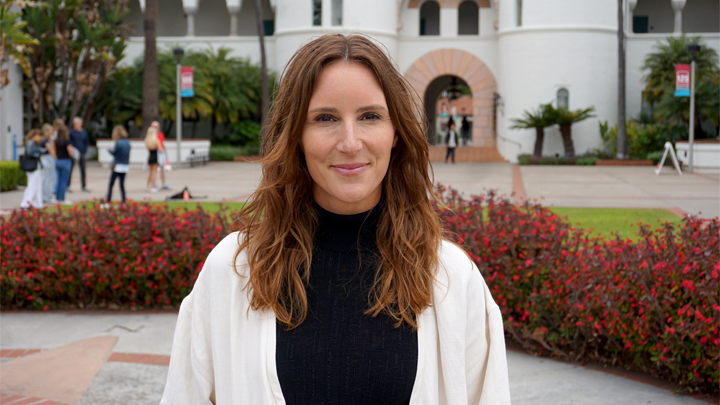
The apprenticeship in attention
Her first job after graduating from San Diego State University in 2004 was at a small New York advertising agency. The accounts were pharmaceutical. She learned account management, how work moves through a room, and how young employees become visible by being useful. She also learned that subject matter matters. As she later joked, she was not rushing to discuss a diabetic peripheral neuropathy drug with friends and family.
The agency years took her from New York to Portland and Boulder before California, her home state, became home again. Along the way she worked on American Express, Microsoft, Ford and MillerCoors. It was practical training in the unglamorous mechanics beneath a glamorous campaign: briefs, budgets, client nerves, competing opinions, the peculiar corporate ritual of making a brave idea safe enough to approve without sanding off the bravery.
A career built where categories were changing
Netflix changed the scale of the assignment. Imbres arrived when streaming still needed explanation and stayed six years. She worked on the first season of House of Cards, became North American director of marketing, and later moved into product creative. She also helped establish Netflix Originals as a distinct brand.
That last achievement sounds obvious only because it worked. A service once known as a digital shelf had begun making the objects on the shelf. The marketing had to tell viewers that an unfamiliar distribution system could also be a studio, and that the small red “N” carried a promise. Imbres managed teams in Singapore, Japan, Britain, Amsterdam and Brazil. International business had returned through the side door, no spreadsheet required.
“You have to learn how to ride the wave, and to not swim against the current.”
The interesting middle
A clean career profile can make every move look preordained. Imbres’s is more instructive when the awkward chapter stays in frame. In 2019 she joined Quibi as head of brand and content marketing, working with Jeffrey Katzenberg and Meg Whitman on a mobile streaming service built around short episodes. The company raised serious money, attracted famous creators and shut down in 2020. Ambition met timing, product behavior and a market that declined to cooperate.
Failure is often treated as a character test, which is unfair to both failure and character. It is also market research delivered without the polite packaging. Quibi sat between Netflix and two later chapters that demanded different muscles: building a brand for Amazon Ads, then leading Apple’s Los Angeles marketing communications group for services.
At Amazon Ads, Imbres scaled a team in one of the company’s fast-growing businesses. At Apple, she worked with creative directors, writers and filmmakers on campaigns whose canvas stretched from screens to stadiums. Her team helped deliver the Apple Music Super Bowl Halftime Show and Apple TV’s partnership with Major League Soccer. Apple was an education in craft: the fewer elements a message contains, the less room each one has to be mediocre.
There is a useful consistency here. Netflix, Quibi, Amazon Ads, Apple services and Peloton all live where technology asks people to adopt a behavior. The marketer’s job is not merely to announce the technology. It is to translate the behavior into desire, then make the desire legible across culture. Imbres has called herself a “galvanizing leader.” The word suggests less solitary genius than collective voltage: align the room, clarify the idea, get the specialists moving together.
A CMO in the saddle
Peloton announced Imbres as chief marketing officer in June 2025. She started July 7, reporting to CEO Peter Stern, with a sprawling brief: global brand and product marketing, growth, creative, consumer insights and member engagement. The appointment reunited two ideas that had traveled beside her for years. One was professional - the business of motivating people. The other was personal - the pleasure and punishment of endurance sport.
Imbres is a competitive triathlete and a passionate cyclist. Her Peloton leaderboard name is MalibuMeg; power zone cycling is her preferred modality. In 2025, while settling into the CMO role and balancing motherhood, she completed the Ironman World Championship in Kona in 11 hours, 48 minutes and 42 seconds. She has qualified for the world championships twice.
The easy metaphor is that marketing is a marathon. The better one is that both disciplines punish confused priorities. Training plans and brand plans are arguments about what matters now. Every yes consumes recovery, budget or attention. Consistency wins attention slowly; panic spends it quickly. Imbres has described the wave as her career metaphor, but cycling contributes one too: power is useful only when applied at the right time.
“Be open to different opportunities - determine your unique skill set and find your superpowers.”
Her early Peloton work has pushed the brand away from demonstrating equipment and toward showing how movement feels. The 2026 “Let Yourself Go” campaign, featuring actor Hudson Williams moving from the Tread+ into floor work, used choreography and David Bowie’s “Fame” to make exercise look like release. “Movement is at its best when it feels like a release rather than a chore,” Imbres said when the campaign launched.
That sentence is also a strategy. A screen can show a metric. A campaign has to show why anybody should care. Peloton’s instructors, playlists, live leaderboard and community make the equipment more than furniture with excellent posture. Imbres has discussed taking those personalities into real-world cultural moments, including Formula 1 in Las Vegas, and letting the brand behave more like the community it serves. The product remains visible; the emotion gets top billing.
Taste is a management tool
Imbres does not build her reading stack from the business aisle alone. She has cited Unreasonable Hospitality, a book about the demanding generosity behind a celebrated restaurant, and Careless People. The restaurant story appealed to her as a self-described foodie, but also as a leader interested in how teams can overdeliver without becoming alienating. “You can be the best in the world and have mutual respect,” she said. “It is really critical for a leader to understand.”
That is a better management philosophy than most laminated value statements. Excellence without respect creates impressive work and exhausted people. Respect without standards creates pleasant meetings and ordinary work. The craft is holding both. Colleagues on her public profile describe kindness joined to clarity, a willingness to use her voice and a leadership style that is forceful without becoming chaotic.
Away from work, the details are pleasingly specific: live shows at the Greek Theatre, bike rides through the Malibu canyons, experiments with recipes from New York Times Cooking. They form the private syllabus of a public marketer - music, movement, appetite. None belongs in a strategy deck, which may be why all three are good for strategy.
The return trip
In 2023, Imbres joined the International Business advisory board at San Diego State, the institution that had once required her to leave San Diego. She now hopes to create a scholarship so other students can have a study-abroad experience like the one that rerouted her. The symmetry is almost suspiciously neat: the reluctant departure becomes a reason to open the same door for someone else.
Her advice to students is not to reverse-engineer her résumé. It is to remain open, notice their particular abilities and learn when to move with the current. Careers, like waves, are not controlled by admiring the forecast. The skill is adjustment. Some opportunities arrive with famous logos. Others look like the wrong French city.
At Peloton, Imbres is working on another act of adjustment: asking a connected-fitness company to remind people of the joy inside the connection. The equipment counts repetitions. The brand must give the repetition meaning. After a career spent naming new behaviors, she has reached a category where the central verb was there all along. Move.