Consider the procedure tray. Before anyone opens it, somebody must decide which supplies belong inside, assemble them and make sure the package reaches the right room. The patient rarely sees that work. The clinician depends on it. Somewhere between those two perspectives sits Medline, a company whose business is making the background of healthcare behave.
- Medline combines medical products, manufacturing and distribution.
- Its Prime Vendor model takes on more of a provider’s supply work.
- Scale helps, but the Tracy fire exposed the cost of losing capacity.
The numbers are substantial: $28.4 billion in 2025 net sales, approximately 335,000 products and operations reaching more than 100 countries and territories. Yet the useful unit for understanding Medline is smaller. It is the item a care team needs next, and the sequence of decisions required to put it within reach.
A customer redraws the business
Brothers Jim and Jon Mills founded Medline in 1966, building on a family history in textiles. The company made healthcare apparel. It moved into plastics in 1972 and customized surgical procedure trays in 1985. Each move put it closer to the practical problems surrounding a medical product: preparation, consistency, storage, disposal.
Then, in 1996, came a question. In Medline’s account, a customer wanted one distribution partner to handle its medical-surgical logistics and supplies. Why couldn’t Medline do it? A manufacturer could keep adding things to its catalog. This request asked it to take responsibility for the connections between them.
That became the Prime Vendor model. Medline supplies its own products and distributes other manufacturers’ products, helping customers coordinate ordering, inventory and delivery. Hospitals, surgery centers, physician offices, laboratories and long-term care providers can buy both merchandise and a more organized way of receiving it.
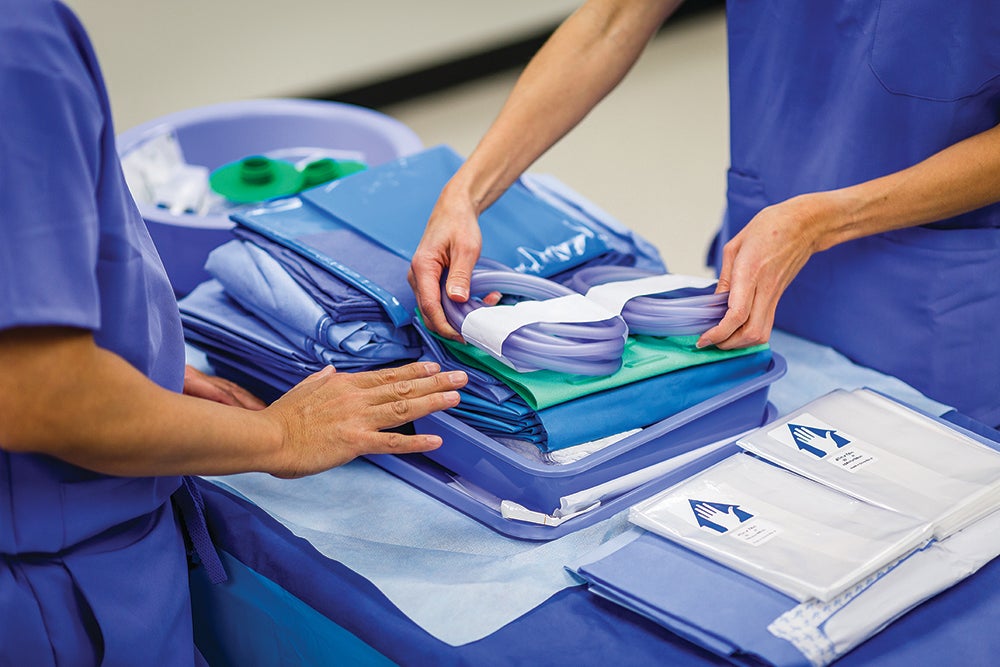
Consider Santiam Hospital and Clinics in Oregon. Its June 2025 agreement covered distribution and work on standardizing sterile procedure trays across 11 clinic locations. The opportunity was concrete: make the contents more consistent and reduce the work around obtaining them. It is a better explanation of the business than a warehouse photograph alone.
The same model is now being tested abroad. Medline Canada began rolling out logistics support to Mohawk Medbuy member hospitals in southwestern Ontario in August 2026. The move extends a familiar U.S. arrangement into a different purchasing system. Its usefulness will depend on the unglamorous details: receiving schedules, replenishment quantities and whether local teams can spend less time chasing orders.
The price of being dependable
Medline has two financial engines. Medline Brand generated $13.720 billion in 2025 sales. Supply Chain Solutions generated $14.712 billion. The first sells the company’s branded products; the second distributes third-party supplies. Their reported segment adjusted EBITDA margins were 24.3% and 5.5%, respectively. This is an adjusted segment measure, before corporate costs, rather than a company profit margin.
Those figures explain the attraction of combining products with delivery. Distribution brings Medline into the customer’s routine. Its product portfolio gives that relationship another source of revenue. Alternatives include Cardinal Health and McKesson Medical-Surgical, alongside specialist manufacturers. Medline’s proposition is the combination: more of the product journey within one organization.
It takes money to keep that promise. In December 2023, Medline reported another $300 million of spending through its Healthcare Resilience Initiative, on top of $2 billion invested since 2018. Its 2021 majority investment brought in Blackstone, Carlyle and Hellman & Friedman, with GIC also participating.
The December 2025 IPO offered roughly $7.2 billion of shares including the underwriters’ option. That figure needs unpacking. Proceeds supported debt repayment, general corporate purposes and purchases or redemptions of existing owners’ interests. A large offering is not automatically a warehouse-building budget.
Nor does growing sales guarantee growing earnings. Revenue rose 11.5% in 2025 while net income fell 3.6%. Medline attributed the pressure to tariffs and higher operating costs, including staffing and IPO expenses. Boxes still have to move when moving them becomes more expensive.
A warehouse disappears
On June 11, 2026, fire destroyed Medline’s million-square-foot distribution center in Tracy, California. No injuries were reported. Local officials described apparent sprinkler and water-pressure problems during the response; those early observations should not be mistaken for a final finding about the fire’s cause.
For customers, the immediate question was where their next delivery would come from. Medline reassigned distribution to other regional facilities. On July 6, it announced replacement leases: 925,000 square feet in Tracy and another 709,000 in nearby Stockton, the latter planned for January 2027. Replacement capacity would take time to put to work.
Reported Tracy fire-related losses in second-quarter 2026, before expected insurance recoveries.
The lesson is practical. A supply network needs alternative routes before a building disappears. For a buyer, concentrating purchasing may simplify administration, but backup arrangements deserve the same attention as the price list. For an operator, spare capacity can look wasteful right up until the moment it becomes essential.

The next bottleneck is a decision
Physical capacity is only part of the problem. When an item is unavailable, someone must identify a substitute and secure approval. In May 2026, Medline launched Mpower, developed with Microsoft, to bring supply risks, alternatives and approval workflows into one system. Its early results came from a limited customer rollout, so they remain evidence to follow rather than a universal promise.
“Everything is very manual.”Dave Kordik, Medline customer technology executive, on post-acute inventory work, October 2026
October’s enhanced TrackPoint addresses another small friction: recording which supplies were used for which patient. Designed for long-term care and inpatient hospice, it adds PointClickCare integration and barcode-enabled workflows. Meanwhile, a Symbotic warehouse robotics pilot is planned for 2027. Its benefits are still prospective.
The transferable idea is to follow the customer’s task beyond the product. Standardize repeated work. Make exceptions visible. Keep a second route available. This approach depends on trustworthy inventory records, clinically acceptable substitutes and dependable execution. A dashboard cannot supply those conditions by itself. Medline’s next chapter will be measured where its earlier ones were: in what actually reaches the care team.