Consider the box of gloves. To a patient, it is background scenery. To a practice manager, it is one more thing that must arrive before somebody opens the treatment-room door. Henry Schein built its business around that second perspective. The interesting customer was the person responsible for making the office work.
- Supplies bring Henry Schein into dental and medical practices.
- Equipment, software, and services expand the relationship.
- The bargain works when saved effort outweighs price and complexity.
That explains why a healthcare distributor would want a place on the receptionist’s computer. A practice needs products, certainly. It also needs appointments that hold, records that make sense, claims that get submitted, and equipment somebody knows how to use. These jobs surround the clinical encounter. Henry Schein has spent decades finding ways to sell help with them.
The office behind the chair
Its customers are primarily office-based dental and medical professionals, alongside laboratories, clinics, and other care settings. The business sits between manufacturers and practitioners, assembling products from many suppliers into a usable buying relationship. That matters when an office needs a small quantity of many different things. Nobody went to dental school hoping to become a procurement department.
Yet a distributor faces an awkward fact: competitors can sell many of the same products. Patterson Dental and Benco compete for dental orders; McKesson and Medline compete in medical distribution. A practice can compare a price, switch a basket, or buy directly from a manufacturer. Henry Schein’s answer is breadth, supported by people who understand the office and technology that reaches into its routines.
A pharmacy learns to travel
Henry and Esther Schein started with a Queens pharmacy in 1932. By 1935, the business was fulfilling mail-order prescriptions using flyers. During the 1950s, its focus shifted toward office-based practitioners. There is a pleasing continuity here: the company kept finding customers it could serve without waiting for them to walk into a shop.
The catalog arrived in 1962. The public offering came in 1995. In 1997, Henry Schein acquired Dentrix Dental Systems. Buying software gave the supplier another role in a customer’s working day. The appointment book and clinical chart were now places where it could provide something useful, alongside the stockroom.
“Customers’ success is our success”
Stanley Bergman · 2022 interview
The sale after the sale
The expansion became more explicit in 2018, when Henry Schein and Internet Brands announced Henry Schein One. The joint venture brought practice management together with marketing and patient communication tools. Henry Schein held the majority interest. The ambition was to connect work that an office might otherwise perform across separate systems.
Today, Dentrix Ascend puts scheduling, charting, insurance, billing, and patient engagement in a cloud system. Its 2026 packages include tools such as Voice Notes and Image Verify, designed to reduce documentation work and catch image-quality problems. These are product promises to test against actual practice workflows. A demonstration becomes useful when somebody follows one patient all the way through.
- 01BookSchedule & intake
- 02TreatSupplies & equipment
- 03RecordCharting & imaging
- 04CollectClaims & payments
The business model follows the same logic. Product sales generate distribution margins. Software adds subscriptions and support; specialty products and services widen the mix. Equipment can lead to installation, training, and further assistance. For a buyer, the useful comparison is the total effort of running that system, including staff time and conversion work, alongside the invoice.
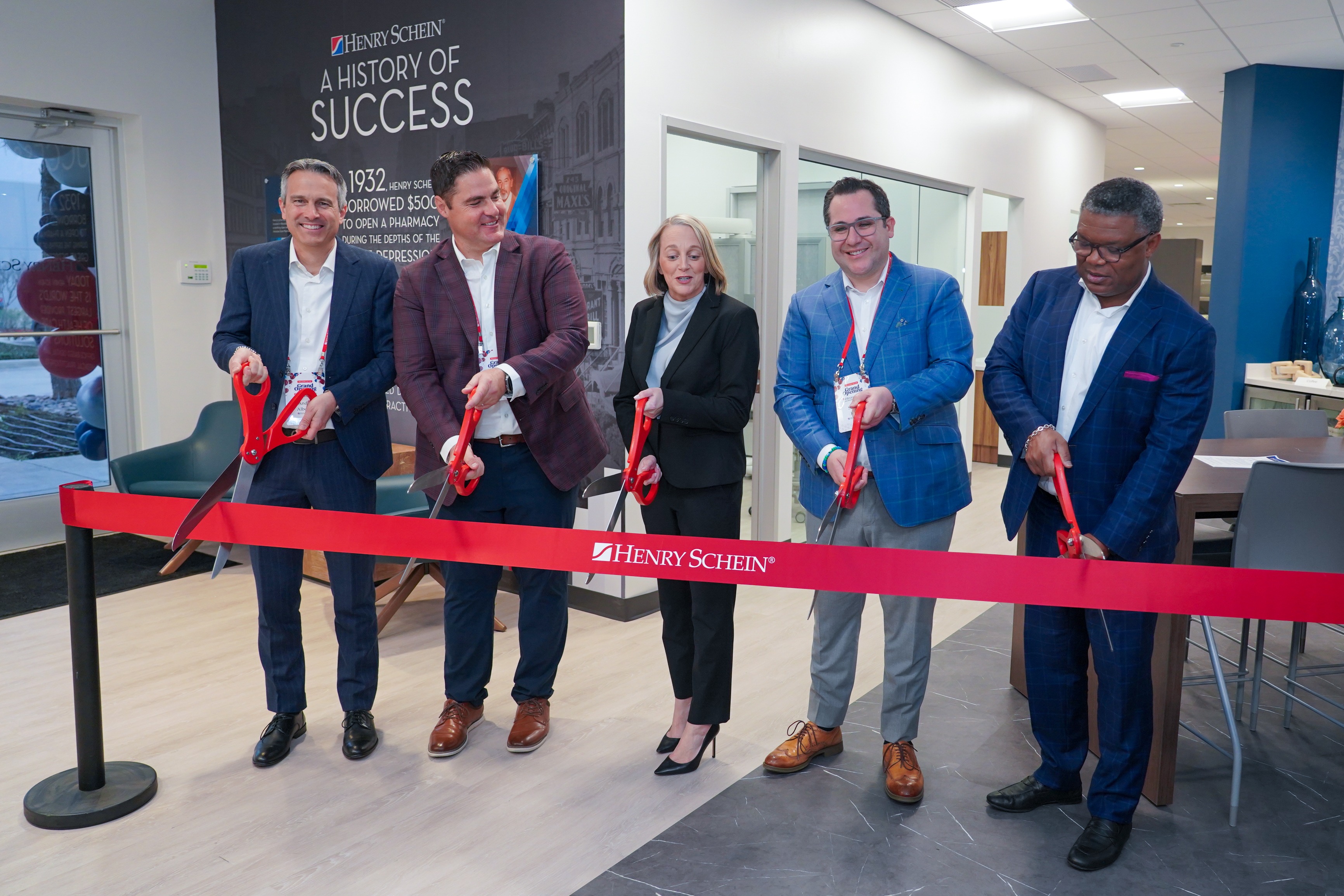
Training makes that proposition tangible. In March 2026, Henry Schein opened its Dallas Discovery Center in Southlake, Texas. The 8,300-square-foot facility combines dental and medical learning spaces, including an equipment showroom and exam-room demonstrations. Expensive machinery is easier to understand when you can see the room around it and ask somebody how it works.
When the ordering system stops
The vulnerability of this arrangement became visible in October 2023. A cyber incident disrupted North American and European dental and medical distribution operations. Another disruption affected ecommerce and related applications in November. Henry Schein One was unaffected. The distinction matters: separate parts of the portfolio did not experience the same failure.
Estimated reduction in fourth-quarter 2023 sales attributed to the cyber incident. Lost sales are not the same as lost profit.
Direct incident expenses were another measure: $11 million in 2023 and $9 million in 2024, mostly professional fees. The company reported $40 million in insurance recoveries during 2024. Those figures should not be piled together as one tidy damage bill. They measure different things. What they establish is that restoring service has consequences beyond getting a website back online.
The next operator
In May 2025, KKR completed a $250 million strategic equity investment. Frederick Lowery succeeded Stanley Bergman as CEO in March 2026. By August, Henry Schein reported second-quarter sales of about $3.5 billion, up 6.7%, and raised its annual guidance. October brought an incoming CFO announcement: Emmanuel Caprais is scheduled to take over on November 4.
These developments put operational execution at the center of the next chapter. The company describes its employee culture through Community, Caring, and Career, and a stakeholder model spanning customers, suppliers, employees, shareholders, and society. The practical test is whether those relationships make a complicated organization easier for a practice to deal with.
Ask what happens next
The transferable lesson is to study what happens around a repeat purchase. A customer ordering supplies may also struggle with training or billing. Solve one neighboring problem well, and another sale can follow. That is an interpretation of Henry Schein’s history, rather than a formula for effortless expansion.
The conditions matter. A price-focused buyer may prefer separate vendors. An office without time for migration and training may struggle with new software. A supplier without dependable support can make integration burdensome. For practice owners, the sensible next step is concrete: bring a real workflow to the demo, price the whole arrangement, and make somebody show how tomorrow morning will run.